
“I kept writing and when I worked out the idea as a film script, I dared to confess to myself that it seemed good to me and that something had to be done with it. But I didn’t know anyone in the movie world; I had never had a special connection with that environment and had never progressed beyond the role of a more or less regular moviegoer.”
-Marleen Gorris, interviewed by De Telegraaf August 23rd, 1980
Marleen Gorris never intended to be a filmmaker. As a young woman coming of age during the Sexual Revolution, Gorris’ initial interest in the arts could be found in her passion for both writing and the theater but by the early seventies, her growing interest in second-wave feminism and the films of legendary French filmmaker Chantal Akerman altered her plans. Gorris’ growing interest in the women’s movement and film coincided with a shocking news story that ultimately changed her life. Gorris recalled to Algemeen Dagblad in February 1982 that a newspaper story detailing the strange saga of three unconnected women who attacked and beat a male boutique owner inspired her to begin work on her first screenplay, which she called De stilte rond Christine M. Although she had zero screenwriting experience, Gorris believed in this dream project despite facing seemingly impossible obstacles. Upon the script’s completion, Gorris initially wanted Akerman to direct the film, and she even traveled to France to meet with the visionary filmmaker. The script extremely impressed Akerman, but she refused to direct telling Gorris that she should only direct such a personal work herself.
Gorris returned to the Netherlands, determined to take Akerman’s advice.
Gorris noted to Algemeen Dagblad that despite Akerman’s support, it took over two years to get the project off the ground. Thankfully, noted Dutch producer Matthijs van Heijningen agreed to take on the project after being suitably impressed by both the script and Gorris’ drive. While the real-life event that inspired Gorris only ended up with an injured man, in her script, the three strangers beat a man to death while castrating and mutilating him. Detailing a female psychiatrist’s attempts to figure out why three normal women simultaneously snapped in such a deadly way and the trial that followed, De stilte rond Christine M. was shot on a relatively low budget and quick shooting schedule in 1981.
Gorris might have been a complete novice creating her first film, but the excellent crew van Heijningen helped her gather featured several seasoned veterans. These included Dutch cinematographer Frans Bromet, who had worked on several of $corpio Films’ most important productions of the seventies. His intelligent yet no-nonsense realistic style of photography became one key to the eventual success of Gorris’ first film. Another $corpio veteran, editor Hans van Dongen was also brought on board as was costumer Jany Temime, who has worked on high profile big-budget Hollywood productions like Gravity (2013) and several Harry Potter films.
With an innovative crew behind her, Gorris and her producer then found the film’s vital leads. Playing the three women who murder the unsuspecting shop owner are Edda Barends, Nelly Frijda, and Henriette Tol. Frijda had appeared in several films throughout the seventies, but Barends and Tol had mostly just done television work before working with Gorris. All three deliver chilling and moving performances that are both captivating and mysterious. The real key to the film’s hopeful success could be found in the casting of the pivotal role of the psychiatrist struggling to understand what caused this violent act and why she feels such a strong connection with these women.
Cox Habbema was born in Amsterdam at the tail end of World War Two in 1944. A remarkable actress, Habbema began working in Dutch film in the late sixties while she was just in her early twenties. Throughout the seventies, Habbema worked steadily on both the big and small screens. Notable films included Harry Kumel’s De komst van Joachim Stiller (1976) and Lothar Warneke’s acclaimed Die unverbesserliche Barbara (1977), which featured Habbema in the title role. Habbema, who passed away in 2016, should have had a bigger career as she was an extremely distinctive actress and she is truly astonishing in Gorris’ debut, creating a character that is even more interesting than the murderous trio she’s studying and eventually relates to.
De stilte rond Christine M., or A Question of Silence as it is more well known, could have turned out disastrous considering Gorris’ inexperience and its loaded subject, but it proved to be one of the most accomplished and masterful debuts of the eighties. Operating as a mystery, courtroom drama, and, most importantly, as a statement against institutionalized societal misogyny, A Question of Silence is a quietly devastating film. Carefully pulling off the trick of telling a story that is simultaneously about imprisonment and freedom, Gorris’ thoughtful direction and pointed writing shows no trace of her inexperience. Throughout its running time, A Question of Silence feels utterly necessary, both to its audience and makers. Punctuated by the creepy synth score from Lodewijk de Boer and Martijn Hasebos, A Question of Silence is an unbelievably gripping cinematic and cultural experience more than deserving of its reputation as both a Dutch classic and a masterpiece of feminist filmmaking.
A Question of Silence was highly publicized in the Dutch press in the days leading up to and well after its release. Gorris exclaimed to Algemeen Dagblad in February 1982 (article scanned below) how smoothly the filming had gone and how particularly memorable it was to shoot in “a still vacant tower of the Amsterdam Bijlmer prison” where “real members of the security staff joined” the cast and crew. Perhaps tellingly she noted the only minor issue was having issues casting some of the male roles because of certain actors’ hesitation with the defiantly feminist material.
A Question of Silence opened up in Dutch cinemas in the early part of 1982 and immediately became one of the most controversial and debated films of the period. Gorris’ debut ended up winning a slew of major awards, including the best film Golden Calf at that year’s Netherlands Film Festival, which helped seal several international releases including in The United States where it opened to mixed but mostly positive reviews. Premiering at The Chicago International Film Festival just before Halloween in 1984, A Question of Silence shocked, impressed, and enraged a wide variety of viewers throughout its English run. Unlike several great Dutch films of the period, including the works of fellow feminist filmmaker Nouchka van Brakel, A Question of Silence was even granted this VHS release after its theatrical showings from First Line Features.
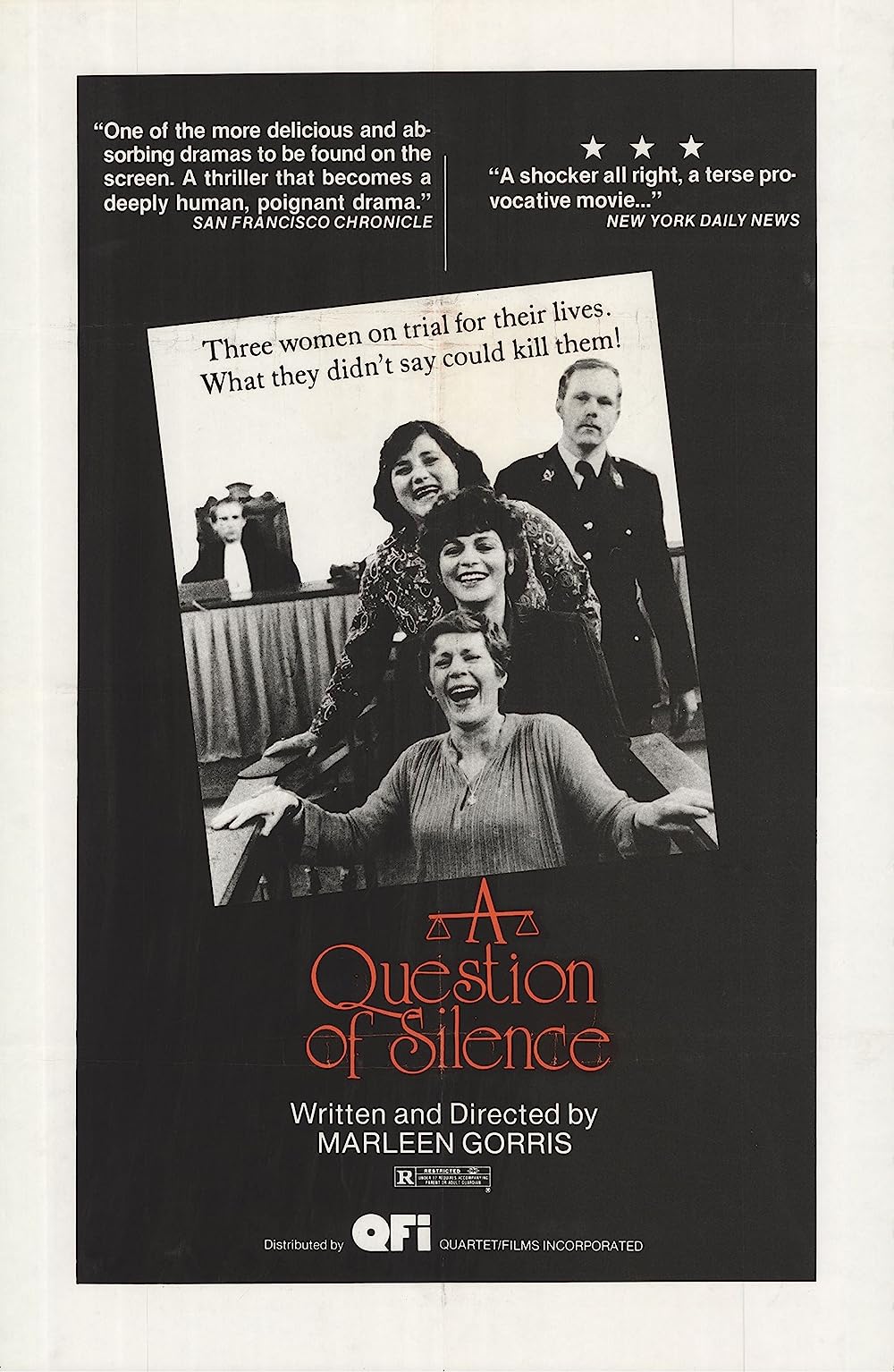
Frustratingly, after that VHS release and some television showings A Question of Silence all but vanished from view by English language audiences and has essentially been a lost film for the past several decades despite its deserved reputation as one of cinema’s great feminist classics, along with the success that Gorris would find directing films like Antonia’s Line (1995) and Mrs. Dalloway (1997). Thankfully, Cult Epics has finally rescued the film from obscurity, bringing a surviving print housed at Amsterdam’s legendary Eye Filmmuseum to both Blu-ray and DVD.
Restored in 2K utilizing the best elements available, Cult Epics’ new release of A Question of Silence joins its growing lineup of Dutch classics and it’s an essential release easily ranking amongst the most important of the year. Along with the uncut Dutch language (with optional English subtitles) print of the film, Cult Epics release comes with several valuable special features. An informative commentary track Film Scholar Patricia Pisters tracks the genesis, creation, release, and cultural significance of the film and is an excellent companion to it. Like several Cult Epics’ other Dutch releases, an excellent vintage Polygoon Journal Newsreel is included as are other vintage interviews with both Gorris and Habbema from the television program Cinevisie, all from 1982. A trailer and promotional gallery are also present. Thankfully, Cult Epics is not done with Gorris’ influential filmography, as her second feature Broken Mirrors is arriving soon as an additional special edition Blu-ray and DVD.
A Question of Silence is available at all major retailers, including Amazon and Diabolik, as well as Cult Epics’ official website.
Here is a selection of vintage clippings and reviews from Dutch and English language sources, some of which are quoted above.
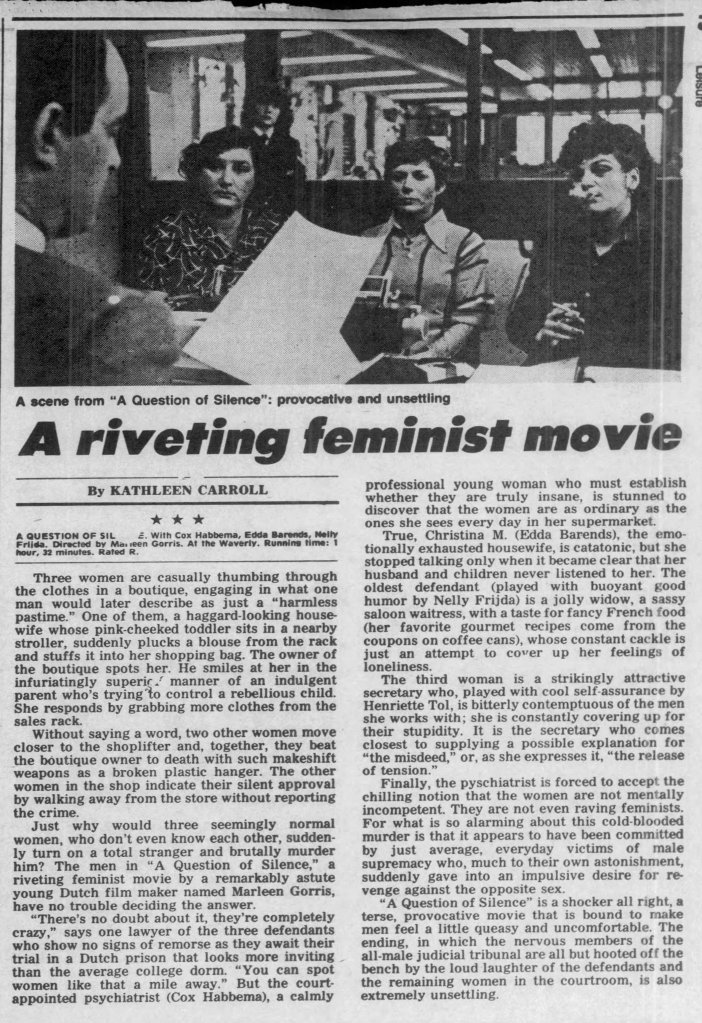


The Telegraph 23-08-1980
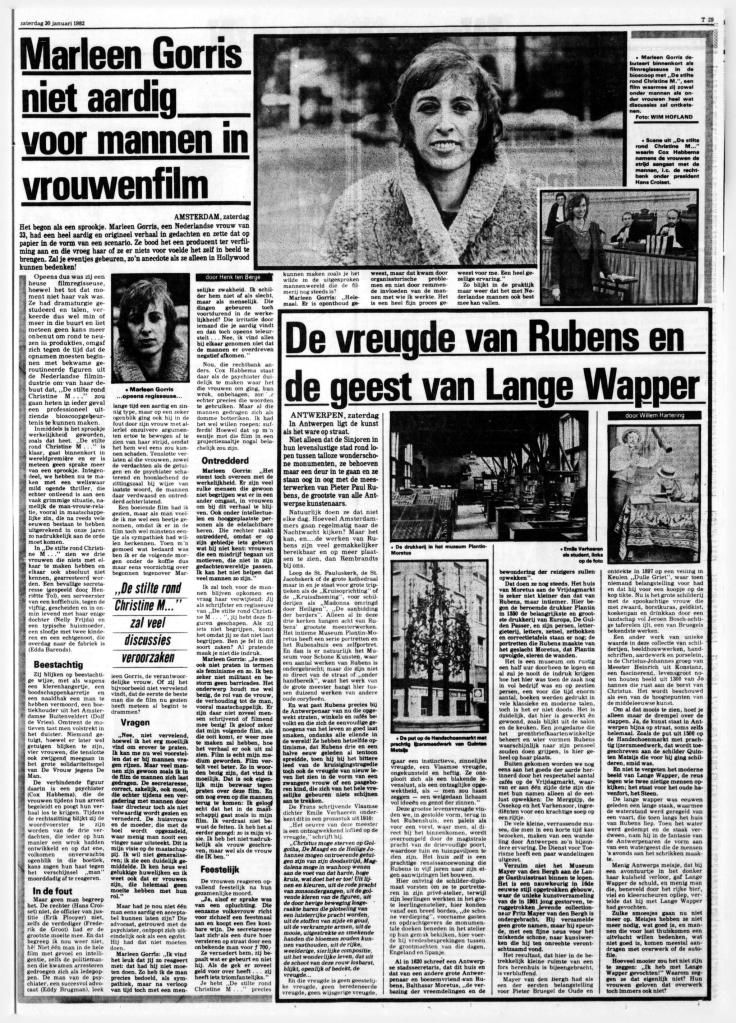
The Telegraph, 30-01-1982
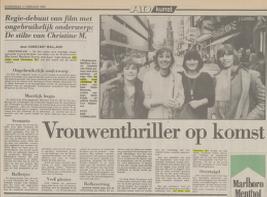
Algemeen Dagblad, 11-02-1982

De Volkskrant, 12-02-1982

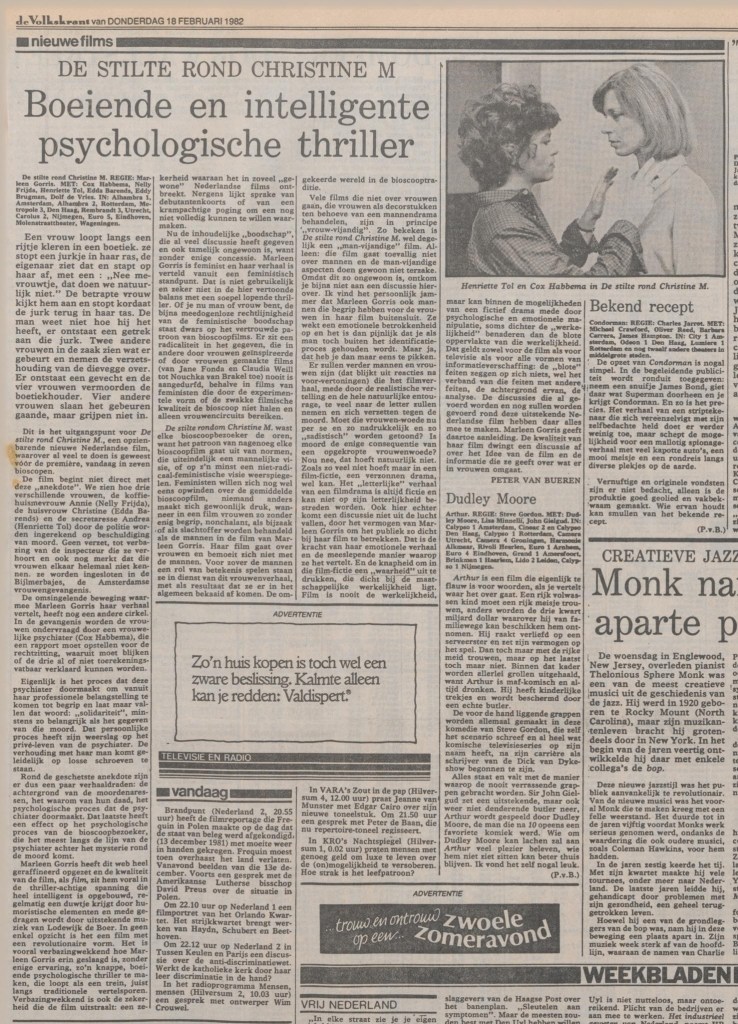
De Volkskrant, 18-02-1982

Limburgsch dagblad, 18-02-1982

NRC Handelsblad, 19-02-1982


The truth, 20-02-1982

Newspaper of the North, 26-02-1982
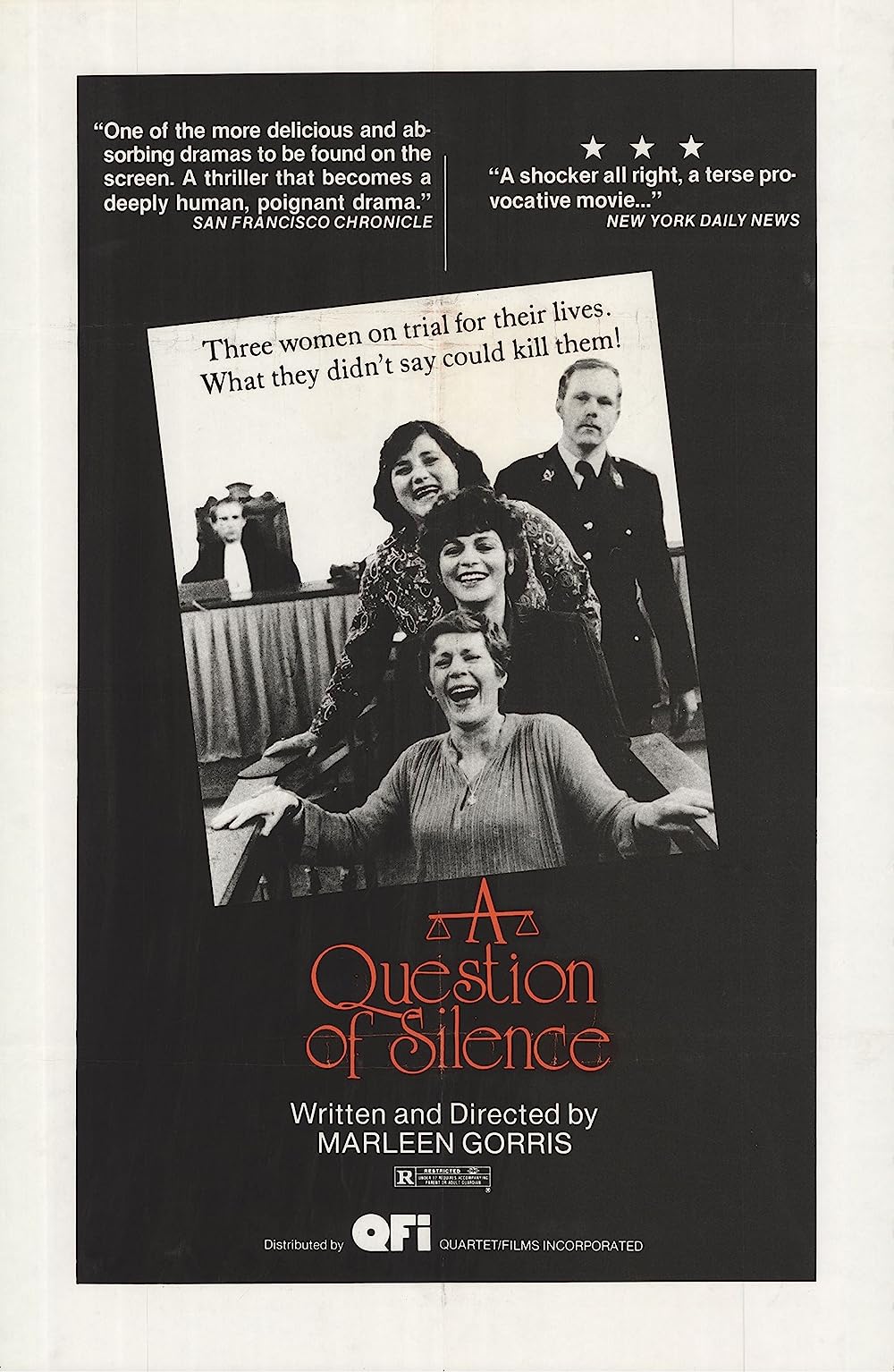
 Nostalgia Kinky
Leave a comment