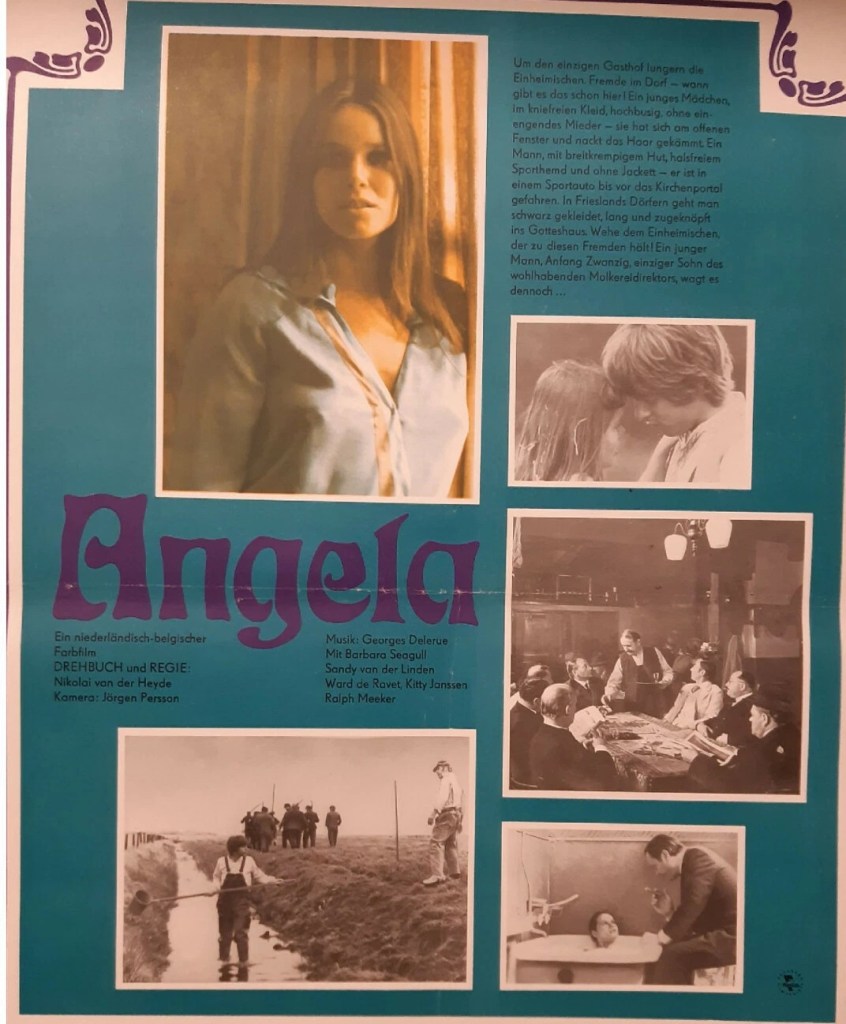
ANGELA, LOVES COMES QUIETLY (1973) is not a good film. It is, in fact, one of the worst films I have seen in recent memory but it has a great backstory…a really fascinating one from research I’ve gathered together goes something like this:
Dutch filmmaker Nikolai van der Heyde began his career as a student at the prestigious Netherlands Film Academy in the early sixties alongside future legendary Dutch filmmakers like Wim Verstappen and Nouchka van Brakel. Verstappen and van Brakel both helped out with van der Heyde’s first short in 1963, De kegelbaan, which got him some positive attention in the Dutch press. De Volkskrant called it a ‘convincing’ short comparing it to LAST YEAR AT MARIENBAD.
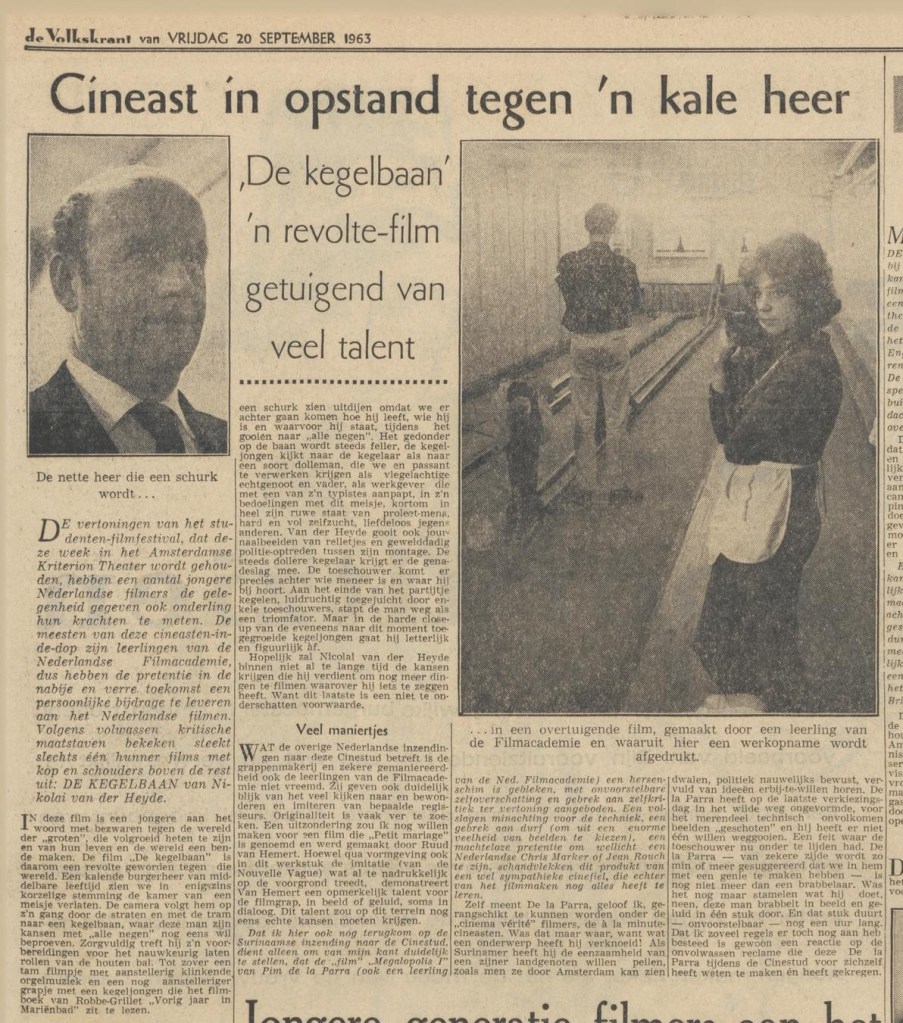
Nikolai van der Heyde finishes his film studies and the ambitious Hollywood junkie completes two relatively successful minor features in the Netherlands by the end of the sixties. Riding high from his early successes, a just turned thirty year old van der Heyde begins planning his next feature, which he has high hopes for.
Back here in The States, a beautiful young American actress named Barbara Hershey has begun to make a name for herself with a string of striking mostly independent films. At some point around 1970, van der Heyde sees Hershey’s legendary early film LAST SUMMER and becomes obsessed with the idea of bringing her to Holland to play the title tole in what he is calling ANGELA and he begins writing her letters explaining his idea.
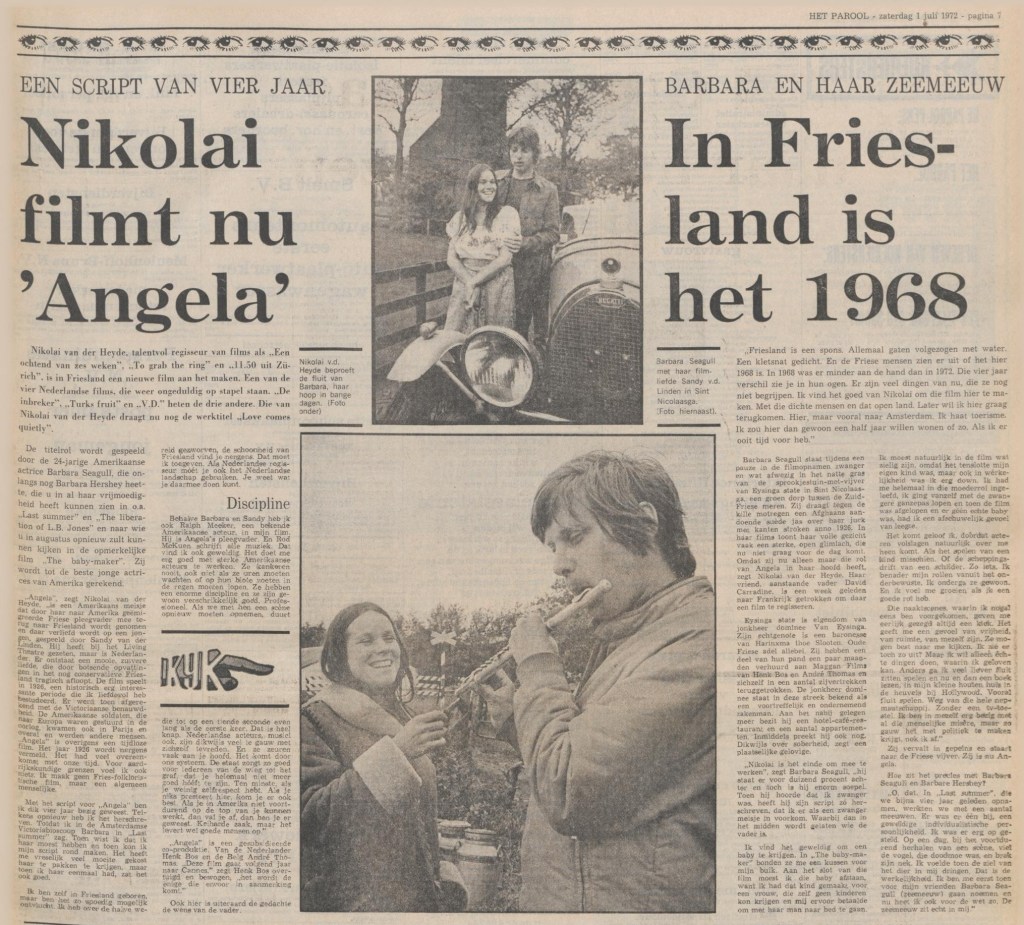
Now, things get a bit weird. Hershey had changed her professional name to ‘Seagull’ in this period, as a tribute to a bird she accidentally killed during the making of LAST SUMMER, and this change caused issues getting cast back in Hollywood. So, a lovely little trip to Holland, where she could appear as ‘Barbara Seagull’ came at the perfect time…sort of. Turns out Hershey was six months pregnant when she accepted the role, forcing van der Heyde to rewrite the script, and she wouldn’t travel without her boyfriend so David Carradine indeed travelled with her to Holland in May of 1972 to film ANGELA.
Hershey wasn’t a star in 1972 but she was known and up and coming. This, and her relationship with Carradine, caused the story of their Dutch adventure to be picked up by the American press. News of their departure and plans for ANGELA made its way through the American media throughout mid 1972, the same year btw Hershey starred as the title character in Scorsese’s BOXCAR BERTHA. I like to picture her travelling to Holland with the copy of THE LAST TEMPTATION OF CHRIST Scorsese gave her, but that’s just cinematic fantasy on my part.

While Barbara got the most attention from the American press, director Nikolai van der Heyde garnered a fascinating if random mention in Norma Lee Browning’s gossip columns where she detailed his hobnobbing at a fancy party alongside Meeker, Barbara and some of the Hollywood legends the Dutch director so adored, like Ida Lupino.
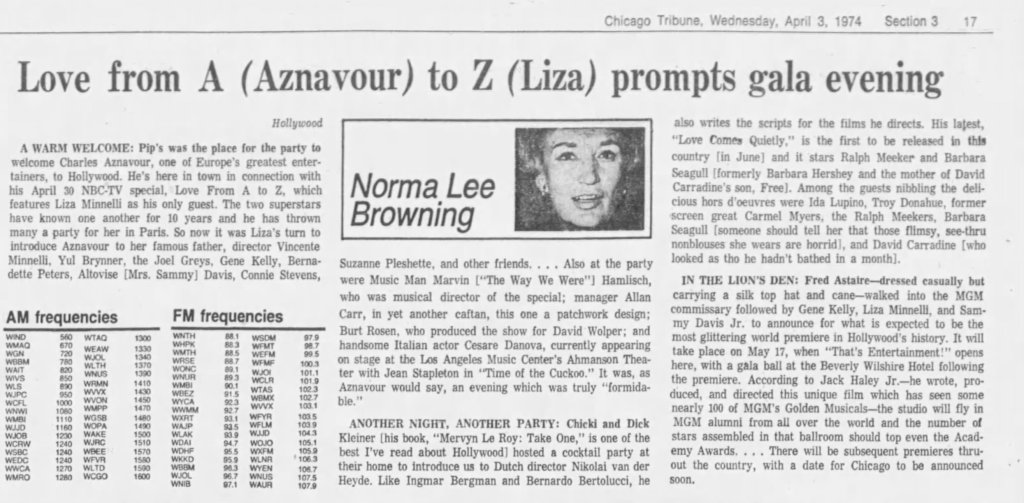
Hershey, or Seagull, was mostly treated like an oddity in the American press. Constantly poking fun at her lifestyle and appearance, Hershey maintained her individuality although her once blossoming career was falling apart due to the press’ treatment. Asked about her freewheeling lifestyle and ANGELA, Barbara longingly replied, “I’m not trying to attract attention to myself or to be different, just to be different. I don’t want anyone else to accept my way of life as their own.”
Like their American counterparts, the Dutch press, not surprisingly, seized on the story as well with Hershey giving a press conference along with van der Heyde shortly after her arrival. She recounted the story of the seagull and the hopeful director mentioned this would be his first real film. She also exclaimed that the character of Angela was already very much a ‘part of her’. Van der Heyde recounted how he had discovered her in LAST SUMMER and their correspondence. He was already struggling to describe his film though, attempting to compare the late sixties American youth movement with the Stock market crash of 1929. Bizarre and still not formed. in America, the story was mostly forgotten before Hershey and Carradine touched down in the Netherlands.

News of the film remained in the Dutch headlines throughout 1972. Algemeen Dagblad even went so far as documenting an average day for Hershey, which began by waking up each day at five at the Leonardo Oranje Hotel Leeuwarden where she was staying. From there she’d take a train to the hamlet of Veenwoudsterwal, located in Groningen for filming.

Van der Heyde was featured in a full page piece about the young vanguard of Dutch cinema in the early seventies, mostly centered around the landmark $corpio Films and their masters, many of whom he’d studied with back at the Film Academy. The young director again praised his American cast and mentioned this was the first film he’d had the chance to make unimpeded by outside forces.

One of the most detailed pieces about van der Heyde and the making of the film appeared in the the summer of ’72 pages of HET PAROOL. The director recalled he spent four years writing the script, how he was impressed by other Hershey films outside of LAST SUMMER and the importance of the pastoral locations. He also again attempted to clarify the connection he saw between 1926 in Holland and America in the late sixties with really only his point comparing the conservative backlash the youth of both eras landing.
I so wish I could report that all the marvelous film history that goes along with ANGELA somehow or another made this a good film. Sadly, with seemingly everything in place it turned out to be van der Heyde’s devotion to other films that became ANGELA’S undoing. Van der Heyde stacks ANGELA from beginning to end with constant allusions and references to some of his favorite films and it…is…exhausting.
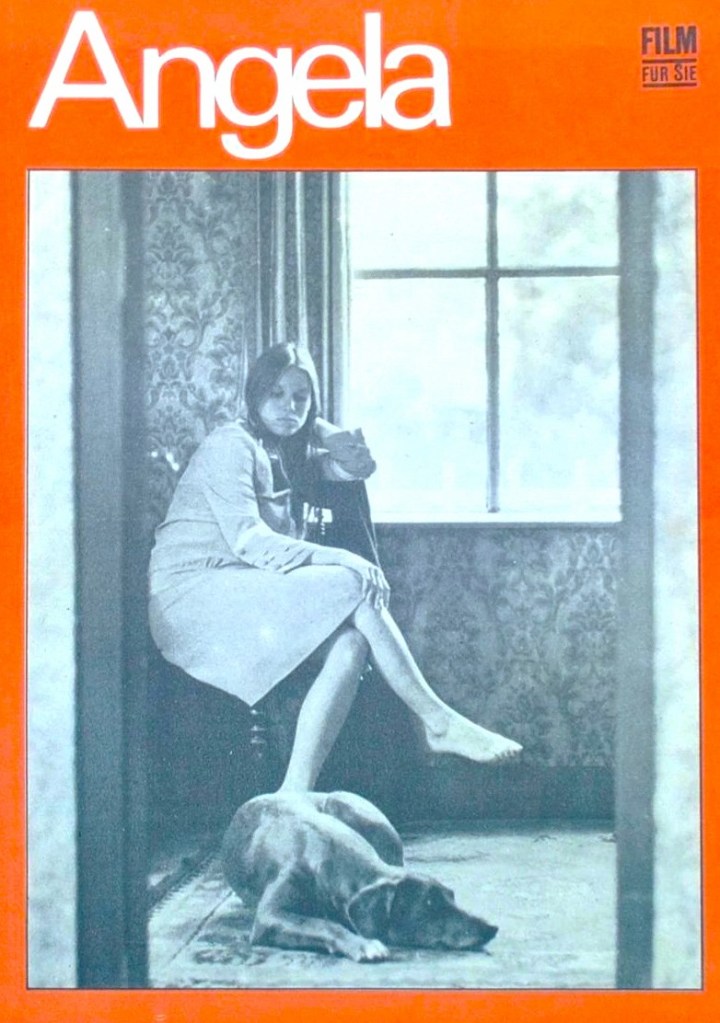
While watching ANGELA, I flashed on that interview Fiona Apple gave about how torturous it was hanging with the coked up and out duo of QT and PTA listening to them ramble on and on about their favorite films. I totally get her. It does sound fucking awful and that is a bit what this film is like, only without the coke. With every scene I kept expecting van der Heyde to pop out from behind the camera assuring the audience that he loves EASY RIDER, that he loves BONNIE AND CLYDE. Hell, he loves ELVIRA MADIGAN so much he even got its DP to shoot his film in a similar way. He never allows ANGELA any life of its own, not a bit, which is a pity…

Outside of having all of the sympathy in the world for poor Fiona Apple, I also questioned just what exactly van der Heyde was aiming for with ANGELA. He sets his film in the twenties but cast Hershey as the early seventies hippie she claimed to be in real life. It’s bizarre…and bizarre that van der Heyde didn’t play up this time warping convention as it is far and away the most interesting part of the film. Instead he just throws Hershey in a flapper dress and away they go, Again, I’m just not sure what he was thinking. Hershey’s Angela in no way shape or form acts, talks or styles in anything other than 1972. It’s not Hershey’s fault, as I’m sure attempting to understand what exactly her young director was going for plus dealing with a new place, culture and type of filmmaking had to all be overwhelming. Plus, six months pregnant! Whatever idea van der Heyde had in mind regarding the connections he saw between the two periods just gets misplaced in artistic translation and it sadly never comes through.
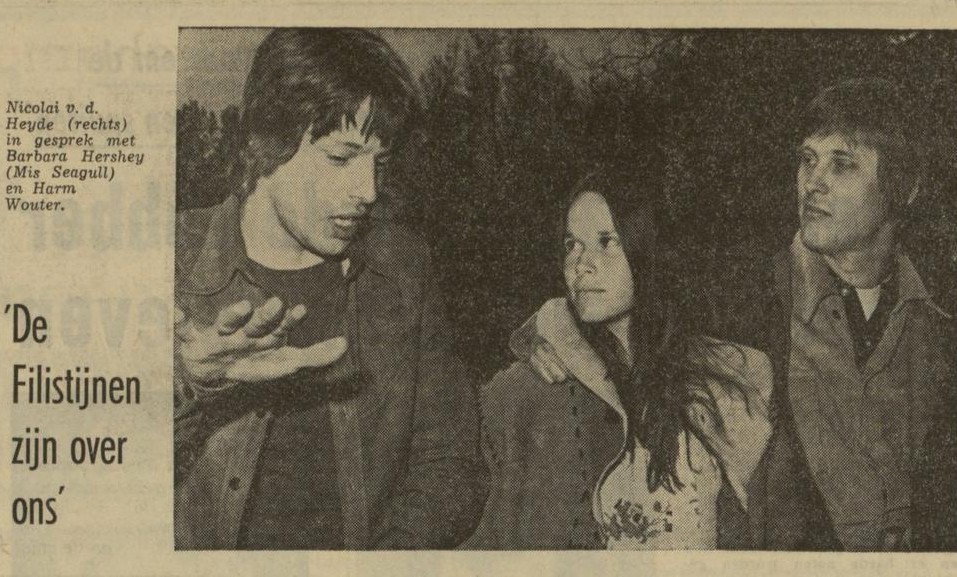
That said, Hershey fairs great compared to poor Hollywood veteran Ralph Meeker, who delivers possibly one of the worst performances I have ever seen and I don’t blame him a bit. van der Heyde has him dressed in a ridiculous cowboy hat offering some of the most mind-numbing ‘this must be the way an American talks’ dialogue I’ve ever heard. It’s rough. I felt bad watching this for the aging Meeker, who looks genuinely confused throughout ANGELA.
The Dutch cast is better, although they spend basically the entirety of the film reacting to the barefoot, topless naked American hippie girl in town, and why wouldn’t they considering she acts and looks like she’s from fifty years in the future? Hershey, and her bare pregnant body, garnered the film the most attention but honestly the star is young Sandy van der Linden, who apparently never made another feature film again so there you go. He’s actually pretty good here and it’s a shame he didn’t continue.
Technically, ANGELA is fine with Georges Delerue delivering a nice theme, although I wish he had been utilized more. After a brutally slow opening half, the film also begins to find its way in its second after Angela’s introduction before van der Heyde completely wrecks it with one an unbelievably annoying and undeservedly pretentious climax that goes on…and on…and on. In some nightmarish world the closing of this film is just endlessly playing on a loop.
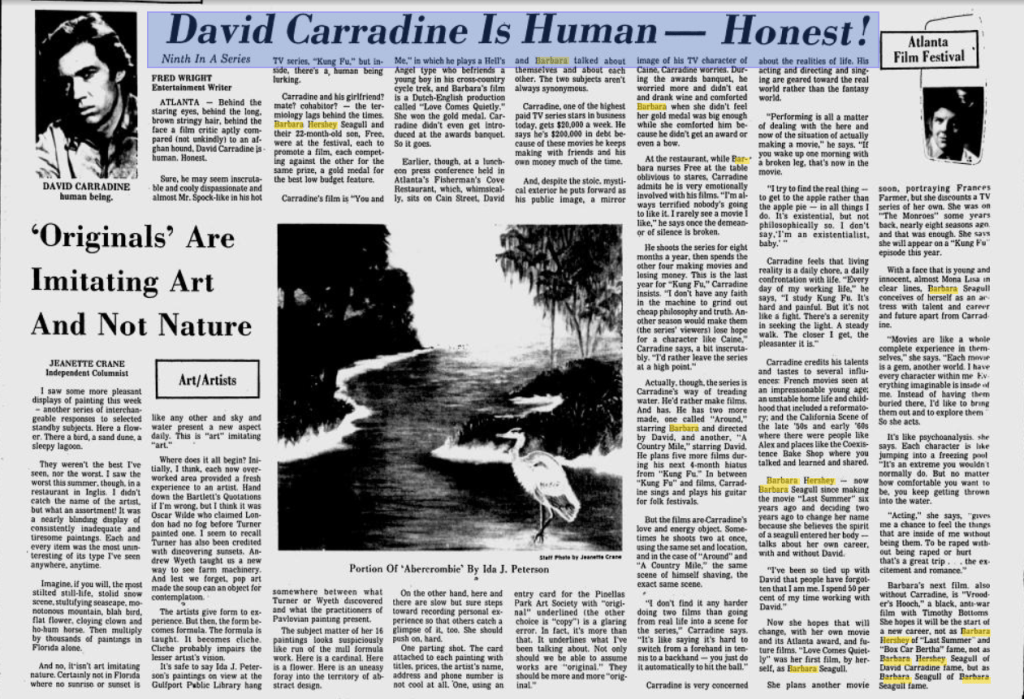
ANGELA’S grating conclusion killed any minor good will I had for it. The film’s scenes of sexual assault make it a much more unpleasant production than it has any right to be as well. Barbara’s very apparent late-period pregnancy also add to the distastefulness of the scenes, although thankfully she didn’t have any problems with them, recounting at The Atlanta Film Festival that “To be raped without being raped or hurt that’s a great trip…the excitement and romance.”
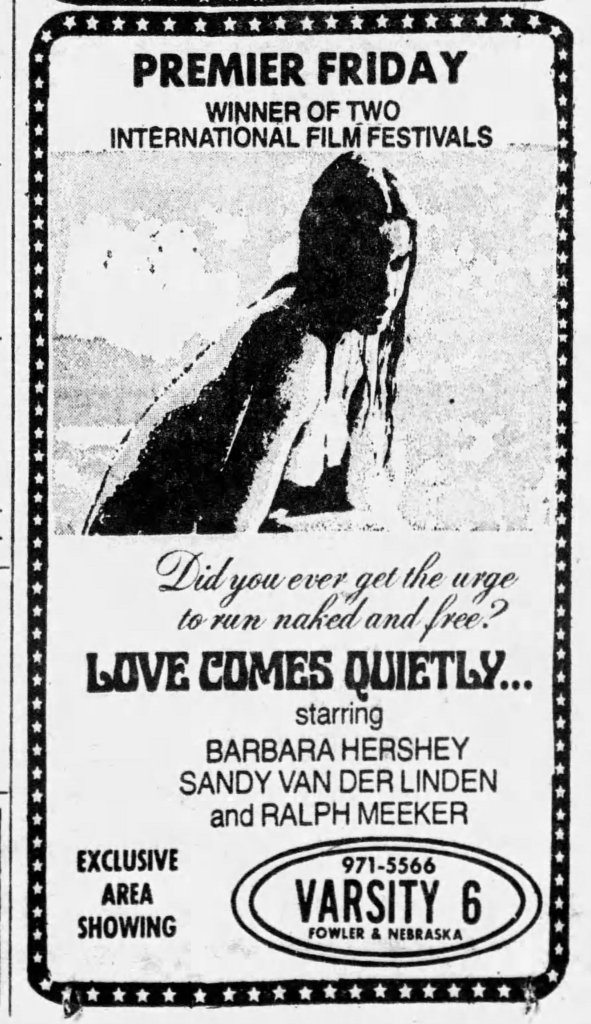
ANGELA finally opened up in The States as LOVE COMES QUIETLY in October of 1976.
English reviews were sparse and mixed. I actually found myself agreeing with Vincent Canby in The New York Times, who savaged the film as being a complete ripoff of much better works.
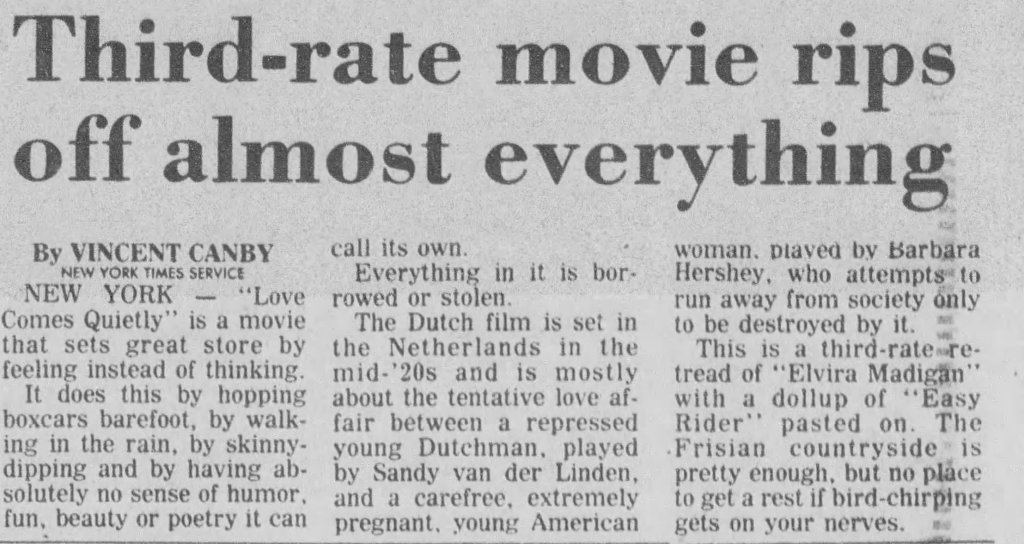
For the most part, LOVE COMES QUIETLY was ignored. It did get a faintly positive enough notice in Variety, which mostly responded to Barbara’s performance. ANGELA limped along theatrically not garnering much attention although Barbara did win a Best Actress award at an Atlanta film festival that she attended with Carradine and son Free in tow. Interviewed by the local paper, Barbara discussed her acting style and how she approached her characters.

Retitled yet again in late 1977 finally as ANGELA, LOVE COMES QUIETLY the film played in a few international markets but save for some mention in later pieces about Hershey’s youth the film all but vanished and I don’t believe it has had any sort of home video release, although I certainly might be mistaken.

Barbara Hershey, or Seagull, was completely lost in the cinematic woods for a decade after ANGELA. She’d thankfully get a marvelous second act in the eighties that really allowed her to shine as an actress. Her performance especially in HANNAH AND HER SISTERS is an all time favorite…plus she is a fellow progressive. Love Barbara.
ANGELA is obscure, quite obscure. There is a nice looking version over at the Archive but it’s only about a 1/4 of the film. The full version can be found on YouTube from either a TV or VHS rip. You gotta add the custom subs over at Open subs but we do what we gotta do though don’t we?
-Jeremy Richey, July 2025-
 Nostalgia Kinky
Leave a comment