In the summer of 1972, English language film programmer and Boston Globe critic David Overby travelled to report on that year’s Cannes Film Festival. During his time there, Overby witnessed the mythic premiere of Harry Kümel’s Malpertuis. Recalling that the film shook what had been a festival of ‘generally unexciting cinema’ out of its stupor, Overby noted that the reaction was violently divided, with both ‘cat-calls and excessive booing’ as well as enthusiastic ‘shouting and standing applause’. Overby had no way of knowing but he’d attended not just a chaotic premiere but an odd fifty plus year cinematic journey, both tragic and triumphant.

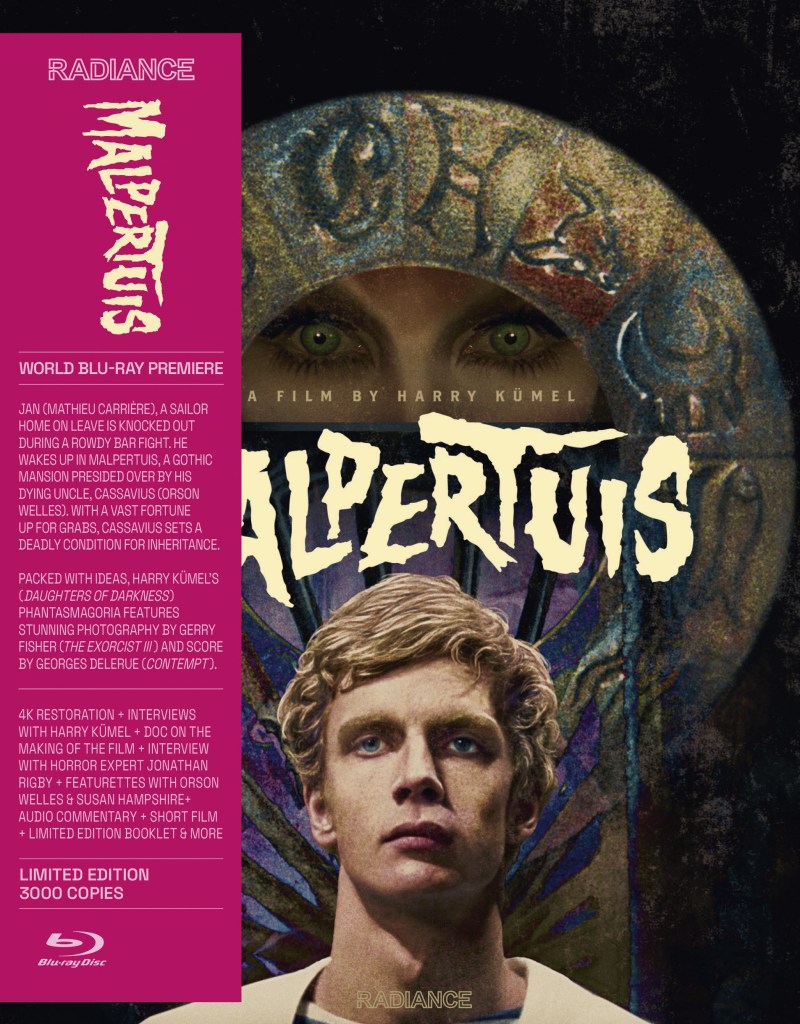
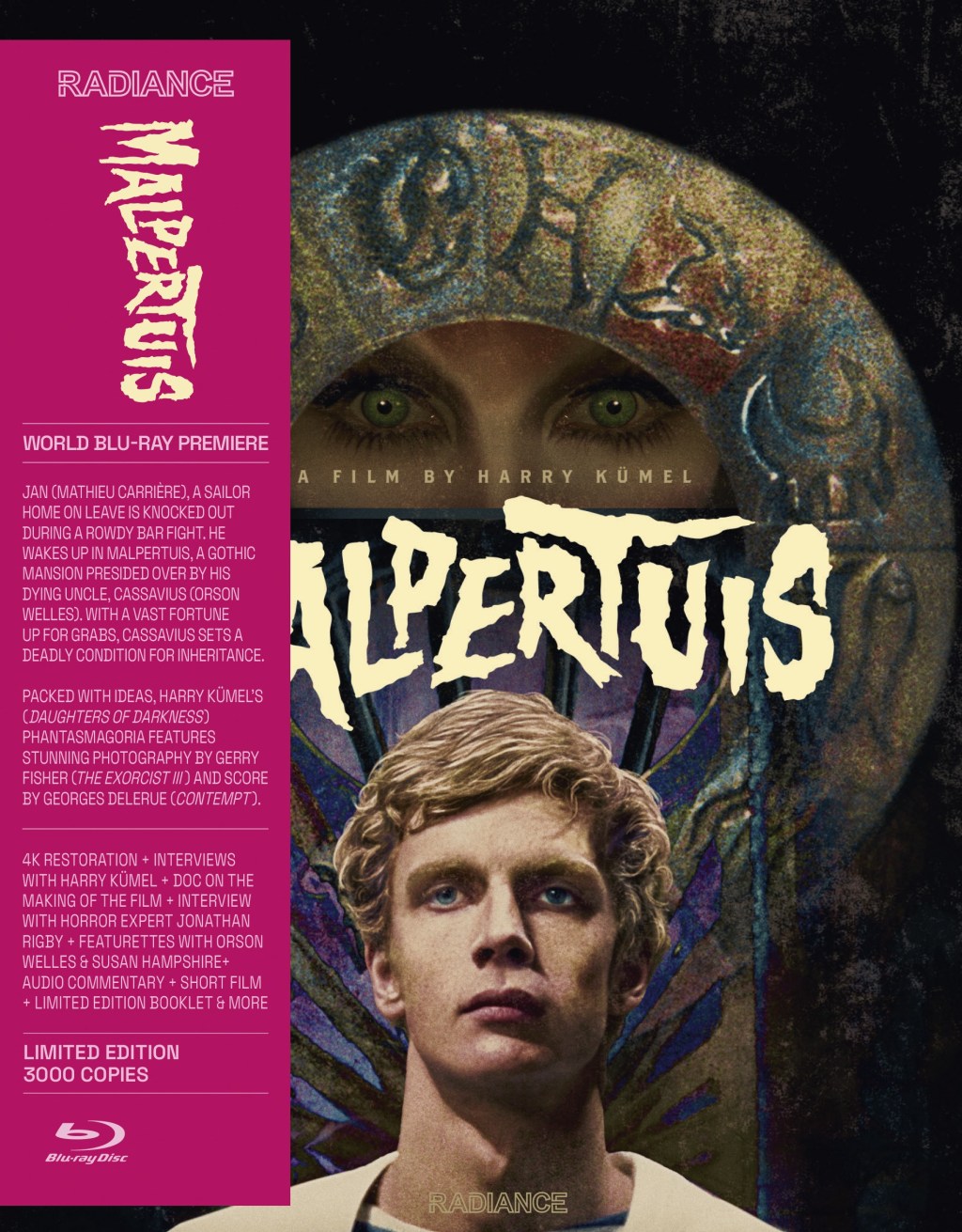
Amongst the greatest European art films ever made, Harry Kumel’s mesmerizing Malpertuis is now available via a remarkably extensive Radiance Blu-ray collection, that ranks amongst the year’s best. Featuring hours of archival and new extras, two cuts of the film, a book and best of all a remarkable restoration, this new limited edition Radiance collection is a dream release for an incredibly dreamy and dreamed on film.
Decades before Belgian born filmmaking genius Harry Kümel turned it into one of the unforgettable films of the seventies, Malpertuis began life as an acclaimed novel by fellow Belgian Jean Ray. Published initially in France in 1943, Ray’s work of French Fantastique had long been the dream project of Kümel who utilized the success of his equally dazzling Daughters of Darkness to get it made. Film historian Jonathan Rigby points out during his excellent interview on Radiance’s set that Kümel wisely chose to rift on parts of the original novel he most connected to, as any sort of complete and completely faithful adaptation would have been all but impossible for such a complex written work.
When Jean Ray passed away at the age of 77 in 1964, a 24 year old Harry Kümel was preparing the longest short film he’d ever attempted, the compelling De grafbewaker (The Warden of the Tomb), a 30 minute work that also appears on Radiance’s disc. Kümel already had Malpertuis in mind in the mid-sixties but he was still a few years away from his first feature Monsieur Hawarden (1968) so there was nothing to suggest that this young Belgian filmmaker was the genius who’d help shape European film just a few years later.

Despite the fact that Malpertuis is just Kümel’s third narrative feature, it is an incredibly accomplished work on every level. A stylistic triumph driven by Kümel’s dazzling compositions and grand style, Malpertuis is a special work of art made by a visionary steeped in the history of it. Like a number of his peers, such as Jean Rollin, making similar surreal works in the seventies, Kümel’s knowledge of film, literature and painting come through in incredibly striking ways. Kümel is a man who clearly loves art, he loves film. There is sense of responsibility at the heart of his filmmaking, both to his work but also to film itself. It’s not at all surprising that he’s also worked as a film professor.

Even though it is Orson Welles that ultimately appears in and looms rather largely over Malpertuis, another key figure is the great German genius Josef von Sternberg, whom Kümel had made a feature-length documentary about in 1969. Few in cinema history have ever rivaled the way Von Sternberg captured Marlene Dietrich in the string of films those great two visionaries made together but Kümel comes close several times in his career, never more so than in the hypnotically gorgeous and unforgettably strange Malpertuis, which is as drunk on cinema as something like Von Sternerg’s The Scarlet Empress (1934).
Malpertuis has always had an element of myth about it, fitting for a genuinely mythic film. Its history of alternate cuts, fading negatives and dashed dreams are all chronicled beautifully via this beautiful box Radiance has put together, including many archival and new insights from Kümel himself. Somewhere on an alternate timeline, Malpertuis wasn’t rushed for Cannes and was released to wild rapturous acclaim which led to a prolific film career for Kümel. Sadly that wasn’t the case.
Before the many post-production woes of Malpertuis kicked in, Kümel was a hot young up and coming director meeting with Catherine Deneuve about the idea of casting her in the key role(s) of his follow-up to Daughters of Darkness. It made sense. After all, Kümel had just directed Deneuve’s fellow French New Wave icon Delphine Seyrig in one of her most legendary turns but it wasn’t to be.
Lots of things weren’t to be.
Deneuve’s decision dramatically and surprisingly worked in the films favor as it allowed British actress Susan Hampshire the chance to play multiple roles and she is astonishing in the film. It’s impossible to imagine anyone, even the great Deneuve, being as spectacular as Hampshire is in Malpertuis. Hampshire absolutely demolishes the screen here vanishing into each character so completely that the effect is at times delightfully disorienting.
Malpertuis has a fairly large ensemble cast joining Hampshire featuring everyone from Welles to a young Mathieu Carrière and scene-stealing Michel Bouquet. It is a fairly large cast including a memorable supporting turn from a personal favorite, the wonderful singer Sylvie Vartan.

Before appearing as the ‘Betts’ in Malpertuis, Sylvia Vartan had only made a handful of very frothy light musical films with then husband Johnny Hallyday (who also briefly appears in Malpertuis). It wasn’t her film career that Vartan was known for though as she had been one of France’s most successful singers for nearly the entirety of the sixties. Her road to being one of the great unheralded figures in Rock history was a hard one. Vartan had a sadly rough childhood due to the Soviet occupation of her home country Bulgaria. Thankfully she found escape and solace in the music that crawled out of the American south while she was a teen in France, living in a single room with her family. Vartan particularly gravitated towards Elvis Presley, who set off the rebellious streak that helped her invent one of the most important musical movements of the sixties, Yé-yé. By the mid-sixties, she was playing shows with The Beatles, whom she helped inspire. Vartan has continued recording for decades now but her film career remained only a sporadic footnote, but she’s so memorable in Malpertuis, magnetic, super charismatic, mysterious. Lovely to hear Kümel praising her during his audio commentary track.
But I digress…
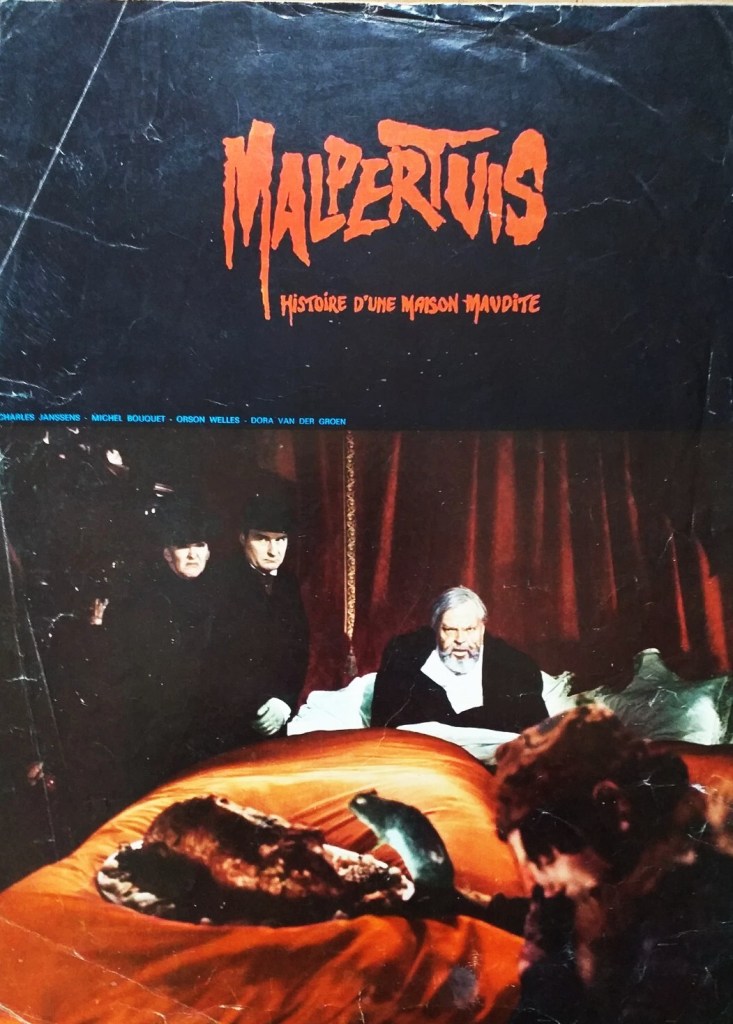
The big selling point for Malpertuis was supposed to be the classic Hollywood star Kümel cast for the small but key early role of the dying and very wealthy Cassavius. After some consideration, the young Belgian surrealist chose Orson Welles, who of course created no small amount of headaches on the set during his mercifully brief four-day stint. Welles is fine in the film and gave it some notoriety but he’s honestly probably the least compelling figure in Malpertuis, which has such a deep and excellent supporting cast of players.

Charged with the daunting task of transforming Malpertuis from a book to a script was given to Daughters of Darkness scribe Jean Ferry. Unlike the relative outsider Kümel, Ferry had been working in the French industry for decades and was perhaps most well-known as the writer of some of Henri-Georges Clouzot’s earliest works. By the mid sixties, Ferry’s career had stalled out after a flurry of frothy star vehicles for the likes of the Bardot and Loren. At the height of the New Wave, Ferry watched his career all but vanish. He’d surprisingly return as the sixties were coming to a close, away from the more studio driven pictures he’d been doing in the early part of the decade. He’d work with experimental Belgian director Patrick Ledoux and then with legendary French auteur Georges Franju. It would be with Harry Kümel that Jean Ferry found his true liberator and the three films they made together are all masterpieces.

For Malpertuis’ complex color designs, Kümel worked closely with famed cinematographer Gerry Fisher to bring this remarkably strange world to life. Fisher and Kümel were from totally different worlds themselves, with the British born Fisher being more than thirty years Kümel’s senior. Fisher had worked in a variety of behind the scenes capacities before his career as a director of photography started proper, but it was as DP that he’d really find his footing. In the years leading up to Malpertuis, Fisher worked frequently with the likes of Joseph Losey and Tony Richardson. In the years after his fantastical work for Kümel, Fisher worked well into the nineties including supplying two William Peter Blatty masterpieces with their unforgettable looks.
Because some of the production cost for Malpertuis came from the American United Artists, Kümel felt pressure in regards to the film’s eventual editor and it was here that trouble truly began for the great Belgian and his masterpiece. With a planned Cannes premiere looming, Kümel agreed, in the production’s only misstep, to let Britisher Richard Marden cut a version of the film. Marden was a fine editor and very well known for his works with Stanley Donen and John Schlesinger but he’d never cut anything like Malpertuis and it shows. His rushed and shortened Cannes cut (which Radiance have graciously supplied in full as an extra) turned a masterpiece into a very good film and it proved most damaging. Ever since Marden’s Cannes edit, the story of Malpertuis has been one of an attempted rescue of a great lost classic.

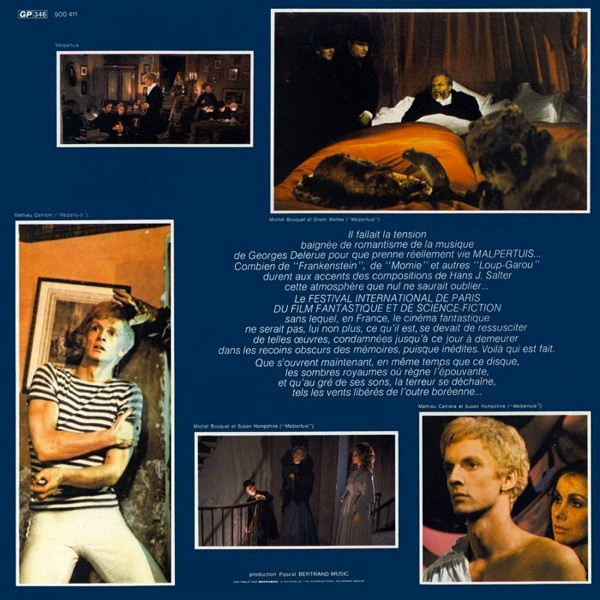
It will remain a mystery lost to an alternate timeline about what might have happened had Kümel been able to screen his eventual edit of Malpertuis at Cannes. By the time Kümel cut his version of the film for the European market all of the momentum was gone and the critical jabs from Cannes remained in the air. Even the remarkable score from legendary French composer Georges Delerue that might have helped its release went unreleased for nearly a decade before it was made briefly available paired with a shlocky Hans J. Salter score.

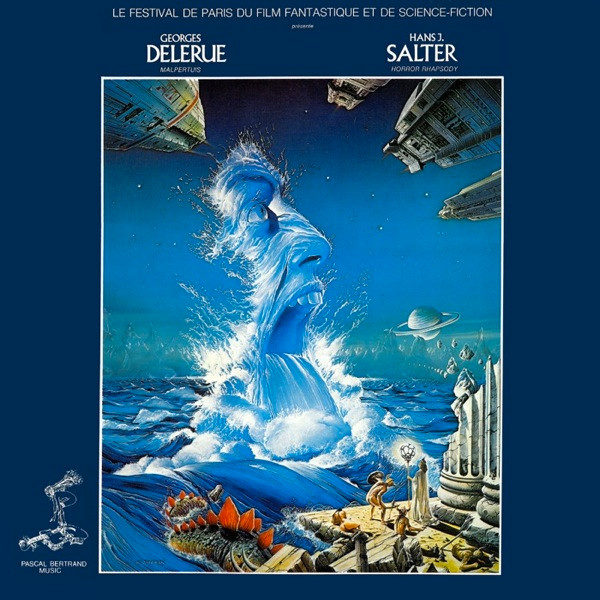
For the next decade, Malpertuis limped around in two different versions, both underseen including the cut with the lame English title The Legend of Blood House that reportedly played the United States. With the shortened Cannes print being the more common, Kümel’s growing legion of fans had to mostly wait decades to see the long cut of the film, initially via the grey-home video market of the nineties before it finally hit DVD in 2007. That release was a valiant effort, containing both cuts of the film and some solid extras (most of which Radiance has carried over) although its standard definition presentation of the film only did it so many favors. Now, thanks to Radiance, we finally have the definitive release of Malpertuis and it was worth the wait.

For those of us who originally saw Malpertuis via bootleg VHS tapes or that 2007 DVD, Radiance’s new print of the film is absolutely mind-blowing. Now we can finally see this extraordinary film looking and sounding the way Kümel always intended, as he oversaw this astounding restoration himself. Even having to create some brief freeze frames in the film to match up the audio track works in the final cuts favor. They add an even more dreamlike feel to the film, like we occasionally get a view of the gods watching over our players. Packed in a sturdy box with a wonderful booklet, Radiance’s new collection dedicated to Malpertuis is easily amongst the best home video releases of the decade and it comes armed with both the new 4K transfer as well as hours of extras.

A brand new interview with Harry Kümel kicks things off supplement wise. Running about 20 minutes, this great new chat catches us up on both Kümel and his film’s history. It is a fascinating new interview with a great artist and the tidbit about Bunuel and Deneuve made me laugh out loud. Another great new interview comes via a lengthy talk with film historian Jonathan Rigby, who supplies so much great commentary on the film and its legacy. All of the older DVDs extras are carried over, save for an older interview with Kümel. These archival featurettes give us the chance to see interviews with a number of the film’s cast and crew, plus get a look at some amazing behind the scenes footage shot at the time of production. The essential mid-2000s commentary track with Kümel and assistant director Françoise Levie has also thankfully been carried over.
Radiance have also dug up some truly incredible unseen vintage material for this release, including archival television interviews with the director, costar Michel Bouquet and even the book’s original author Jean Ray. Combined with the informative and well-researched writing by Lucas Balbo, Maria J. Pérez Cuervo, David Flint, Willow Catelyn Maclayn and Jonathan Owen that appear in the large booklet (all very helpful for this review and understanding the film and its history in general), these many extras make for a truly astounding reissue and 4K scan premiere.

Along with the Cannes cut of the film, Radiance have also added on one of Kümel’s short films from the sixties in the shape of the earlier mentioned 1965’s De grafbewaker (The Warden of the Tombs). This striking black and white 30 minute Franz Kafka adaptation is an intriguing watch as we find the young twentysomething Kümel already showing signs of the master filmmaker he’d soon become. Featuring strongly composed shots and inventive framing, this short horror/political allegory is an intense and rewarding watch. Save for a short promotional look at actress Claudia Cardinale, The Warden of the Tombs was Kümel’s final short film before his feature-length career kicked into gear a few years later. Two earlier shorts from Kümel are available on their Daughters of Darkness collection.
Malpertuis is a staggering achievement and one of the crown jewels of the European Art House. It is hard to imagine a more comprehensive and essential release than Radiance’s new Blu-ray for Kümel’s masterwork. Fingers crossed that Radiance might someday visit Kumel’s remaining filmography from the seventies via his extraordinary The Arrival of Joachim Stiller (1976) and especially Paradise Lost (1978), which Kümel has referred to as his personal favorite.
-Jeremy Richey, November 2025-
Order the limited edition of Malpertuis directly from Radiance or from MVD.
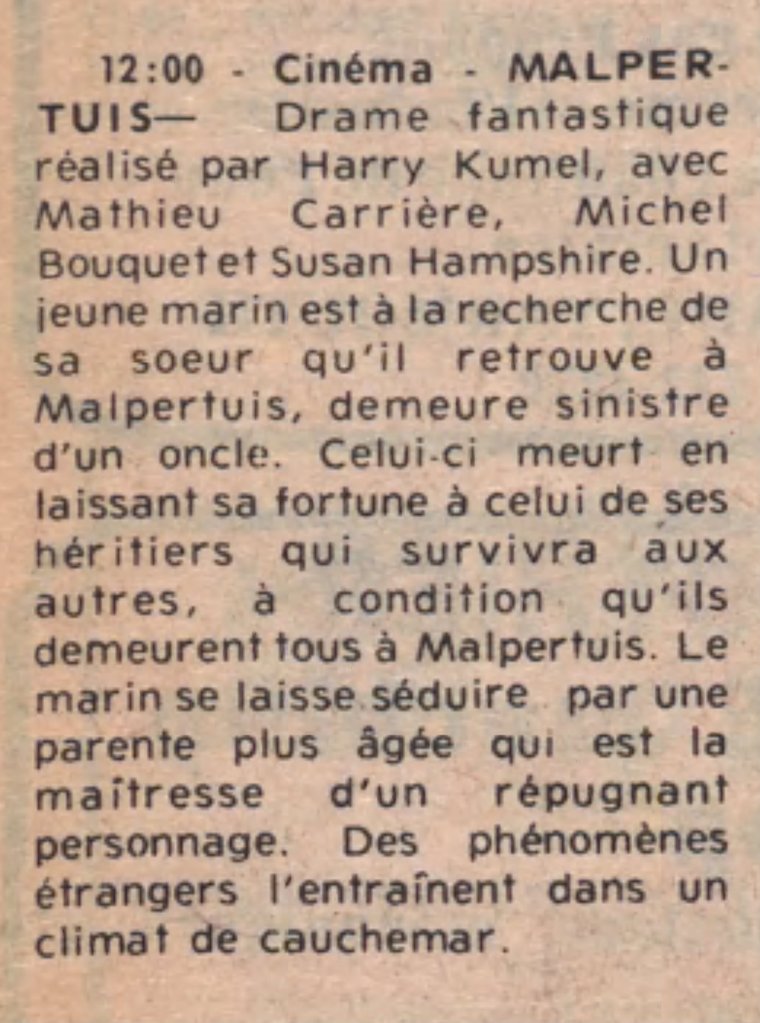
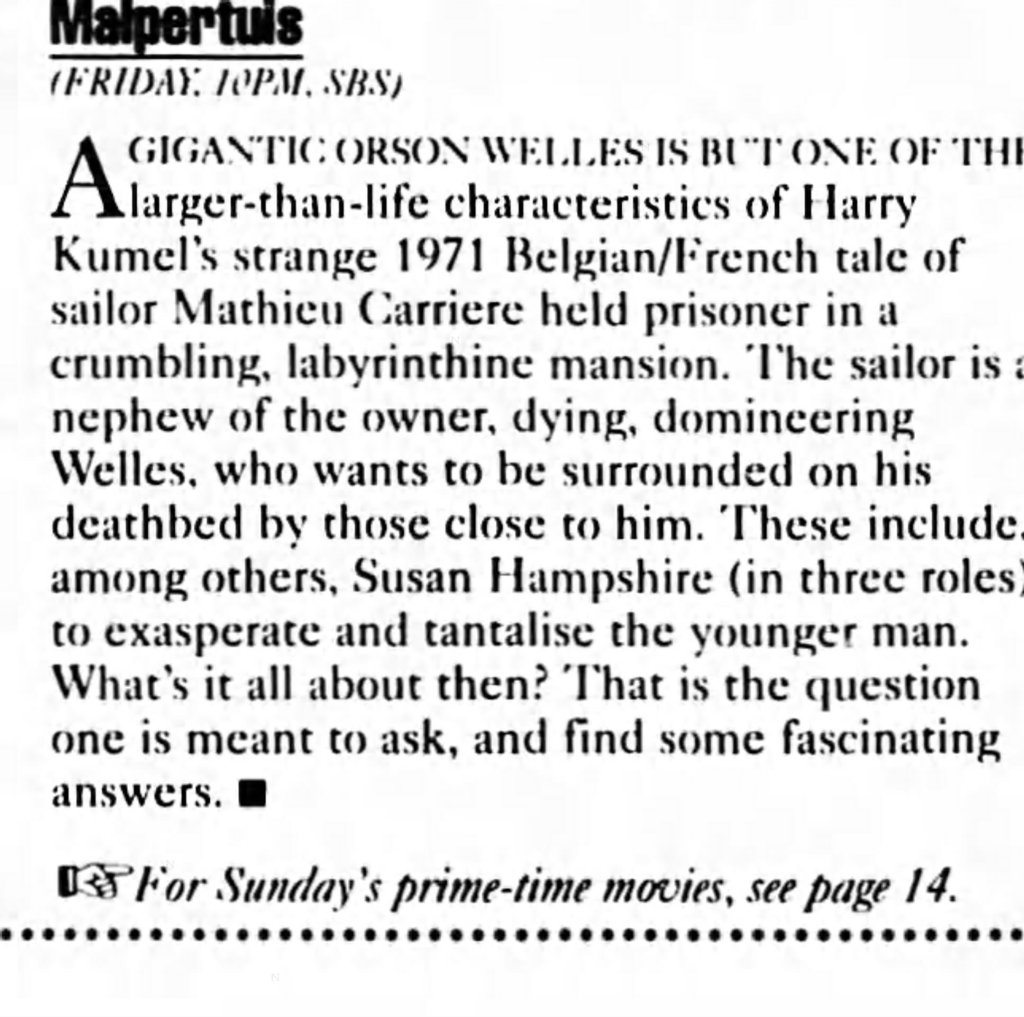
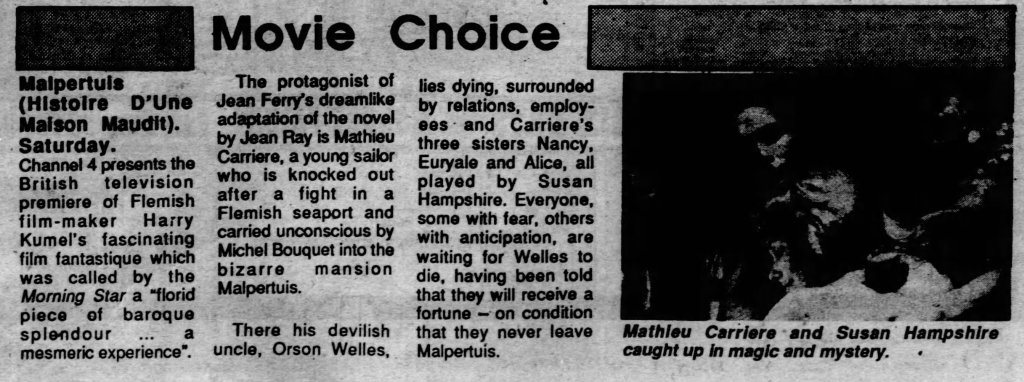
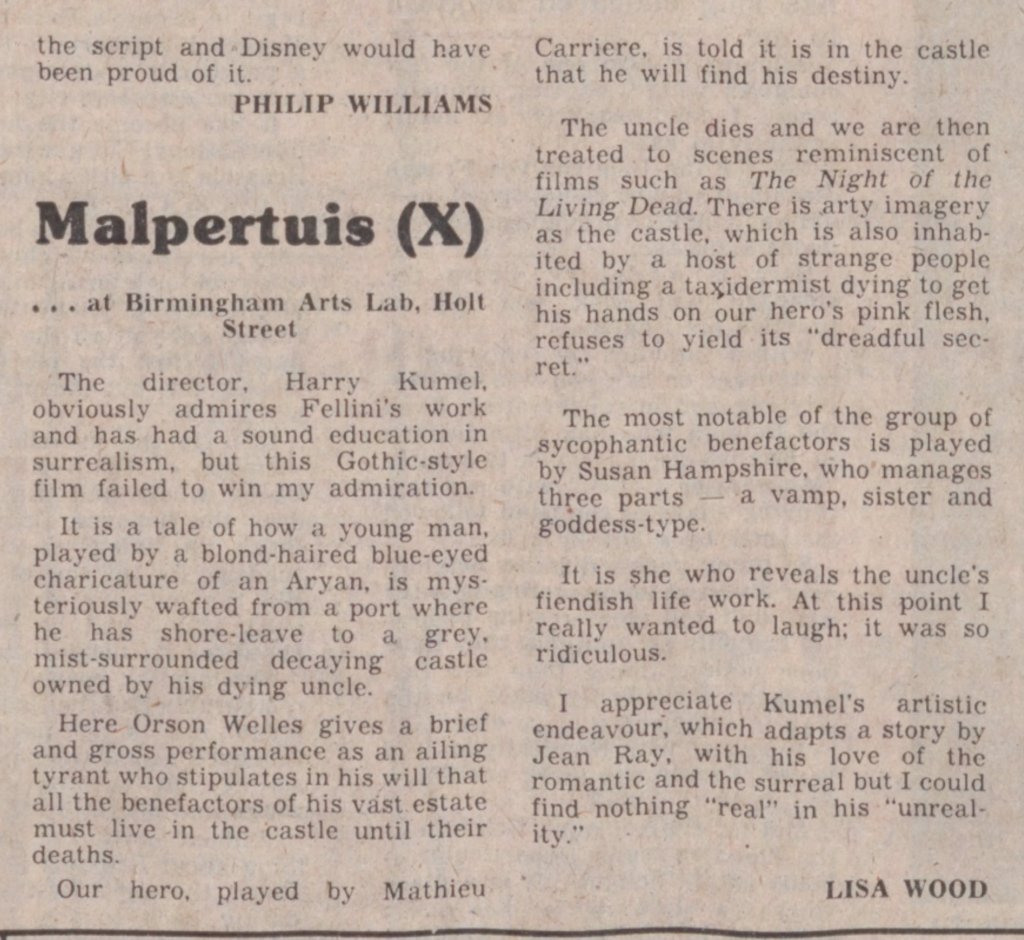
Also, enjoy these additional clippings I collected while researching this piece.







 Nostalgia Kinky
Leave a comment