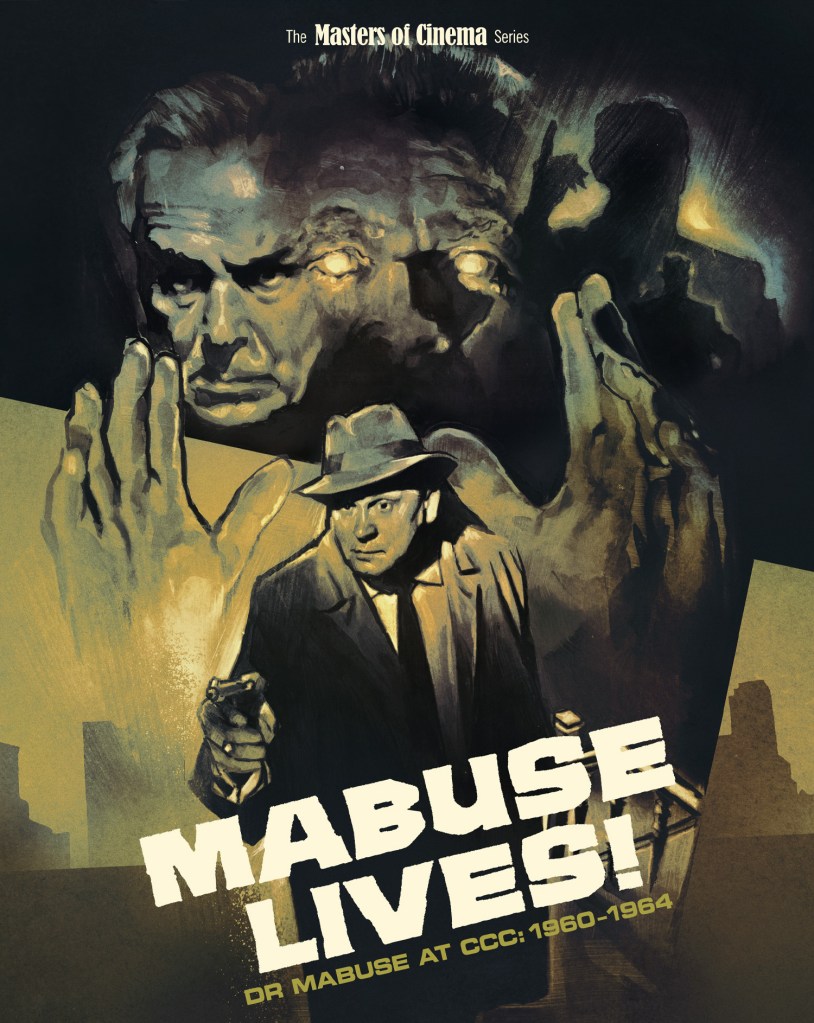
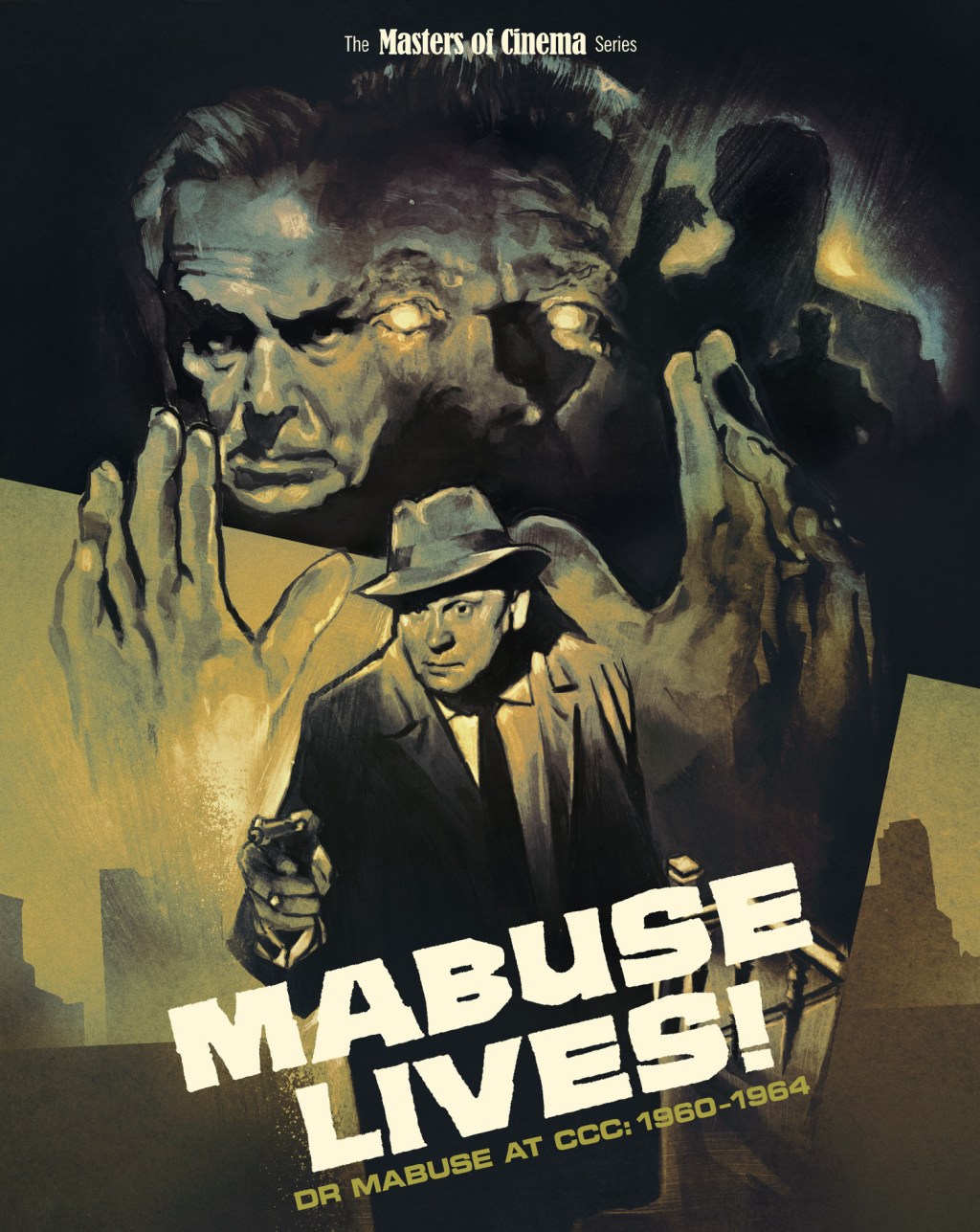
Newly available from Eureka, the 4-disc box Mabuse Lives! Dr. Mabuse at CCC: 1960-1964 is a comprehensive and excellent collection highlighting the return of a fictional cinematic legend. Featuring new 2K restorations of The Thousand Eyes of Dr Mabuse (1960), The Return of Dr. Mabuse (1961), The Invisible Dr. Mabuse (1962), The Testament of Dr. Mabuse (1962), Scotland Yard Hunts Dr. Mabuse (1963) and The Death Ray of Dr. Mabuse (1964), Mabuse Lives! is an exciting new box-set featuring beautifully restored prints and a wealth of new extras. Available directly from Eureka and MVD, Mabuse Lives! is a highly recommended set. Below are my capsule Letterboxd reviews along with some additional clippings I discovered.
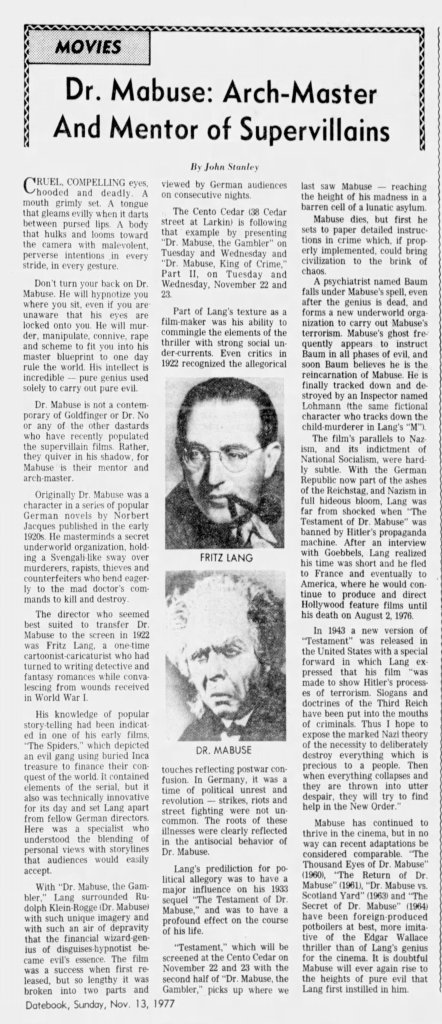
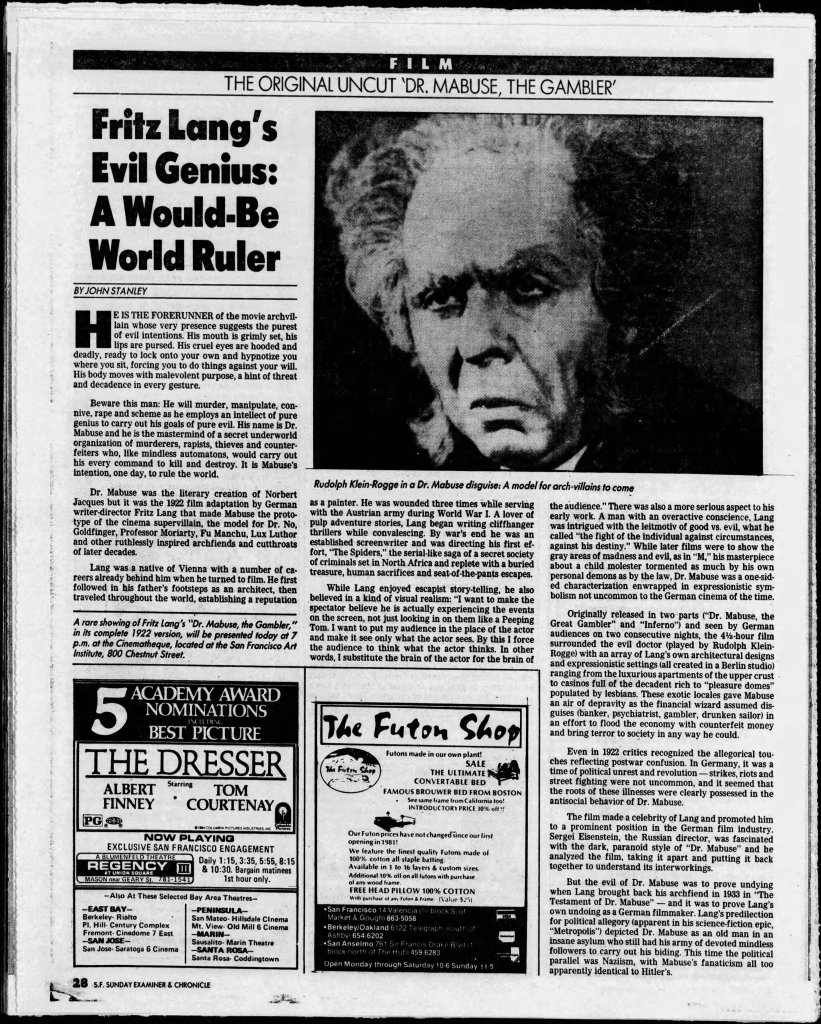
The Thousand Eyes of Dr Mabuse (1960)
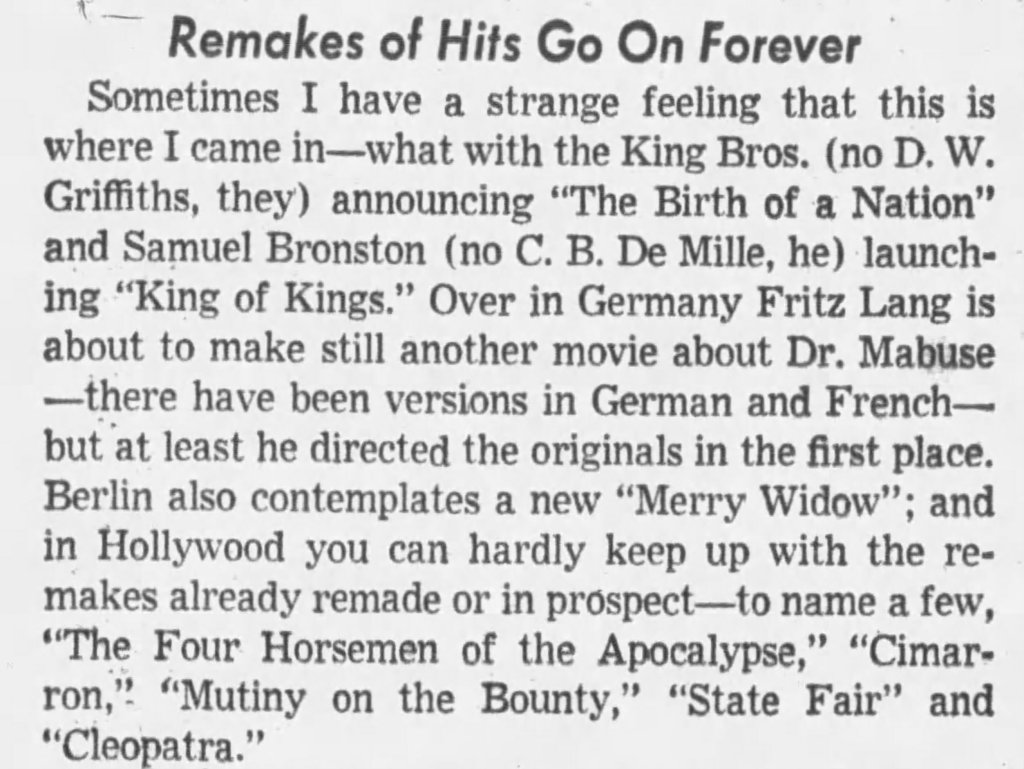
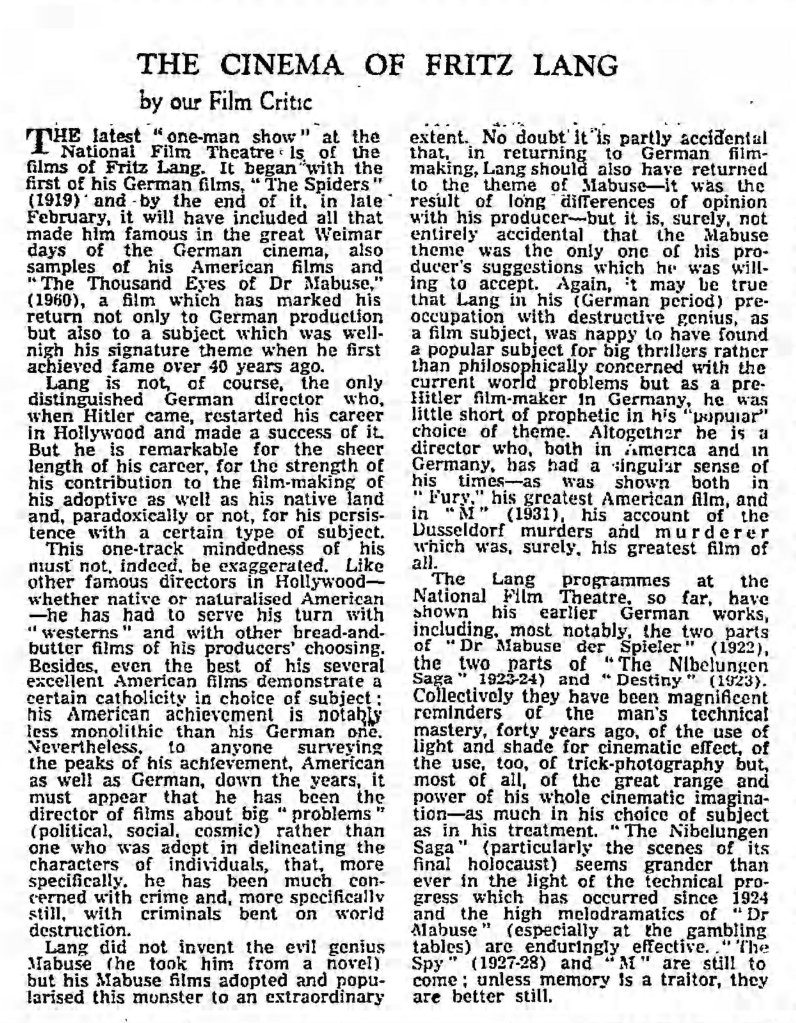
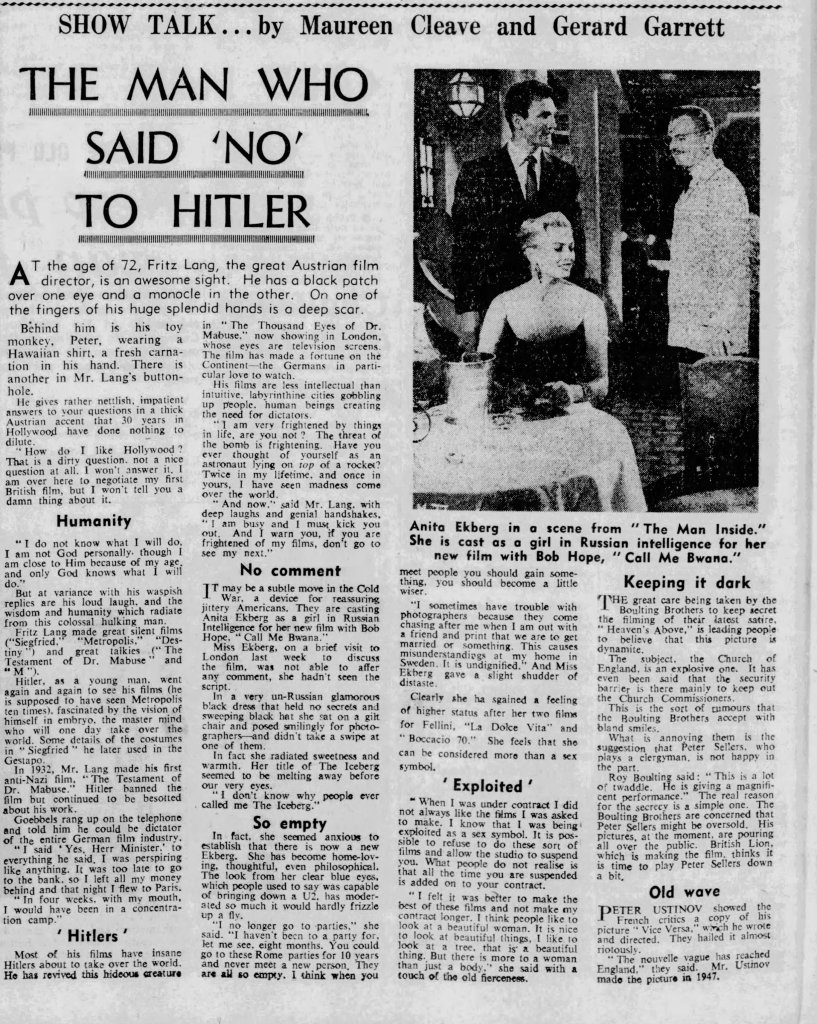
The final film of Fritz Lang’s career, THE THOUSAND EYES OF DR. MABUSE finds the great Austrian/German filmmaker once again making a film centered around the great criminal genius Mabuse. Featuring a strong cast and top of the line crew, THE THOUSAND EYES OF DR. MABUSE is a solid final film from Lang, even if it ultimately isn’t amongst his finest works.
After fleeing Germany in the mid-thirties after he and his THE TESTAMANT OF DR. MABUSE were targeted by Hitler, Lang spent much of his near two decade exile in Hollywood. Lang made over 20 films in America, some classics and some duds but by the late fifties opportunities were drying up and his sight was failing. Even though it was an international co-production between France, Germany and Italy, this film was correctly viewed as a return home of sorts to Lang.
Near blind by the time he made THE THOUSAND EYES OF DR. MABUSE for producer Artur Brauner, Lang was still able to craft a finely-tuned and even visionary work, specifically in how the film presents surveillance and the loss of privacy as essential weapons. A bit overlong at 105 minutes, with a bit too much going on in the script Lang penned with Heinz Oskar Wuttig, THE THOUSAND EYES OF DR. MABUSE is still an effective production that’s both chilling and entertaining.
The ensemble cast is splendid and I’m sure everyone was thrilled to be working with even an ailing Lang. Numerous familiar faces are on hand from Gert Fröbe to Dawn Adams to Howard Vernon. Peter van Eyck and Wolfgang Preiss are featured primarily as well. Shot well in black and white by Karl Löb, THE THOUSAND EYES OF DR. MABUSE works best when it’s at its most paranoid. Playing at times like a direct response to Nazism, the film’s critical eye on the idea of surveillance is remarkably prescient.
The Return of Dr. Mabuse (1961)
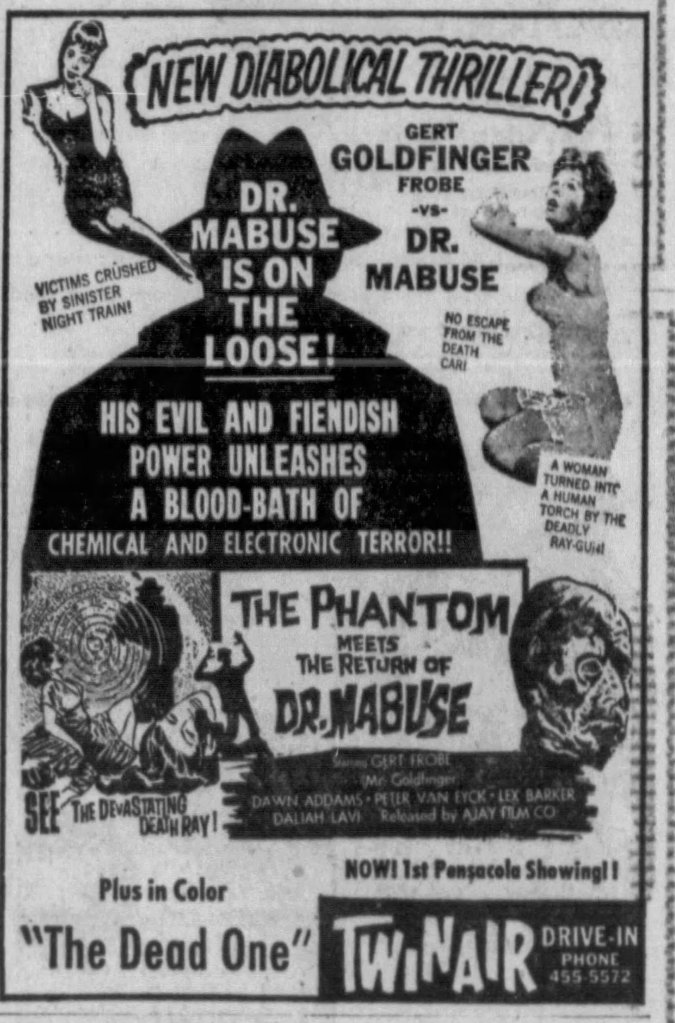
THE RETURN OF DR. MABUSE (1961) is not the film THE THOUSAND EYES OF DR. MABUSE (1960) was and that very much works in its favor. For everything Fritz Lang’s final film had going for its weighty subtextual ambitions removed any sense of pulpy fun. This follow-up film has pulp to spare and it is entertaining as hell. Running nearly twenty minutes shorter than Lang’s work, this Harald Reinl directed film is lean and deliciously mean with some shockingly effective violence for 1961.
Despite Lang’s absence, THE RETURN OF DR. MABUSE does a good job aping the visual style he struck with THE THOUSAND EYES. Much of this is due to the return of cinematographer Karl Löb, whose black and shite photography remains a highlight. Cast wise Gert Fröbe returns and Daliah Lavi makes a welcome early appearance as a roving journalist.
The Invisible Dr. Mabuse (1962)
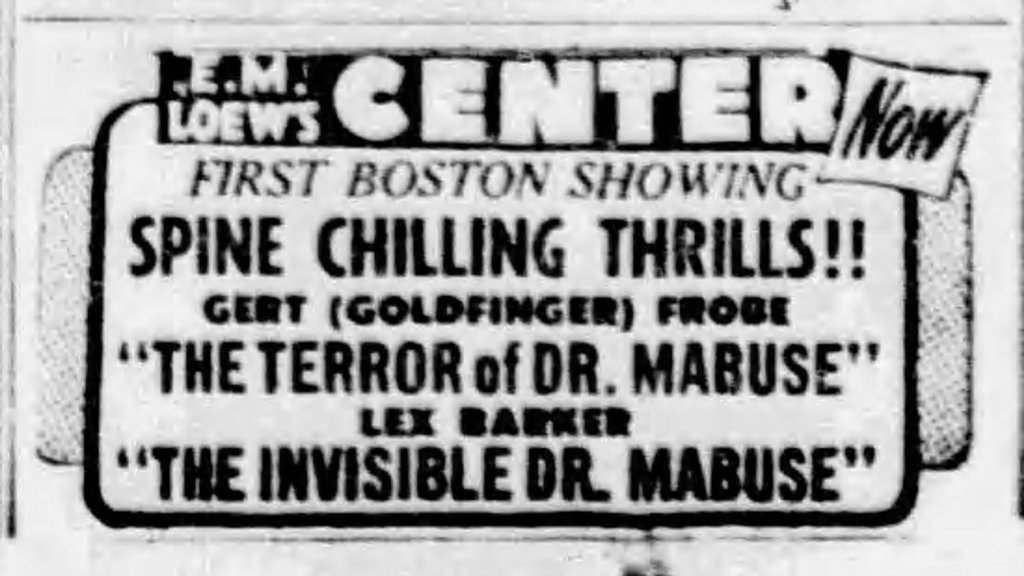
The very silly THE INVISIBLE DR. MABUSE (1962) is a step-down in quality from the first two films found on Eureka’s MABUSE LIVES! Blu-ray box, although it is still a fairly entertaining ride. Director Harald Reinl returns after his, imho, superior THE RETURN OF DR. MABUSE (1961). Part sci-fi, part horror, this Mabuse chapter features a script from Ladislas Fodor, who’d close out his film career about a decade after this with the very fun Jess Franco film, THE DEVIL CAME FROM AKASAVA (1971). Everything about THE INVISIBLE DR. MABUSE represents a step-down from the nice if unremarkable black and white cinematography to the sometimes obtrusive score Peter Sandloff. The shocking violence throughout THE RETURN OF DR. MABUSE has been replaced by a much more cartoonish tone. Cast wise, Lex Barker and Wolfgang Preiss are back. German star Karin Dor also appears. THE INVISIBLE DR. MABUSE certainly isn’t a bad film and is still recommended.
The Testament of Dr. Mabuse (1962)
The 4th film in CCC’s Mabuse series, THE TESTAMENT OF DR. MABUSE thankfully drops some of the previous films silliness, replacing its overtly sci-fi elements with a more traditional (if still supernatural) crime story. A loose remake of Fritz Lang’s classic 1933 entry in the series, THE TESTAMENT OF DR. MABUSE offers German filmmaker Werner Klingler the chance to step in as director. Klinger, already sixty and a veteran of the film industry, does adequate work behind the camera here. THE TESTAMENT OF DR. MABUSE is fine if nothing special. Aspects of it I preferred to the previous entry just due to the fact that there was no Invisible Man style subplot, but much of the kookiness and sheer weirdness of the series is missing here. Save for idea that an incarcerated Mabuse is controlling criminals with his mind, this is a fairly standard heist film. Not a bad one, just a standard one. The cast is strong, with Gert Fröbe returning to the series and famed Senta Berger gets a rather thankless roll, but her presence is welcome none the less.
Scotland Yard Hunts Dr. Mabuse (1963)
The 5th film in CCC’s Mabuse reboot series from the sixties, SCOTLAND YARD HUNTS DR. MABUSE (1963) feels considerably cheaper than the earlier entries, and we have yet another director new to the series. For this round, German director Paul May steps in behind the camera and his rather uninspired direction fails to impress. May is, on the basis of this film at least, simply not the stylist of a Harald Reinl. SCOTLAND YARD HUNTS DR. MABUSE also takes the series even further in style and tone from Lang’s originals and as a whole has a bit of a TV movie feel about it. All that said, this is still kind of fun. The film zips along, often guided by Rolf A. Wilhelm’s brassy beat score. Some of the detours the film makes are interesting as well, especially related to Peter van Eyck’s ‘MIss Marple’ like mom who solves the damn case halfway through the film and, as played by Agnes Windeck, is kind of delightful. Also, Klaus Kinski is on hand looking like a total sociopathic degenerate playing a police detective and it is kind of hilarious. All in all, SCOTLAND YARD HUNTS DR. MABUSE is both a drop in quality and an enjoyable watch.
The Death Ray of Dr. Mabuse (1964)
I’ve yet to see Jess Franco’s unofficial 1972 Mabuse film but I’d wager a bet it is closer in spirit and tone to Fritz Lang’s originals than THE DEATH RAY OF DR. MABUSE, the disappointing film that closes out CCC’s original reboot series. We’re deep in James Bond territory here feeling far, far away from not only Lang’s original Mabuse classics but also the earlier CCC productions from just a few years previous. Shot mostly in Italy, this is a much sunnier Mabuse, losing most of the noirish elements of the earlier CCC films. Argentine director Hugo Fregonese who, like Lang, had spent much time working in Hollywood does adequate work here and the film has some nice visual touches. Stylish sequences aside, THE DEATH RAY OF DR. MABUSE just doesn’t feel like a Mabuse film in the slightest.
Tim Lucas notes in his introduction to the film that the film’s much longer Italian cut feels much closer in tone to the earlier Mabuse films. Featuring an entirely different score and nearly 20 extra minutes, Eureka presents this rare Italian version as bonus on the final disc of the MABUSE LIVES! set. While I did prefer the alternate score in this variant, the additional scenes didn’t do much more than stretch a relatively poor film to a 110 minute run-time.
Despite some film’s varying quality, Mabuse Lives! Dr. Mabuse at CCC: 1960-1964 is an excellent collection chronicling an overlooked series and period. All of the films look very strong via these 2K restorations. Sound wise, strong German and English language tracks are available for each film. Film historian, author and Mabuse expert David Kalat delivers finely informative commentary tracks for each film, offering a wealth of information on the works and the people who made them. My man Tim Lucas is also on hand for each film, providing fascinating introductions to each work. Tim’s fine contributions run roughly 8 to 15 minutes a piece and Eureka gives you the option of watching each film with the introduction or viewing them as their own separate video essay.
Speaking of video essays, Eureka gives us the thirty minute Kriminology by David Cairns and Fiona Watson. We also get a moving archival 2002 interview with actor Wolfgang Preiss, who passed away shortly after this footage was captured. Also on hand is an intriguing chat with CCC’s current producer and managing director of CCC Film Alice Brauner. I added Brauner’s own film Münter & Kandinsky (2024) to my watchlist after watching this interview. Trailers, reversable sleeves and a limited edition booklet complete this very fine set from Eureka.
-Jeremy Richey, January 2026-
 Nostalgia Kinky
Leave a comment