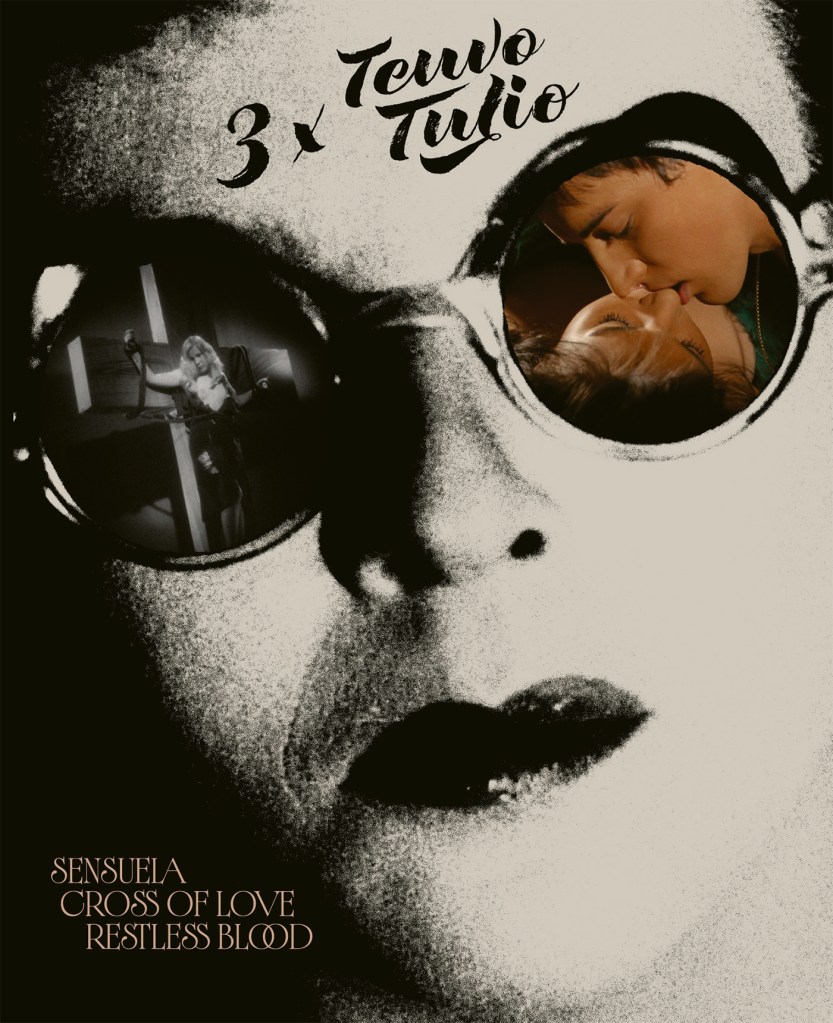
A personal favorite recent discovery is Finnish filmmaker Teuvo Tulio. Three of his finest films, along with a slew of vintage and new supplements, are now available from Deaf Crocodile as 3x Teuvo Tulio. All three films have been newly restored by KAVI – the National Audiovisual Institute of Finland and have never been available on Blu-ray before. I spent the last couple of days with this remarkable set. Here are my Letterboxd reviews of each film. A huge recommendation for this very special collection that will cause cinema lovers to rethink the history of film we’ve been taught. Order it directly from Deaf Crocodile or MVD.
Cross of Love (1946)
A wholly awesome kick-off to Deaf Crocodile’s 3x Teuvo Tulio Blu-ray box-set, Rakkauden risti (1946) is an unforgetably dark melodrama that the great Finnish filmmaker made just after World War 2. Known as Cross of Love, this black and white beauty features everything from a spooky lighthouse to prayers to the Grim Reaper and even full-frontal nudity. This is a delightfully mature film from an era where something like this was unthinkable in English-language territories.
Teuvo Tulio was only known to me as the director of Sensuela (1973), going into this, and what a wonderfully distinct introduction this is. Just in his mid-forties at the time of Cross of Love, Tulio wasn’t new to the film world as he’d been around since the silent era. Originally an actor, Tulio directed about half a dozen films before Cross of Love, and this film finds him in fine shape behind the camera, crafting a weirdly effective Sirkian noir-like Melodrama with a capital M.
Written by frequent Tulio collaborator Nisse Hirn, Cross of Love’s storyline concerning a lonely young woman who leaves her father in an isolated lighthouse where they work to find adventure and love in the big city isn’t all that interesting. What is interesting is what Tulio does with it and how he takes a fairly basic story and makes it something so chilling and seductive.
The small ensemble cast gathered together for this 1946 production is uniformly fine for this type of material. Star Regina Linnanheimo seems particularly in tune with what Tulio is going for here, turning in a moody and moving performance that feels ahead of its time. Like the cast Sirk usually assembled, each player seems acutely aware that they need to be overly melodramatic without going too far. For the most part, they succeed.
Along with the rather predictable narrative, my only little gripe with Cross of Love is the woefully old-fashioned score. Pity that the film’s music isn’t as forward-looking and modern as Tulio’s direction, but it is a small complaint. This is a fine film.
Deaf Crocodile has added some cool extras to this release, including a new commentary from historian Rolf Giesen. This is a very dense and rich commentary loaded with historical information about this period and film. Awesome stuff. Even better is 22 incredible minutes from the otherwise lost Tulio film Fall Asleep When Young. We are also treated to a featurette about the restoration of this once-lost fragment.
Perhaps best of all is the nearly five-minute Finnish trailer, made up of alternate footage as Tulio shot two versions of this film simultaneously. My guess is that version has been lost, but it is great that Deaf Crocodile was able to locate this trailer. The differences are a bit startling. Finally, the restoration presented here is heroic considering the condition of the print. There are obvious signs of age and wear, but thankfully, this restoration has stayed true to the film and not opted for any horrible modern ‘fixes’. This was one hell of a pleasing and surprising film.
Restless Blood (1946)
An even more devilishly diabolical noirish melodrama than the just-completed Rakkauden risti, Levoton veri (1946) is the second film found in Deaf Crocodile’s terrific 3x Teuvo Tulio Blu-ray box-set. Finnish director Tulio turns to full ‘two-forty’ here, creating a bold, hyper-stylized vehicle of betrayal and karma. Imagine a Black and White Almodovar shot thriller several decades before its time, and you’ll arrive at Restless Blood.
Once again powered by a wildly driven Regina Linnanheimo performance, Restless Blood is an orgiastic cinematic carnival packed with heartbreak, tragedy, and finally madness. The Small ensemble cast of Eino Katajavuori, Toini Vartiainen, H. Stenroos, and Nora Mäkinen are all in fine form, but Linnanheimo drives the film in a fiercely unforgettable performance.
As with the earlier film on Deaf Crocodile’s set, Restless Blood’s script is the least interesting thing about it, making none of the film’s turns and twists all that surprising. It doesn’t matter in the slightest. Tulio injects every moment with enough style to surpass the familiar narrative.
With Restless Blood’s, Tulio creates a powerful work centered on people paying for the consequences of their actions. There isn’t a traditional ‘villain’ in Restless Blood, nor is there a ‘hero’. Like reality, everyone here exists in a morally grey area. The biggest antagonist each one of our protagonists ultimately faces is themselves.
Considering my biggest complaint about Tulio’s earlier 1946 film was its overbearing score, I was pleased to discover no such issue here. In fact, a particular musc-box motif that plays sporadically throughout is amongst the film’s most haunting pleasures.
Deaf Crocodile has again done heroic work bringing these restorations to HD, introducing them to most Stateside audiences for the first time. This print has even more signs of wear than the set’s earlier film, but it is hard to imagine it could possibly look much better than it does here.
Deaf Crocodile’s release includes an academic and historical commentary from Dr. Eloise Ross and a new video essay from Dr. Will Dodson. A brief surviving excerpt from an otherwise-lost earlier Tulio feature is also found on the film’s supplements. Surprisingly, and perhaps best of all, is a perfectly preserved 1946 Finnish education film Tulio made concerning a charity hospital for newborns. If only his early features had been as well cared for throughout the decades as this little classroom film.
Also, why are those babies napping in the snow?!?!?
Sensuela (1973)
It happens very rarely, but nothing excites me more than finding a film so utterly peculiar and unique that I can honestly say that I’ve never seen anything like this before.
I’ve never seen anything like Teuvo Tulio’s Sensuela (1973) before. The final film in Deaf Crocodile’s incredible 3x Teuvo Tulio Blu-ray box left me positively beside myself. Outside of being aware of the film, I went into Sensuela completely cold, and I found it a joyous and shocking cinematic experience. Packed with so many things I love in film, from surreal absurdist humor to graphic female and male nudity to endearing practical effects, Sensuela is just extraordinary.
A very loose remake of 3x Teuvo Tulio’s first film, the stark B/W Cross of Love (1946), Sensuela is bursting with color. Photographed exquisitely by Tulio himself, with assistance from Yrjö Norta Sensuela is one of the most gorgeous films of my birth year. Tulio’s basic story (young woman leaves father in small hometown for love in big city) is transformed into an erotic snow-bound oddity. Set within the indigenous northern Scandinavian Sámi culture, Sensuela defies any genre. It’s funny, sexy, sad, even goofy and sad. I cried at the end of this film for no other specific reason than that it was ending.
Sensuela features an extraordinary lead turn by near one-and-done actress Marianne Mardi. Her finely nuanced performance here keeps the film at a human level, even in the moments when Tulio takes off on the craziest moments of cinematic whimsy. Unlike the other two films in Deaf Crocodile’s set, Sensuela doesn’t feel ahead of its time. More than that, it feels like it occupies its own specific time, neither past nor future.
Sensuela is one of those rare films that doesn’t remind me of another film, not in the slightest. I thought of Poor Things a few times, but I think that was down to how each made ME feel on a deeply personal level. Why can’t more films be this adventurous, this rule-breaking?
3x Teuvo Tulio’s from Deaf Crocodile is one of my favorite collections in recent memory and Sensuela is, along with Ruslan and Ludmila (1972) and Taxi zum Klo (1980), my most valuable discovery of 2026. Deaf Crocodile’s release comes with a fun commentary by Heidi Honeycutt and a personal video essay by Reinert Kiil. An early education short by Tulio is also on hand. I Would Like To Be A Queen (1947) warns teenage girls against the dangers of alcohol and horny young boys. It’s fine for what it is, although one of the earlier discs might have provided a better home for it. Unlike Tulio’s films from the forties, Sensuela was thankfully much better preserved and looks beautiful via Deaf Crocodile’s restored presentation.
Two Big Thumbs UP for Sensuela, one of the most off-the-wall works of outsider cinema I have encountered in a hot minute. Same goes for Deaf Crocodile‘s 3x Teuvo Tulio set. This is an important release.
-Jeremy Richey, March 2026-
 Nostalgia Kinky
Leave a comment