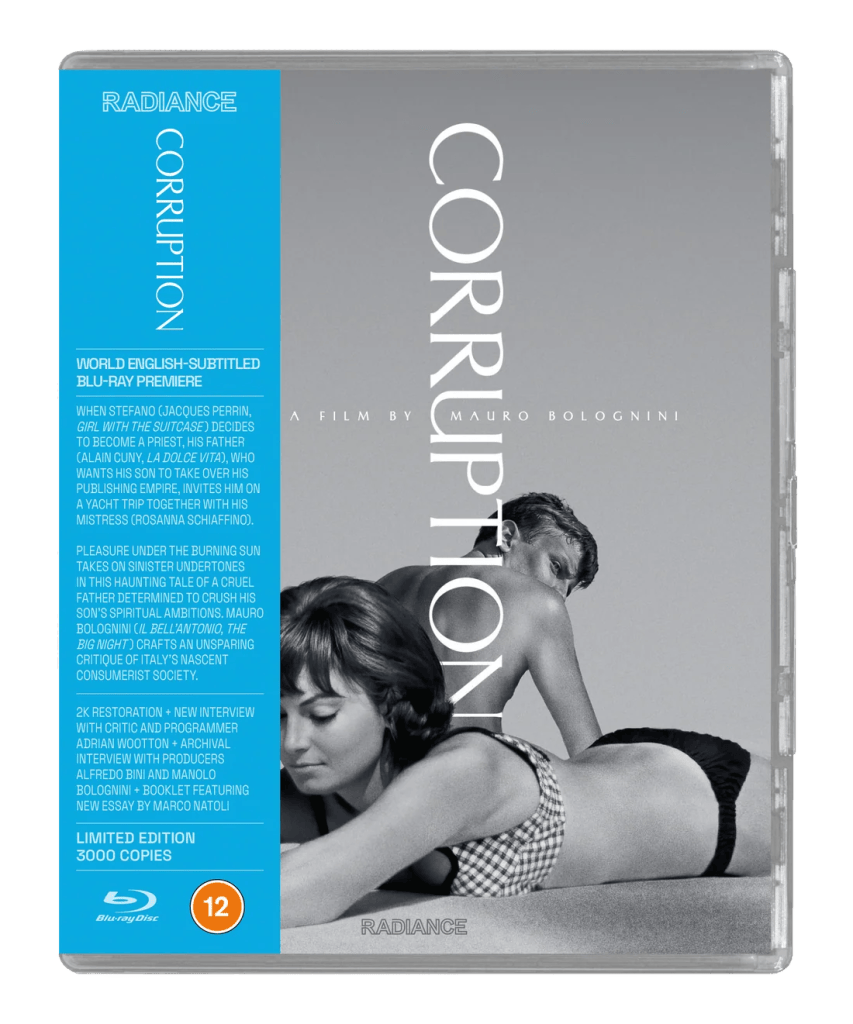
Radiance continues its exemplary work of rescuing and restoring great, underseen works of classic European cinema with Mauro Bolognini’s startling Corruption (1963). Featuring Rosanna Schiaffino and Alain Cuny, Corruption is a contemplative and remarkably forward-thinking black-and-white production that looks wonderful on this new limited-edition Blu-ray. Order this must-see film directly from Radiance or here in the States from MVD.
Corruption contains one of the most extraordinarily erotic scenes in film history. Happening about halfway through this haunting film, this poetic scene in front of a bathroom mirror is not at all explicit, and yet it is among the sexiest moments I have ever seen onscreen. The moment scandalized star Schiaffino and damn near got Bolognini and producer Alfredo Bini excommunicated. You’d think with that kind of publicity, Corruption would be much more famous than it is, and yet this Radiance release will offer most English-language audiences one of the first chances to see this powerful work.
Corruption is a deceptively simple film. The script by Fulvio Gicca Palli and Ugo Liberatore tells the story of an idealistic young man named Stefano, looking to enter the priesthood against the wishes of his practical-minded businessman father. Emotional trauma ensues when the father hires a beautiful young woman in the hopes she might lead his son away from his calling. Far from being just another film about lost faith and young lust, Corruption’s true focus is on the divide between capitalism and tradition, and it is quietly one of the most devastating films I have discovered this year.
Mauro Bolognini is a filmmaker I am mostly aware of due to his connections to Pasolini. Corruption has convinced me Bolognini was probably one of the great Italian filmmakers of his era. There are moments in this film that are, simply put, as great as any mythic masterpiece from the period you care to name. Corruption was so far ahead of its time and its release so disappointing that Bolognini’s career was damaged for years. Amazing, as Corruption rivals the great films of his peers.
Corruption marks Bolognini’s 15th feature in just the first decade of his career. By 1963, he was probably best known for his Handsome Antonio, a 1960 film that featured both Marcello Mastroianni and Claudia Cardinale. He’d score another hit with the luscious Cardinale with the next year’s The Lovemakers. In fact, Bolognini and the legendary Italian actress frequently worked together. For the pivotal role of Adriana in Corruption, Bolognini wisely went with Rosanna Schiaffino, who dominates the film with her unforgettable performance.
Still just in her early twenties when she shot Corruption, Schiaffino had spent most of her early career in costume dramas and comedies. Her luck changed when she landed a high-profile role in legendary Vincente Minnelli Hollywood-backed Two Weeks in Another Town (1962). She’d follow that up by collaborating next with no less than Roberto Rossellini on his section of the anthology Ro.Go.Pa.G. (1963). It was just after that Corruption appeared. The film should have turned the young Italian talent into one of the major stars of the period.
The majority of Corruption takes place on a yacht, itself an example of gross prosperity. Bolognini directs his small ensemble with the greatest of care, composing every shot with the most delicate hand. A deadly serious film, Bolognini wisely chose Giovanni Fusco as the film’s composer. His jazzy score lessens the dark edges surrounding Corruption, as this is an exceedingly dark, even tragic film.
Corruption’s visuals match its somber tone throughout. Cinematographer Leonida Barboni photographs Bolognini’s look at lost ideals with an almost brutal but gorgeous coldness. Barboni’s stark use of black and white highlights the raw eroticism at the heart of the film’s key sequence as well as the delirious handheld moments that conclude it.
Corruption is also blessed to have the mighty Nino Baragli on hand as the film’s editor. A prolific artist and technician who’d been around the film industry since the late forties, Baragli’s career was growing in this period, thanks mostly to his work with Pasolini. He’d continue his work as one of cinema’s great editors nearly up until he died in 2013. He’s probably best known today as the man in charge of the mammoth editing for Sergio Leone’s most epic films like Once Upon a Time in America (1984). Baragli was also the editor on Pasolini’s final film, the monumental Salo, or the 120 Days of Sodom (1975). To say his contributions to Corruption are among the film’s chief highlights is an understatement.
Radiance presents Corruption via a new 2K restoration that brings out Leonida Barboni’s cinematography splendidly. Extras are slim, but both the new interview with critic and programmer Adrian Wootton and
Archival interview with producers Alfredo Bini and Manolo Bolognini are solid. This limited slipcovered reversible sleeve edition also includes a booklet with a fine essay by film scholar Marco Natoli. This isn’t one of Radiance’s more loaded packages, but this is still a fine release of a truly extraordinary film. Highly recommended.
-Jeremy Richey, September, 2026-


Leave a comment