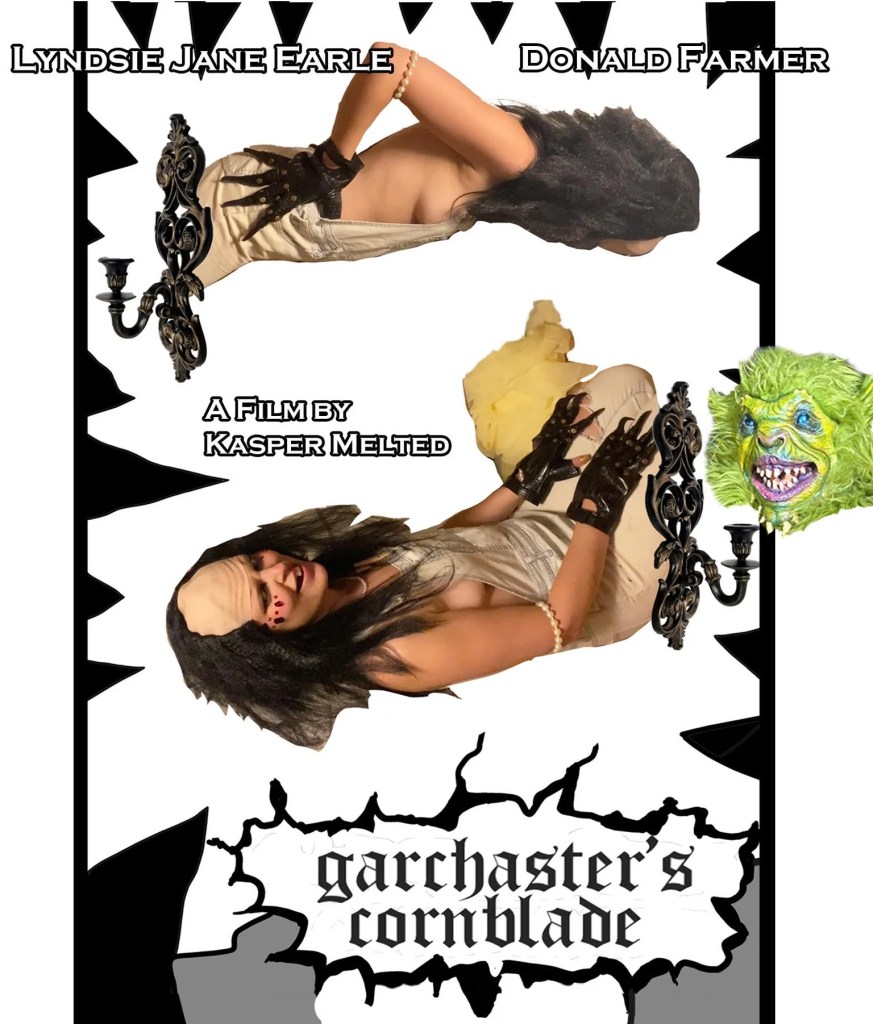
A genuine surrealist lives a few hours from me over in Eastern Kentucky.
Her name is Kasper Melted.
On the morning of July 14th, 1916, poet Hugo Ball walked into Zurich’s Zur Waag guildhall clutching a paper entitled The Dada Manifesto. An artistic as well as political statement, the original Dada Manifesto sought to create an entirely new language, as capitalism had ruined the old. Fitting in with the movement’s anarchic stance, fellow Dadist and poet Tristan Tzara wrote a counter essay, Manifesto Dada 1918, that violently rejected the softer tone of the original. A nihilist, Tzara’s influence inflamed Dada’s experimental, nonconforming power, leading directly to its connection with the Surrealist movement.
We’ve had a lot of glorious artistic weirdos appear out of Kentucky, myself included. Richard Hell once inscribed a book to me calling me the “King of Kentucky Weird” and I have always embraced the more anarchic folks who crawled out of the hills here, from Mia Zapata to Sean Young. Hell, we even gave the world Charles Manson, and he made one of the greatest outsider albums ever made. With all this in mind, discovering a genuine old-school Dadaist nearby shouldn’t be shocking, but Kasper Melted is a an actual shocking presense in modern cinema, and goddamn does it ever need shocking.
A unique new violence in the 20th century helped create the Surrealist movement. It was just a few years after the Paris, 1919 treaty that French Poet Andre Breton introduced his Surrealist Manifesto. Defining it as “pure psychic automatism” in which the unconscious mind controls all, Breton’s manifesto both broke away from and solidified Dadaism’s main belief system. Over time, Breton’s viewpoints became more political and more extreme, going so far as to say that firing a gun blindly into a crowd would be the ultimate act of surrealism, shocking many of his more measured peers.
Garchaster’s Cornblade is Kasper Melted’s second feature, after the brilliant Busted Babies (2024). With Garchaster’s Cornblade, Kasper has created one of the most extreme, uncompromising cinematic visions of the decade. Defying any sort of traditional (or nontraditional) description, Garchaster’s Cornblade is a near two-hour head-trip into one of the most unique thinkers American cinema has seen in a bit. Garchaster’s Cornblade takes the most idiosyncratic aspects of Videodrome, slingshots it back at itself and then us.
One afternoon as the twenties were nearing a close, artist Salvadore Dali and filmmaker Luis Bunuel were having a lunch at a Paris cafe. At some point during their conversation, Bunuel recalled a dream he’d had in which the moon was literally split in half with a cloud. Mulling this over, Dali suddenly remembered a dream he’d had about his hand covered in ants. Within a year, these two created Un Chien Andalou, still one of the most shocking works of cinema ever created and one of the essential works of surrealism. A broke Buñuel ended up editing the film at home on his kitchen table. He later noted that he expected the reaction to be so violent that he literally loaded up his pockets with rocks to protect himself at screenings. He was Down To Kill for his art.
Shot partially in Kasper’s Eastern, KY home, Garchaster’s Cornblade is gloriously difficult, and it never gives an inch to normalcy. It is a delightfully strange journey into Kasper Melted’s creative mind and world. Built around her own remarkable script containing everything from prose to nonsensical made-up language, watching Garchaster’s Cornblade reminded me of reading A Clockwork Orange for the first time. In fact, Kasper’s script might actually be my favorite thing about the film. Her images are breathtaking in their oddness but it is the way she is able to capture the way that we speak in our dreams that really has me gobsmacked. As a writer, I wish I could do that. I’d give anything to be able to access the absurdist in my brain, literally anything.
Dreams were always important to Alain Robbe-Grillet. With an unnerving ability at accessing those dreams for his art, Robbe-Grlillet’s novels and films are populated by the language of dreams, spoken and visual. His 1953 novel The Erasers shocked the literay world with its use of Free Indirect Speech, in which the third-person narration is connected to the first person’s direct speech. His novels and films rejected and rebuilt both literary and cinematic norms, creating the New Novel in the process. During the period Robbe-Grillet’s fierce star was rising, the young writer met a young filmmaker named Alain Resnais. They decide to collaborate. Robbe-Grillet writes the screenplay as director, proclaiming that he was writing as Resnais thought and that Resnais would direct as he would. The resulting film, Last Year at Marienbad, continues to rewire the minds of all that fall under its spell.
Ever get high off a VHS tape? I mean, seriously, have you ever smoked a VHS cartridge? Lyndsie Jane Earle does in Garchaster’s Cornblade. It is just one of the many moments in the peanut-butter-soaked film that I’ve never seen before. It’s that moment in Videodrome when Deborah Harry comes out of that TV screen beckoning James Woods for a kiss. Regardless of the fact that Kasper chose to shoot the film digitally, Garchaster’s Cornblade bleeds analogue. The film is as obsessed with the idea of VHS as home, VHS as an ultimate end-game, as Earle is with smoking them. Considering this is a pretty impossible to describe film, I found Kasper’s synopsis actually very clear and precise:
“A gricky star planet girl follows a casting call into the Earth oven so she can fulfill her dream of getting inside of a VHS tape… to burn and inhale herself.”
Garchaster’s Cornblade stars both Earle and Kasper, along with legendary DIY no-budget filmmaker Donald Farmer. Kasper has actually assembled a fairly large ensemble here, with everyone from Bloodsick founder and filmmaker Brewce Longo to frequent actor Andy Heck Boyd, along with dozens of Kasper’s friends and peers, many making their screen debut. I have no idea how Kasper harnased all of these distinctive talents into one film, nor how she managed to bring everyone to the place they needed to be.
In the early part of 1976, New German Cinema Jesus, Werner Herzog, was getting more and more agravated with his actors on the set of his Heart of Glass. Frustrated by their inability to essay the trance-like nature he wanted he came upon an idea. Very quickly a professional hypnotist was hired and Herzog had nearly the entire cast hypnotized. They’d remain under the spell for the remainder of the shoot, creating some of the most unique performances of the period. It’s a great story about a great filmmaker and the things an artist will do for their work. It’s also probably complete nonsense as Herzog has always created his own truth, his own mythology, his own bullshit.
But still, what a great story.
I don’t think Kasper Melted had anyone hypnotized on the set of either one of her features but regardless, she has her cast completely under her spell. Garchaster’s Cornblade is a film that could easily slip out of control, like an acid trip taking a bad turn but Kasper’s total control here is quite extraordinary. Garchaster’s Cornblade never slips out of character, even in the moments where any other filmmaker might give a little wink to the normalcy this film mocks.
An 18-year-old Genesis P-Orridge was a college dropout living in a Hull commune when he decided that he’d had enough and was returning to his parent’s home. Shortly after his return he had an out of body experience in which he heard voices and saw visions of what soon became the COUM Transmissions. Throughout the next decade P-Orridge along with several friends, including Cosey Fanni Tutti, shocked Britain with some of the most outragous and dangerous performance art ever created. Rejecting an artist’s safety net, the group experimented with sex and violence in the most extreme ways it could, concluding with P-Orridge nearly dying after injesting large amounts of bark on top of losing too much blood at one performance. This near-deadly dance with art at its most extreme led to the founding of Throbbing Gristle and five more years of the most extreme visionary art ever created.
Garchaster’s Cornblade has its own unique relationship with violence. Same with sex. There’s a wonderful sequence in this film where fully nude Lyndsie Jane Earle and Kasper Melted appear out of one of our Kentucky Caves, and it is one of the most magical and transcendent moments in a film I’ve seen in a bit. The fact that this delightful moment concludes with one of the film’s most disturbing scenes makes it even more poetic. And Garchaster’s Cornblade is poetic as fuck, thanks to the wonderfully lyrical quality of Kasper’s writing. She’s using her very own unique language here and the way she combines it with sometimes nightmarish moments is incredible.
Brion Gysin was always looking to de/reconstruct. He was in a mood that night at the Beat Motel when he mentioned the Dadist technique of cutting up what you’ve written and putting it back together again to his friend, novelist William S. Burroughs. The inventor of the dream-machine, Gysin, no doubt knew how much the junk-powered writer would latch on to this cut-up technique. Within a decade, Burroughs wrote one of the most extraordinary literary trilogies using the method. Works like Nova Express were treated like freakworks by the older establishment but young readers David Jones in England were taking notes. By the end of the next decade, Jones now known as Bowie, was utlizing the method in his own lyric writing. All looking to create their own very specific language. This method allowed the art to essentially control the artist, allowing them access to areas of their imagination otherwise unknown.
Kasper Melted creates her own unique Dream Machine with Garchaster’s Cornblade. Busted Babies was an absolutely thrilling debut but this is on another level as one of the most audacious films of the decade. If Garchaster’s Cornblade was a gun, it would be a loaded one.
Richard Kern was at the Zoo Atelier cinema in Berlin when he’d had enough. He’d been traveling around with his film Fingered throughout the better part of 1986, fighting off protests and scandal at every turn. That night in Berlin as his transgressive masterwork was being jeered, Kern leaped up on stage screaming “Fuck You” to an audience still shocked from seeing Lydia Lunch fucked with a gun by Nick Zedd. The Cinema of Transgression was actually credited to Zedd, who yearned for a cinematic playing field with absolutely no limits.
Garchaster’s Cornblade is very much a film with no limits and Kasper Melted is a filmmaker not held back by any. Within the span of just a couple of years she has created two Dadaist masterpieces and she does nearly everything herself. Not to take away from anyone else on the set of Garchaster’s Cornblade but I have seen few films more controled by one-central figure. Just check the film’s end credits to see how hard Kasper Melted worked to create this valuable trip of a film.
Garchaster’s Cornblade is available on Blu-ray, from Bloodsick. There are a couple of extras including a set-tour and behind-the-scenes footage. Wisely though, Kasper is letting her film speak for itself here. There is no commentary or attempt to explain anything, thankfully. Like the best dreams, Garchaster’s Cornblade’s meaning will be down to each viewer.
I found this one of the most exciting and invigorating works of art I have seen.
One of the most mystifying, too.
As someone who likes their dreams to remain mysteries, I was so ever so grateful to be mystified.
Read my lengthy interview with Kasper Melted in Franju, due out in March.
Follow Kasper at Instagram.
Download her music at Bandcamp.
Order her films at Bloodsick.
-Jeremy Richey, October 2026-


Leave a Reply