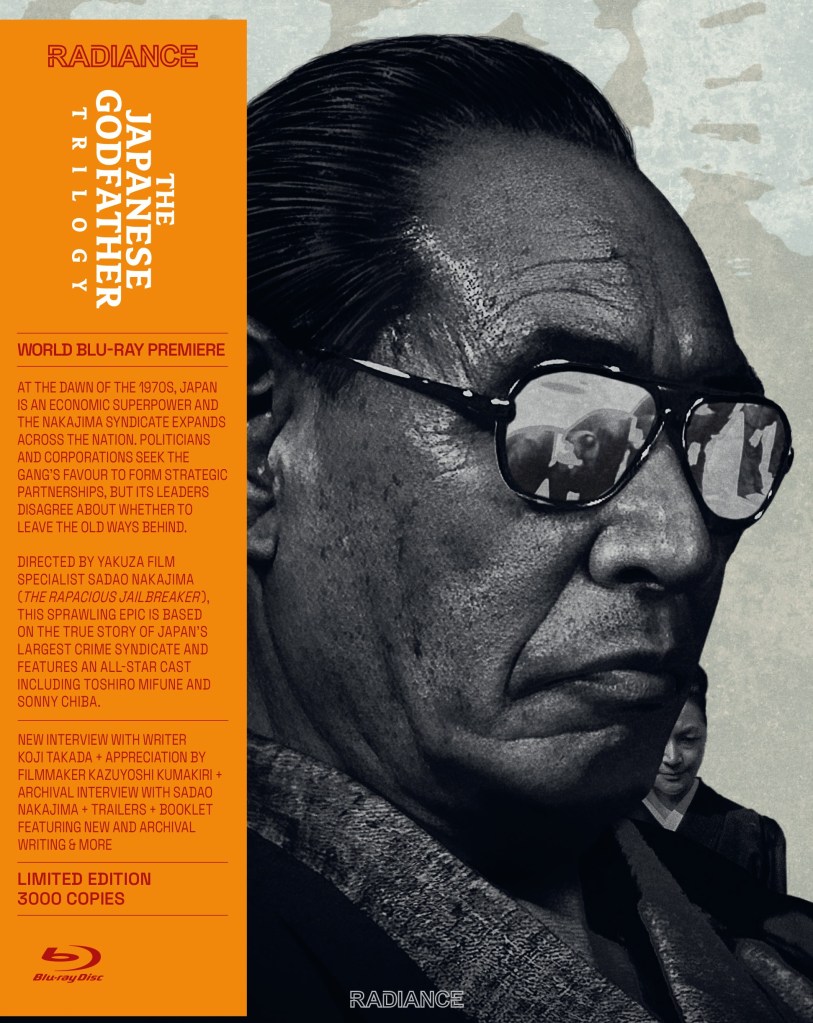
Amongst the most interesting archival releases in recent memory, Radiance’s box-set for The Japanese Godfather Trilogy presents three quite rare films for the first time on Blu-ray. With each film clocking in well over two hours, this is indeed a very EPIC collection, beginning with Sadao Nakajima’s Japan’s Don (1977).
Japan’s Don is an interesting and extremely noble work, incredibly well-directed, filmed, and especially acted. Sadly, the adapted script by Kōji Takada is far too dense, at least to my eyes, making the film more a great collection of scenes rather than a cohesive piece.
Loaded with an all-star cast featuring the likes of Koji Tsuruta, Bunta Sugawara, and Sonny Chiba, Japan’s Don has a huge ensemble all of whom play their roles with great strength. Tsuruta especially gives a wonderfully spiritually exhausted performance, and the film in general is just loaded with quality work scene to scene. I ultimately had a hard time connecting and keeping up with the film’s sweeping narrative though, which feels like a landmine of side-stories.
Nakajima was about fifteen years and forty-plus films into his directorial career when he helmed this 130-minute crime drama. Outside of failing to completely weld together all of the film’s plot-points, Nakajima delivers great work behind the camera. Even when I was a bit baffled by what was happening story-wise in the film, I still found Japan’s Don highly engrossing.
Stylistically, Japan’s Don is a very captivating, if not overly flashy, work. It’s a rich film with fantastic and detailed production design and art direction. As the start of a seven-hour-plus trilogy, this first entry needs to feel impressive and it does. This is a very ambitious film that surpasses its narrative faults.
There are some sporadic bits of violence and gunplay throughout Japan’s Don , but this is more dialogue-based and meditative than a typical yakuza action film. The HD scan Radiance utilizes looks nice, although again, this is a rather muted-looking production often shot at night or inside.
Finally, I kept wondering while watching this how the film would play if it wasn’t trying to emulate aspects of Coppola’s first 2 Corleone Crime Sagas so clearly? While The Godfather has certainly influenced countless numbers of films, few have been as wildly daring as Japan’s Don. Missteps aside, there is a lot to be said just for that.
The second and longest chapter in the The Japanese Godfather Trilogy, Japanese Godfather: Ambition (1977) again finds the much-admired Sadao Nakajima directing an epic work from a script by Kōji Takada. Japanese Godfather: Ambition is nearly the equal of the original and an interesting watch.
Amazingly, Japanese Godfather: Ambition was released in the same year as the original. Most impressive when you consider both films’ length and complexity. Incredibly, Nakajima also shot Japanese Humanity and Justice (1977) nearly simultaneously as well. It is much to his credit that Nakajima’s work behind the camera remains, imho, the main reason to see these films, all of which are exceedingly well-made.
Much of the original all-star cast returns for this second installment, with legendary Toshirō Mifune joining the fold. Japanese Godfather: Ambition does indeed feel like a true follow-up, matching the look and tone of the original while the cast again all do admirable work.
Sadly, Japanese Godfather: Ambition also continues the first chapter’s main issue, Takada’s unbelievably complicated scripting, which frustratingly sucks much of the cinematic fun from the picture. If anything, this is even harder to follow than the first film. In an attempt to combat this, Nakajima allows more voice-over narration explaining certain aspects, but it only makes things feel even more convoluted and lessens the film’s impact.
Japanese Godfather: Ambition thankfully features a fantastic closing section, ferociously executed by Nakajima. It’s pretty breathtaking stuff and does much to save the film from its script. Like Japan’s Don, this plays better as a collection of scenes rather than a cohesive or followable narrative. When you have scenes as strong as the closing of Japanese Godfather: Ambition, then that is more than enough.
Radiance’s HD scan looks and sounds as good as the first film. It becomes even more apparent here that cinematographer Toshio Masuda is attempting the impossible task of copying some of Gordon Willis’ work for Coppola. He apes the feel, lighting, and style quite well, making these good-looking if not overly exciting visual works. Extra-wise on this disc, Radiance gives us a nice interview with filmmaker and former Nakajimi student Kazuyoshi Kumakiri, which is quite enjoyable.
The new Radiance Blu-ray box-set The Japanese Godfather Trilogy concludes with the appropriately named Japanese Godfather: Conclusion (1978). Released just a year after the first two films, Japanese Godfather: Conclusion hits all of the same highs and lows as the first two entries, making this the most cohesively incohesive trilogy I’ve come across in a bit.
It really is remarkable just how much of a whole the three films in the The Japanese Godfather Trilogy make. There’s never any question that this is essentially the same team in front of and behind the camera here. If Japan’s Don ultimately feels like the ‘best’ film of the saga, it is honestly just because it was the first.
Because of this, my thoughts on Japanese Godfather: Conclusion are so closely aligned with the first two films that I’m not sure anything I have to say bears much repeating. Like the original two films, The Japanese Godfather Trilogy features excellent direction from Sadao Nakajima, a stellar cast delivering fine performances, and a dreadfully cumbersome and confusing script from Kōji Takada that bogs down three otherwise wonderfully made and performed films.
Considering my main issue with each film in this Radiance box was the overloaded scripts from Kōji Takada, it is ironic that the new interview with the screenwriter featured on The Japanese Godfather Trilogy is just about my favorite thing on this collection. Takada recalls his career and work on this very complicated series of films with great warmth and humor during this 30-minute chat. I liked this interview and Takada very much. It provides a wonderful send-off to a difficult but valuable set of films. It’s as interesting as the director’s interview found on the first disc. While none of the films are graced with a commentary, the 75 minutes worth of interviews and the incredible book that accompanies the limited edition make this a finely curated collection.
Radiance has done its usual great work on the three-disc The Japanese Godfather Trilogy, granting each film its worldwide Blu-ray debut. While I enjoyed the collection, I do not doubt that folks more familiar with Japanese history who love Yakuza Films will dig this even more than I did, without the same reservations.
-Jeremy Richey, April, 2016-
Order The Japanese Godfather Trilogy direct from Radiance or from MVD, here in the States.


Leave a Reply