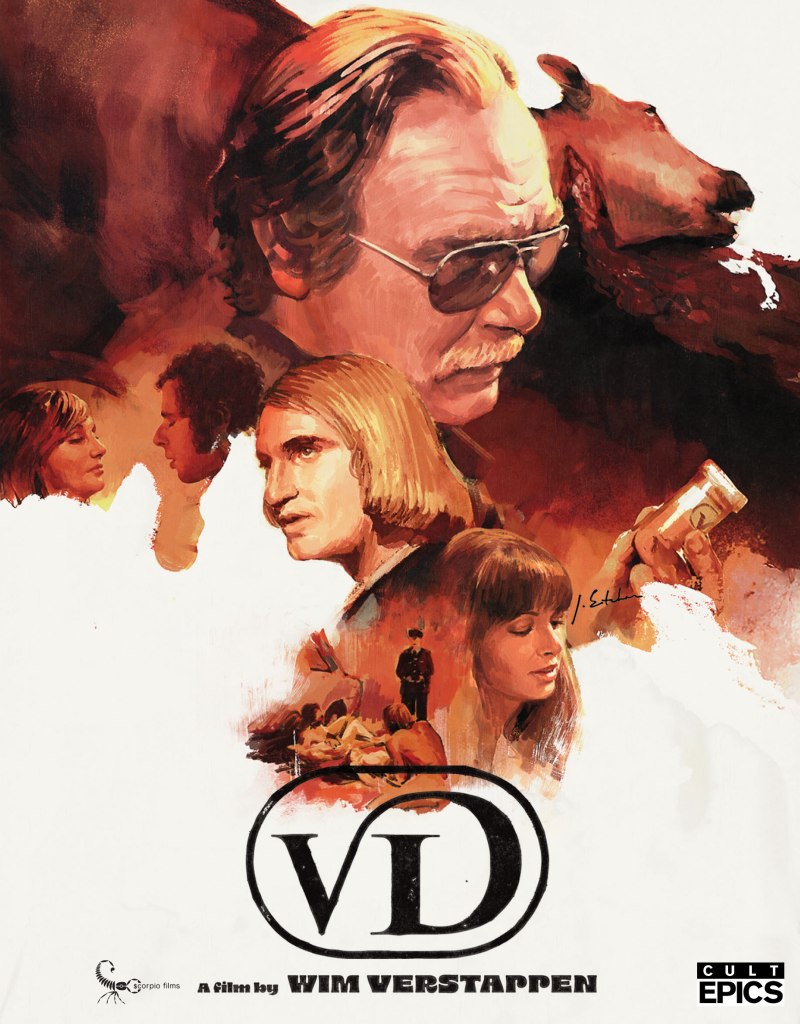
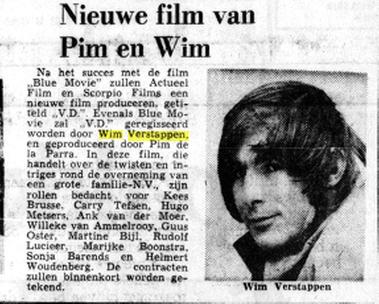
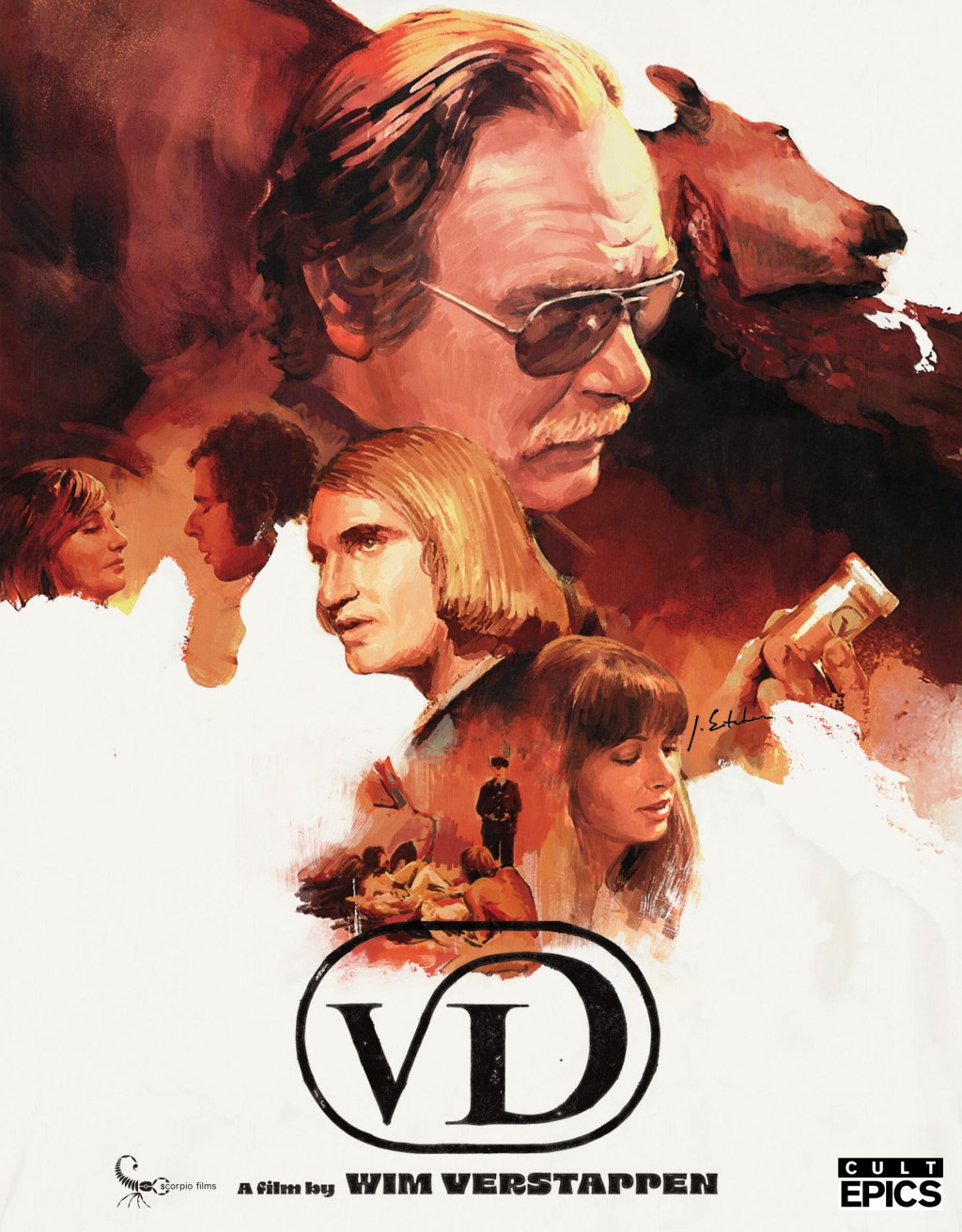
In June 1972, Scorpio Films issued a press release announcing its upcoming film. All eyes were on Scorpio’s founders, Pim de la Parra and Wim Verstappen, after the astounding success of Blue Movie, the groundbreaking 1971 Pim-produced film directed by Verstappen. This next production, centered on “disputes and intrigues surrounding the takeover of a large family public limited company,” was to be called V.D., and Verstappen again returned to the director’s chair with de la Parra producing. Recently released by Cult Epics on Blu-ray, as part of its essential Scorpio Films collection, V.D. is one of the strangest films the company released. After the taboo-busting Blue Movie, a family business drama wasn’t what anyone was expecting, much to the delight of both Pim and Wim.
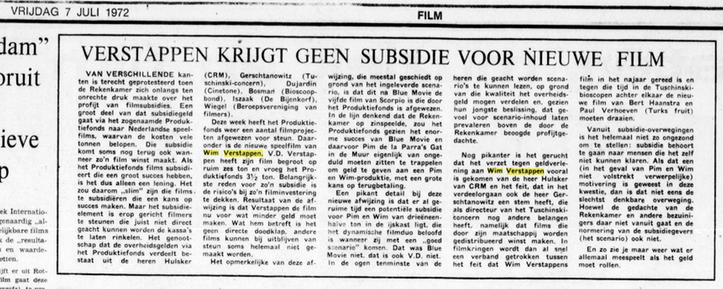
Troubles began immediately, as once again, Scorpio faced rejection upon attempting to acquire Verstappen’s projected budget by the National Dutch Production Fund. De Tijd noted:
“The result of the rejection is that Verstappen now has to make the film for a little less money. As far as he is concerned, it is not a direct blow; other films can sometimes not be made at all if there is no support. The remarkable thing about this rejection, which usually takes place on the basis of the submitted screenplay, is that this is Scorpio’s fifth film after Blue Movie to be rejected. Thinking in line that the Court of Auditors alluded to this, given the enormous success of Blue Movie and before that Pim de la Parra’s Hole in the Wall, the Production Fund should actually be eagerly eager to give money to a Pim and Wim-production, with a high chance of reimbursement.”
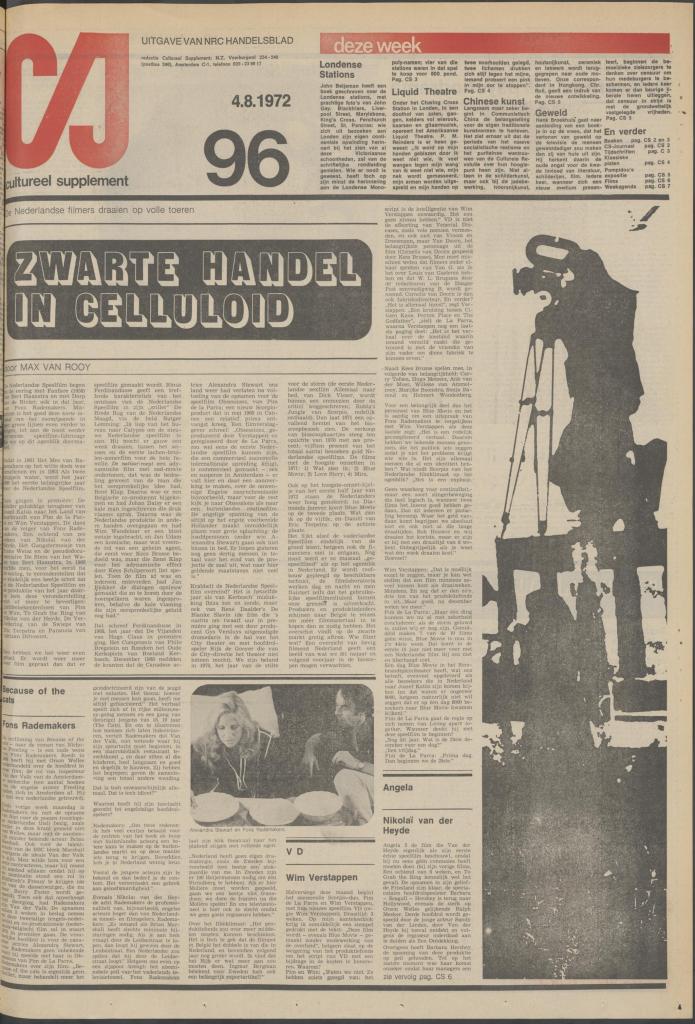
While a dwindling budget was cause for concern, Pim and Wim had long accepted their outsider status. For Verstappen it seems to have increased his desire to make a great masterpiece, with his soon doomed Dakota already flooding his creative mind. By the time August rolled around, NRC Handelsblad featured a full-page story on modern Dutch cinema, including a look at V.D. and Scorpio featuring Verstappen talking about the film’s influences:
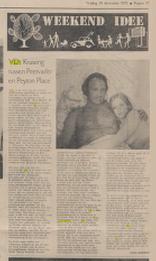
“It’s all incest. A cross between Citizen Kane, Peyton Place and The Godfather…it’s a fairly complicated story. That’s why we cast famous people so you don’t have the problem of knowing who is who. They’re all people who already have an identity.”
With a fairly distinguished ensemble cast assembled, including Kees Brusse and Hugo Metsers, V.D. (short for Van Doorn) is a fairly prestigious production. Featuring rich interior cinematography by Frans Bromet and a lush score by Truffaut collaborator Antoine Duhamel, V.D. is a shockingly stately affair after something as gloriously free as Blue Movie. For the most part, Verstappen succeeds in creating a complex and uneasy dramatic family picture.
A key influence on V.D. was indeed the American film and series Peyton Place, with bits of recently released The Godfather thrown in for good measure. Shot in less than 20 days, by the time V.D. was ready to premiere, it was obvious the film wasn’t going to have the financial impact and Pim’s promise that “it wasn’t a sex film” certainly was true. In fact, for a film partially about contraception, V.D. is a fairly chaste film, save some nudity.
Pim de la Parra, in the midst of preparing his next film Living Apart Together, assured the Dutch press that V.D. was going to be Verstappen’s greatest film. He was mistaken, but V.D. is a good film if perhaps the most subdued in the Scorpio library. More than anything, this is kind of a menacing little film.
Filming took place in Holland, with Duhamel’s score being recorded in France. Because of the French composer’s strong connection to the French New Wave, the press paid particular attention. Interviewed by De Tijd in October of 1972 in the lead up to V.D., Duhamel recalled how much the French musicians loved the score, noting he was looking for a “compromise between easy, smooth film music and the much more experimental, sometimes atonal classical work.”
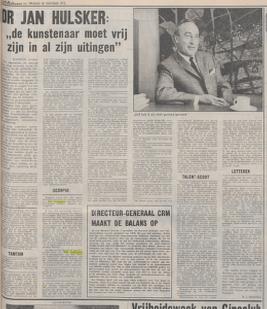
With shooting progressing, the head of the Production Fund board Jan Hulsker went directly after Verstappen, de la Parra and Scorpio in the pages of De Volkskrant. Taking delight in trashing the screenplays for V.D. and Blue Movie as well:
“I don’t have to hide anything. The screenplay submitted by Scorpio, V.D., in my opinion shows a lack of quality. Even if I take into account that a film can turn out very differently than previously indicated in the paper scenario, I deny the possibility of quality in the cinematic development of the story submitted by Scorpio. There is no reason for me to subsidize it. As at the time in the case of Blue Movie, for which a subsidy was refused for the same reasons. If Scorpio wants to make such a film, rather than any other, then I was left behind, but I didn’t think it was the case of the Production Fund to stimulate this activity with funds from the fund. There is of course some dispute about the concept of quality. I cannot deny that a judgment about quality is always subjective.”
Once the shoot wrapped, Verstappen fired back also to De Volkskrant stating:
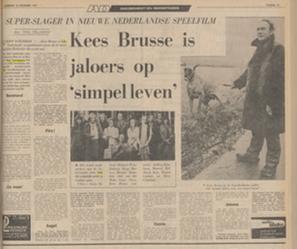
“V.D. is a very cocky film, and what it’s going to do commercially is very much in demand, but it’s certainly one of our better (if not our best) films. Kees Brusse, undoubtedly the Netherlands’ most sympathetic actor, brilliantly plays the most disgusting Dutchman ever seen on the film. Because the film almost literally follows the screenplay submitted to the Production Fund, it might be nice to also invite the Fund to the premiere or press presentation so that there is still a discussion about the quality or lack of quality. We have also proposed this to the Fund. But do they want to do something like that?” In any case, it is a nice idea that, as far as we are concerned, should be realized. A unique opportunity to be open to the six members of the Production Fund with their far-reaching decision-making power.
Despite Verstappen’s confidence, dark clouds were looming. An early report from Het Parool in December of ’72 predicted the film would have little success in part due to how “critical it is of people’s behavior.” Even more ominous were exciting reports about a film called Turk’s Fruit by a young director named Paul Verhoeven. By the end of 1973, Turk’s Fruit was the biggest box-office success in Dutch history, and V.D. was all but forgotten.
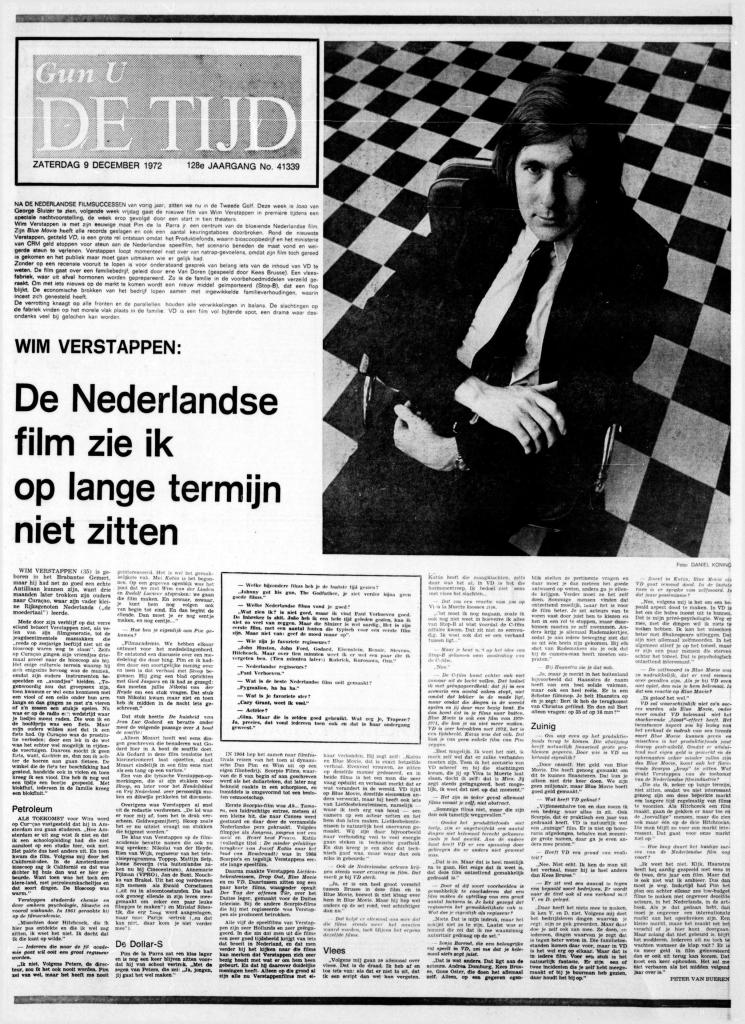
In the days leading up to V.D.’s release, Verstappen had no way of predicting the future, and he continued hyping the film to the press. Interviewed by Dj Tijd just before Christmas, Verstappen bragged that Scorpio had been able to finance the film themselves with no issue, thanks to Blue Movie. This bravado surrounding the company’s financing would soon come crashing down with Dakota. In a moment where Verstappen’s confidence slipped, he admitted:
“V.D. probably won’t be a success as a Blue Movie, partly because V.D. doesn’t have the shocking bare all effect. Because we only worked with my own money, the revenues will certainly be less than Blue Movie.
The flourishing Scorpio will also be tight.”
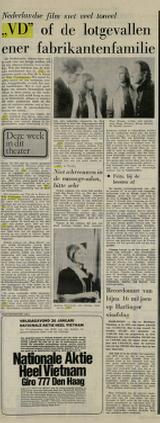
V.D. hit Dutch theaters in the winter of 1972. Critical reaction was mixed but mostly leaning positive. One of the earliest reviews in NRC Handelsblad called the film “a satirical moral game” that is “much tighter in structure and much more smoothly filmed than its predecessors.” De Volksrant also praised the filmwriting, “Verstappens satirical-comic painting is suitable for the quality of his conviction.” Finally De Telegraph called it a “perverted Dutch kind of opera”, one of the most fitting descriptions of the film.
Despite some critical praise, V.D. failed to connect to a large moviegoing audience, and by early 1973, it was mostly gone, as Turk’s Fruit continued blazing. In hindsight, it isn’t hard to see why the film failed to catch any sort of fire. With its confusing title and classical stately tone, V.D. might be one of Scorpio’s more ‘respectable’ films, but it doesn’t have the electric current flowing through it that the company’s great films possess.
Cult Epics does its usual splendid work with this Blu-ray edition of V.D. Amsterdam’s Eye restorations are perfect and this thing looks beautiful. Delerure’s score sounds lovely. This package is a bit lighter in supplements compared to past Cult Epics’ Scorpio releases, with an informative commentary by Dutch scholar Peter Verstraten being the main film-specific supplement. Also on hand is an early Scorpio short, Festival of Love (1969). This is a thirty-minute black-and-white couples study featuring many familiar faces from the Scorpio team, including Nouchka van Brakel.
V.D. can be ordered (with an exclusive poster) directly from Cult Epics. Standard editions are available from MVD.
-Jeremy Richey, June 2026-
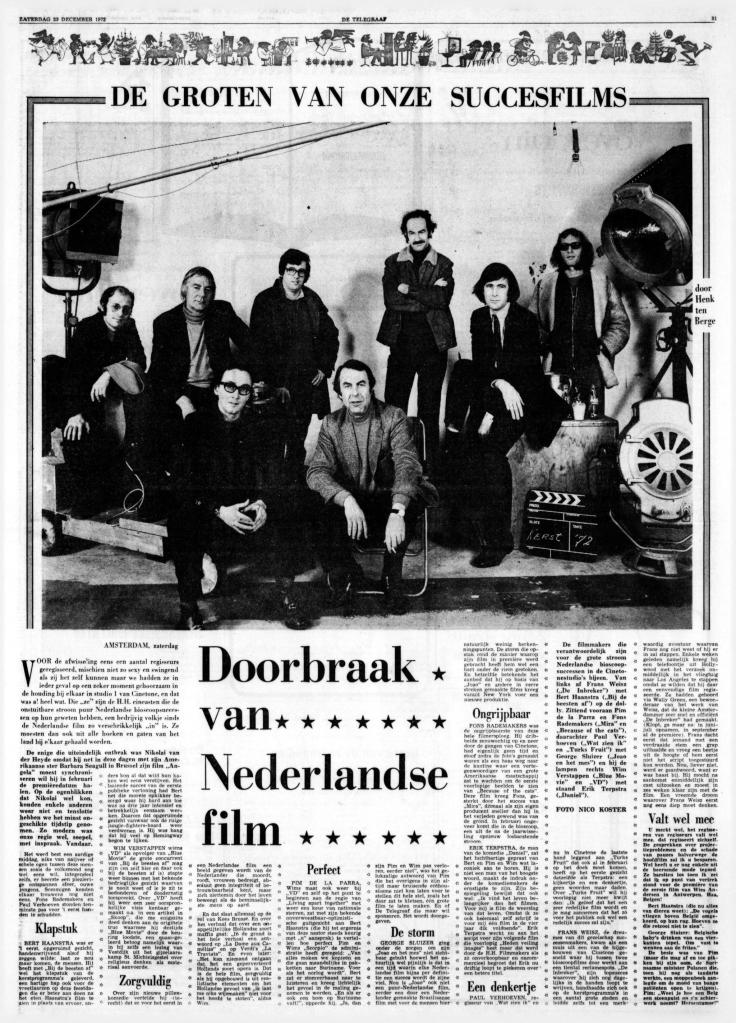
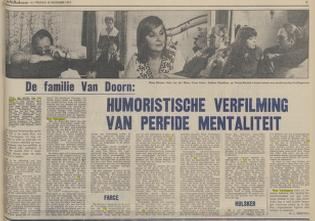
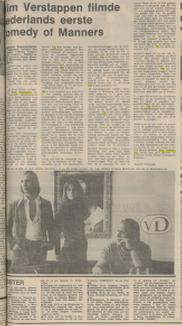
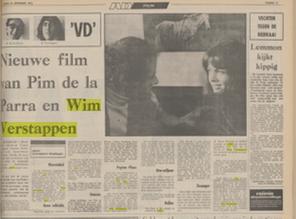
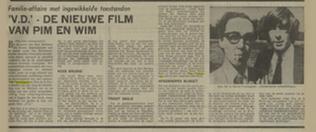
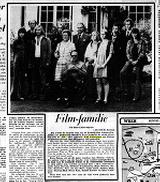
Enjoy this selection of vintage Dutch clippings I found related to V.D.:


Leave a Reply