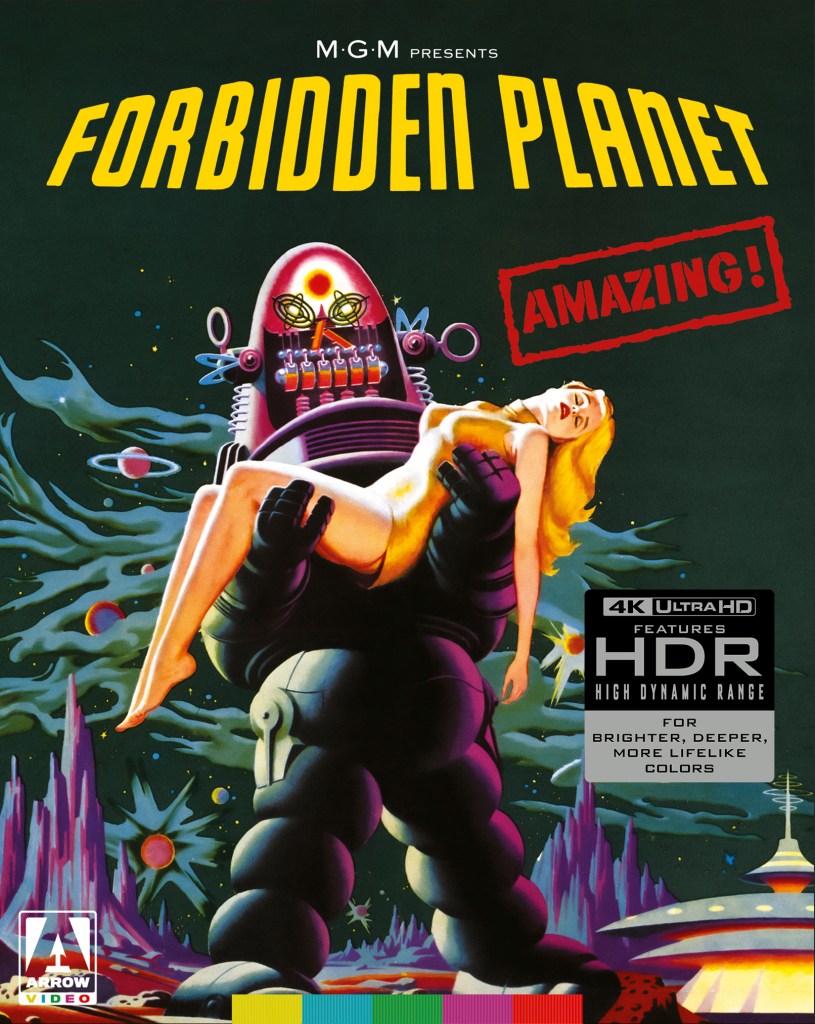
One of cinema’s most influential films has been restored from its original negative for lovely new limited 4K and Blu-ray editions by Arrow. Director Fred M. Wilcox might not have the most recognizable name in 2026, but his Forbidden Planet (1956) certainly inspired countless big names ranging from George Lucas to Ridley Scott to John Carpenter to Steven Spielberg. Forbidden Planet is literally ground zero for modern Hollywood science-fiction and Arrow’s release is a delightful two-disc version, loaded with extras.
The 4K collection can be ordered from Arrow or stateside from MVD.
Fred M. Wilcox is an unlikely influential figure in the film and science-fiction community. Hardly a prolific filmmaker, Wilcox was mainly known as the director of a couple of Lassie films and 2nd-tier noirs when he stepped behind the camera for Forbidden Planet, one of the first big-budget color space operas Hollywood attempted. Forbidden Planet remains not only the film Wilcox is remembered for, but it is a complete one-off in his filmography.
Forbidden Planet also remains a one-and-done sci-fi screenplay for writer Cyril Hume, save for the Robby, the Robot-connected The Invisible Boy, a film made in the wake of Forbidden Planet, included as a bonus on this limited Arrow edition. Hume spent much of his career writing Tarzan screenplays, making him an equally unlikely sci-fi trailblazer based on Shakespeare’s The Tempest as Wilcox. Artist and effects artist Irving Block also contributes to the film’s story, concerning a rescue mission to an unknown planet, as does blacklisted fantasy author Allen Adler.
Much like many of the behind-the-scenes players, the on-screen ensemble was hardly known for space-hopping adventures. Future comic legend Leslie Nielsen appears, as does Hollywood veteran Walter Pidgeon. Starlet Anne Francis eventually ended up with a few more star-based adventures after Forbidden Planet, but in 1956 the future fantasy figure was known for comedies like Susan Slept Here (1954) and teenage crime films like Blackboard Jungle (1955).
Viewed seven decades later, Forbidden Planet feels a bit like the Elvis Presley of American science-fiction films. The film was, in fact, released the same year Presley exploded via his first RCA recordings. Elvis influenced everyone, and even those he didn’t influence were sparked by someone he did. Forbidden Planet’s influence has had the same snowballing effect, making it a positively inescapable icon much like Elvis.
Silly and sexist, Forbidden Planet very much belongs to one of America’s squarest decades, making its obvious influence on some of the most subversive and transgressive films all the more surprising. Viewers will find connections to every major big-budget studio-based picture after Forbidden Planet, ranging from horrific, intense works like Alien (1979) and The Thing (1982) to more childlike films from the likes of Spielberg and Stranger Things. Even viewers with only a passing knowledge of modern American science fiction films will easily spot the wildly vast influence Forbidden Planet continues to have.
If many of its attitudes come directly from the fifties, Forbidden Planet’s score and its effects move far beyond it. Taking nearly a year to create, the early electronic score created by Bebe and Louis Barron might be the most shockingly progressive thing about the film. It is absolutely wild that a major studio not only commissioned the Barrons but ended up using their trailblazing work. I’m surprised the Mad Men suit-and-tie producers didn’t chuck the whole experimental track and just hire Les Baxter.
The still-impressive visual effects, credited to Joshua Meador and Bob Abrams, remain shockingly great. This is especially true when one realizes just how cheap the American cinematic science-fiction world looked before Forbidden Planet. Meador and Abrams hardly had any cinematic language to copy, making their work here all the more amazing.
Forbidden Planet’s greatest asset is its influence. Take that away, and we’re left with a decent effects-driven film hampered by the period’s painfully backwards attitudes. Thankfully, the film’s overwhelming influence on everything that came after makes its faults fall very much to the side. Forbidden Planet is an incredibly memorable and fine film, gorgeous in its look and execution.
Disc one of Arrow’s 4K collections houses the new restoration, which is accompanied by a fun, informative, and adoring commentary track by Kim Newman and Barry Forshaw. The bonus Blu-ray houses all of the many extras. These include two older, lengthy documentaries on the film and fifties science fiction in general. We’re also treated to a previously seen workprint-based deleted reel and some additional ‘lost’ material. Music historian Neil Brand provides a new video essay about the film’s score, and a booklet featuring additional new essays by critics Frank Collins and Johnny Mains is also included. Arrow rounds out the package with some further archival featurettes and promotional material. For Robby, the robot fans, the Blu-ray also comes armed with that second feature I mentioned earlier as well as an episode of The Thin Man he was featured on. All in all, Arrow’s edition of Forbidden Planet is super swell and recommended.
-Jeremy Richey, September 2026-


Leave a comment