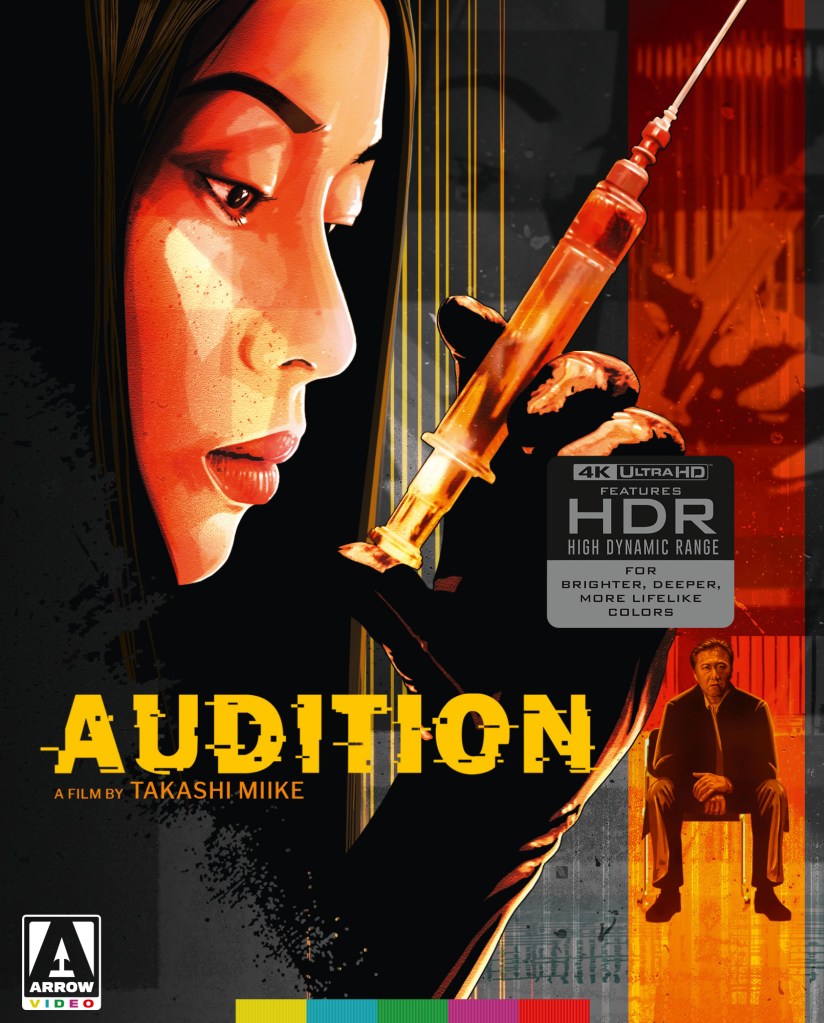
Arrow recently upgraded its decade-old Blu-ray edition of Audition (1999), the legendary film from director Takashi Miike, as a limited-edition 4K set. Featuring the original’s bonus features, along with some new additions, this version also boasts a new 4K restoration from the original Super 16mm camera negative. One of the greatest and most important films of the nineties, Audition’s arrival on 4K is cause for major celebration.
This limited collection can be ordered directly from Arrow or here in the States from MVD.
Perhaps this is an odd way to start a film review but, in the case of Audition, I freely admit I have no idea how to review this.
No
clue.
I find that to be the case for most pieces written about Audition. There’s a reason why everyone seems to have different thoughts behind the meaning of this haunting and completely unforgettable film. Honestly, Japanese film historian Tony Rayns comes the closest during his talk here on this Arrow disc. With Audition, Miike has created a film so deliberately ambiguous that any meaning one brings to the film will most likely be wrong, or especially right.
Audition is the Loveless of modern cinema. Like My Bloody Valentine’s intensely dense musical masterpiece, Audition can be either a delirious experience or a calm one. Audition is both agitating and somber. The deeper one gets into the film, the more dreamily disorienting it becomes.
Is
it
all
a
dream?
Maybe, could be.
Probably
and
probably not.
Audition, as scripted by Daisuke Tengan, weaves in and out of time, daring its audience to essentially make up our own minds about what is happening, what is real, who is good and who is bad.
Are any of us really ‘bad’ or ‘good’?
Perhaps that’s key to the entire film.
I first saw Audition shortly after it hit home video here in the States in the early 2000s. I’ve seen it on a few different formats at this point and it never fails to prove an immeasurably shocking experience. While I have sadly never seen this masterful film on the big screen, it was one of the key works I studied during one of the Japanese Film History classes I took in college.
Studying Audition at school really drove its ambiguity home. Miike’s film proved to be one of the most confounding films that semester. Classmates were divided on whether the film was feminist or misogynistic, and arguments ensued about the film’s POV in general. Whose story is being told in Audition? I’m still not completely sure, and I think that is part of the point. It is certainly one thing that makes the film one of the greats.
I actually don’t find Audition either feminist or misogynistic. Instead, I think this is essentially a portrait of very damaged people living very lonely lives, and that loneliness is directly connected to past trauma. For the widowed father seeking companionship, loneliness leads him to treat a potential dating pool like a casting call. For Asamai, the chosen young woman, her past trauma leads to unspeakable violence.
Audition
reflects
cycles
of
abuse.
Audition is a horror film, and its horrors will hit especially hard for anyone who has experienced a lot of trauma in their life.
Audition is a great classic of PTSD cinema.
At nearly two hours, Audition is mostly famous for its second half, which features some of the most chilling imagery ever caught on film. It is the film’s opening half hour that I continue to find most intriguing though. Audition becomes more and more cinematic and stylish as it proceeds. By contrast, its almost pedestrian opening gives no clue as to just how deeply deranged the film will become. Miike’s resistance to overly stylizing the entire picture is notable. The more basic shooting style he employs at the beginning highlights the cold sterility of the ‘audition’ process, making this perhaps the cruelest section of a film known for its later outlandish torture scenes.
On a purely cinematic level, Audition is gold. The chilling cinematography by Hideo Yamamoto becomes integral to the film’s horror as it progresses. Yasushi Shimamura’s editing is equally important, as it keeps the films more dreamlike moments disorienting without being out-and-out confusing.
And
Miike?
Well Takashi Miike was nearing his goddamn peak in 1999. In fact, Audition seems to be the film that transforms Miike from a prolific cult director into a masterclass filmmaker. In its wake came powerhouse works like Visitor Q, Ichi The Killer and the magnificent Agitator. Dude was on absolute fire in this period, and Audition remains one of the great masterpieces of the nineties.
Arrow’s limited-edition 4K includes a nice slipcover, reversible sleeve and a great booklet featuring new writing on the film by Anton Bitel, Jennie Kermode and Jamie Graham. As far as extras go, we get all of the archival cast and crew interviews as well as Miike’s original commentary. A new cast interview and additional video essays join a fairly packed collection. The big selling point is the new transfer. Save for its original theatrical screenings, there has never been a better way to watch Audition than on this Arrow 4K.
Audition is one of the great films. Every film lover should have a copy in their collection, and this Arrow 4K is an ideal way to go.
“kiri
kiri
kiri”
-Jeremy Richey, August 2026-


Leave a Reply