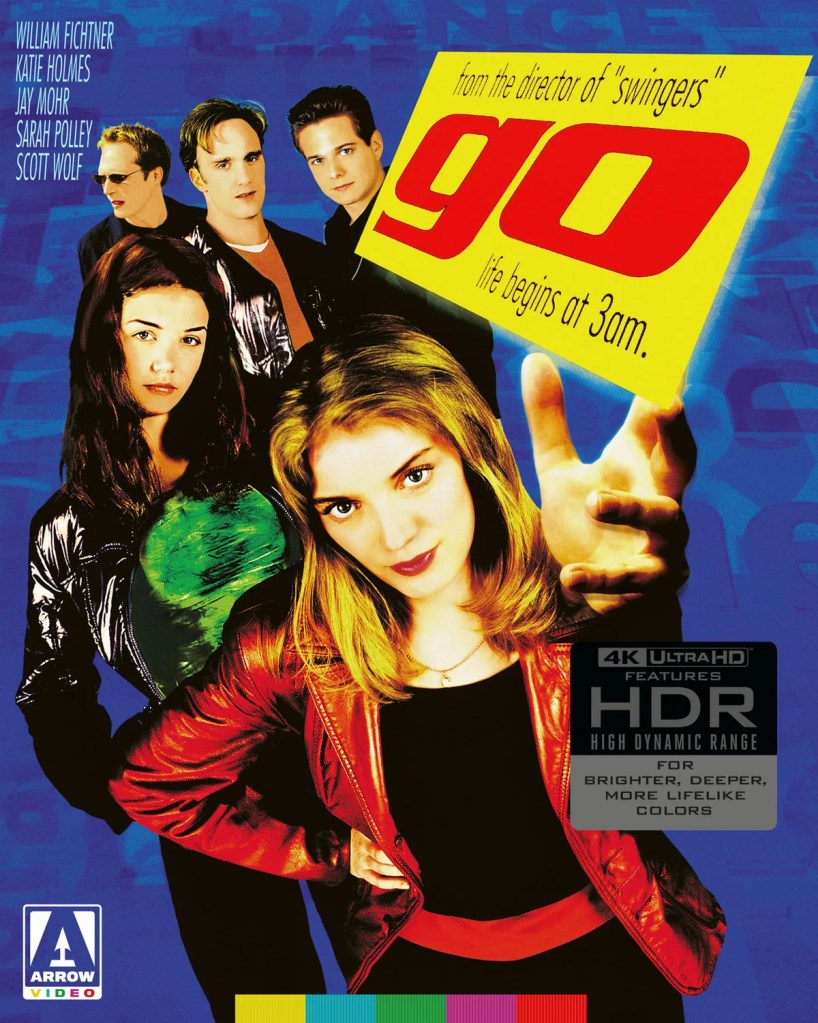
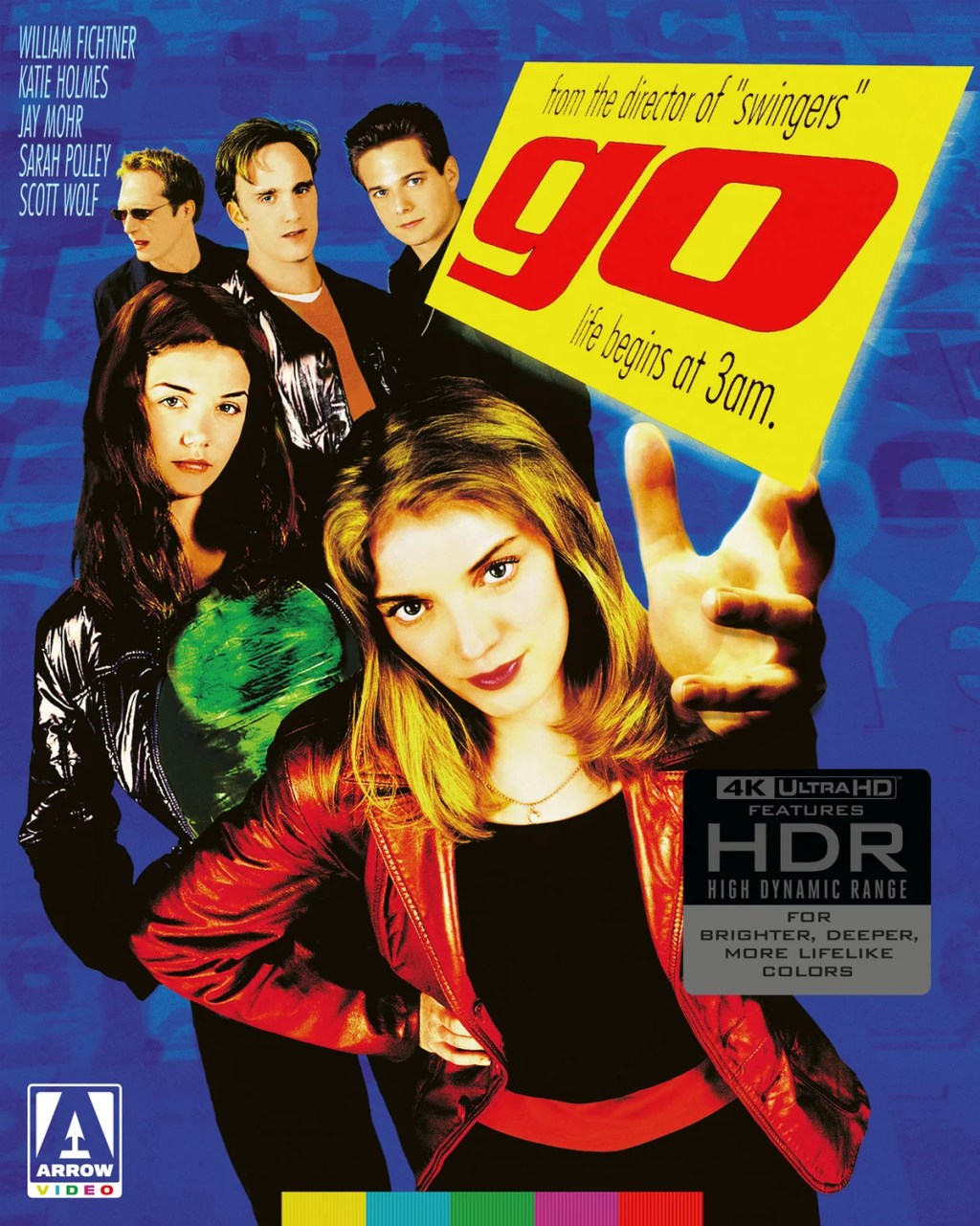
Arrow is releasing Doug Liman’s 1999 cult film Go as a limited 4K special edition. Featuring all of the original DVD bonus features, along with some new supplements, Go is available to order directly from Arrow or here in the States from MVD. This is one of my favorite films of all-time, so to say that I am getting ready to give a hefty recommendation is an understatement.
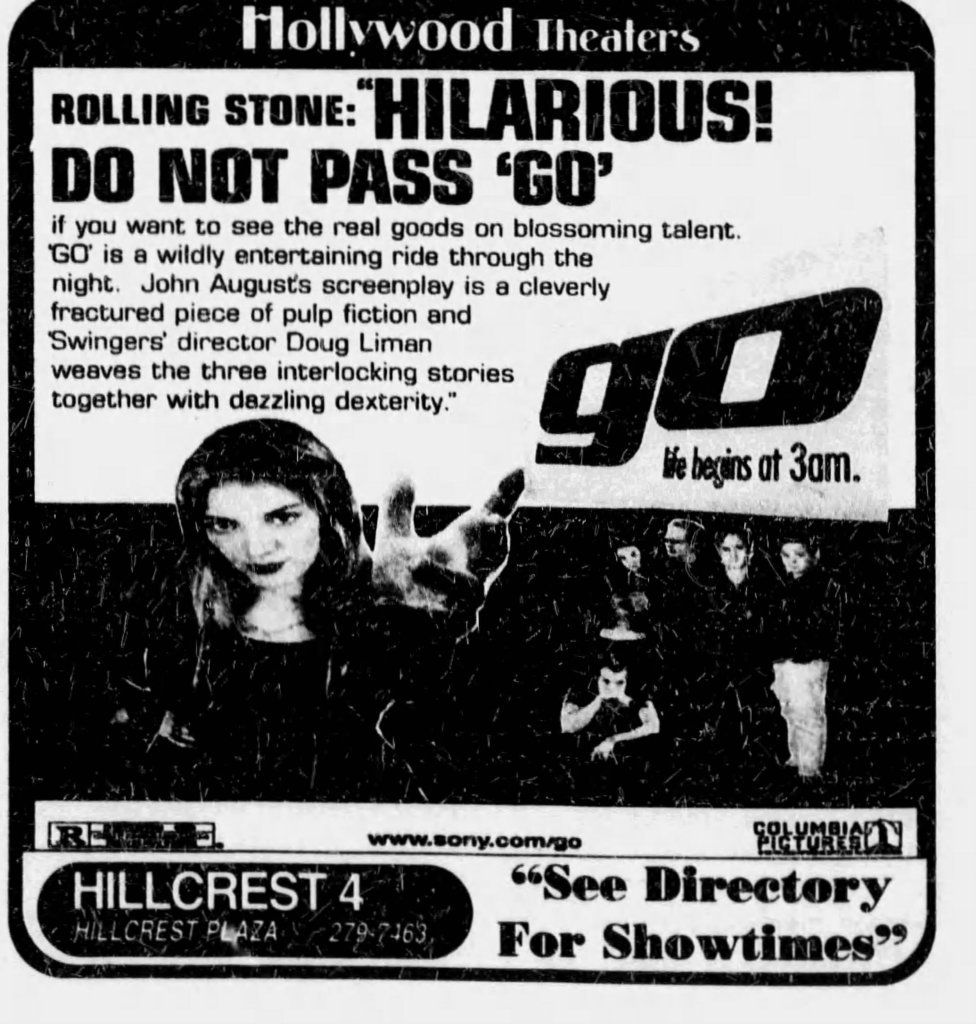
To mark its arrival on 4K, allow me to announce to anyone reading that I think Go is a better film than Pulp Fiction. I’ve thought that since the unforgettable evening I saw Go opening weekend, with my movie buddy Dave, in Lexington, KY. I only mention Pulp Fiction because Go belongs to the legions of films released in the wake of Miramax’s mammoth, killed by the endless comparisons.
First-time screenwriter John August wrote the bulk of his pitch-perfect screenplay for Go while at college in the early nineties, well before Pulp Fiction’s release. While Go has always been unfairly viewed as being directly influenced by Pulp Fiction, the Harvey Weinstein-backed blockbuster did at least allow Go to get Greenlit, saving August’s astonishing screenplay from pre-production hell.
I actually wrote about Go nearly twenty years ago for the first time over at Moon in the Gutter, where I noted:
“In a decade marked by change and reinvention, Go was one of the ideal final films of the nineties and, for many of us who hold the promises of that decade close to heart, it remains an extremely noteworthy work and statement.”
And yeah, that still holds true all these years later. Go is, in fact, one of the ultimate nineties films.
Wanna know what it was like to be in your early to mid twenties during the mid-to-late nineties?
Watch Go.
Wanna taste of what The United States used to be like before we merged into whatever this is now?
Watch Go.
Doug Liman’s breakout hit Swingers also stands as one of the ultimate nineties films, but in a much different way. Swingers actually does owe something to Avary and Tarantino, as it is a more hyper-real production yearning for and sometimes achieving a level of sleek coolness over any sort of actual realism.
Go is a cool film, but it’s not obsessed with making its characters cool. It is, and they are all scrappy AF.
Go is grungy and it feels authentic and honest, about both its characters and its setting.
A Christmas film about an insane 24-hour period featuring several loosely connected characters, Go has much more in common with the incredibly vibrant American indie scene of the late eighties/early nineties than the post-Reservoir Dogs ‘Ain’t it Cool’ crowd. It is hard to accurately describe just how hard the Miramax brand of the mid-nineties crushed out the memory of so many films from the decade before. Go ask Hal Hartley.
Much more than Pulp Fiction, Go reminds me a bit of Heathers, the hilarious American masterpiece from a decade earlier that, like Go, simultaneously seems to be the work of its screenwriter, director, cast, and decade. August’s original screenplay is a wondrous work, as was Daniel Walters’ Heathers script, but the film belongs as much to Doug Liman, just as much as it belongs to its marvelous ensemble cast. And Go belongs to the nineties as much as Heathers does the eighties.
As much as I admire and love August and Liman’s work behind the scenes of Go, it is so much of the cast that I still remain the most in love with all these years later.
First and foremost, Sarah Polley.
Sarah,
Polley.
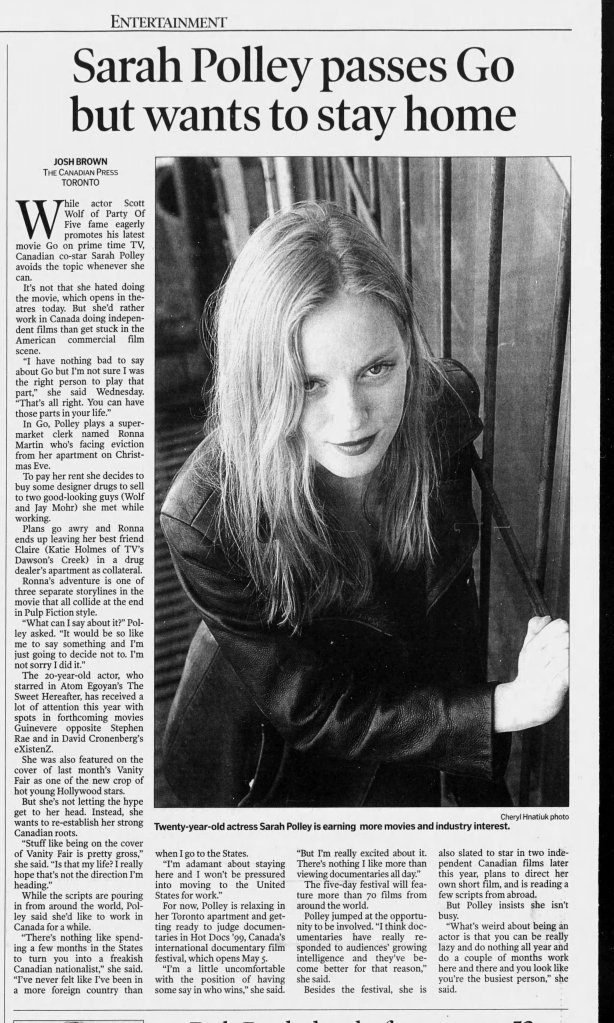
Watching the career of the wonderful Sarah Polley develop throughout the nineties and beyond has been such a tremendous pleasure. Her performance as Ronna in Go ranks among my favorites. Coming into her own as an adult actor in the late nineties, Polley is perfect in Go. She’s not in the film more than any of her castmates, but Go belongs to Sarah Polley as much as anyone else. I wasn’t at all surprised when she morphed succesfully into directing and writing.
And Polley’s castmates?
Holy hell.
Everyone is so great here.
Katie Holmes, Timothy Olyphant, Desmond Askew, Jay Mohr, Scott Wolf, Taye Diggs, Breckin Meyer.
So many great faces from the world of nineties film and television.
The future stars are obvious.
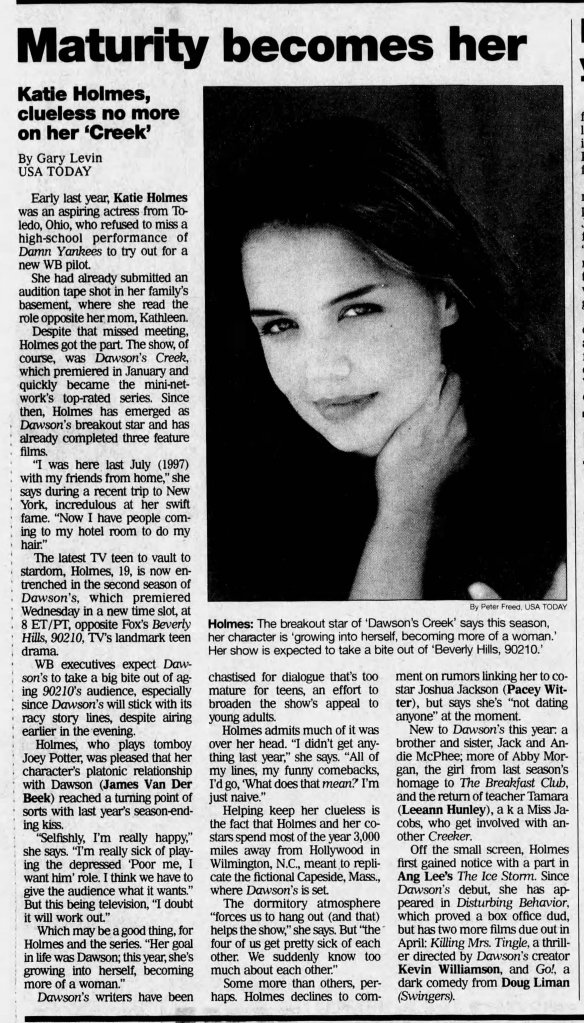
Katie Holmes damn near steals the film with her hilarious, nonchalant performance. It is one of her earliest film roles, and her performance here directly led to the Oscar-worthy turn she gave a couple of years later in Pieces of April.
Everyone is so great here. Not everyone became stars or maintained relevance, but everyone is gold, all delivering frequently hilarious and completely believable performances.
And, man, is Go ever funny?
I’ve seen Go probably close to ten times, and it still makes me laugh. Not at all dated, Go feels as fresh as it did three decades ago.
Who’d a thunk it?
While Go doesn’t have the same amount of endlessly quotable dialogue as Pulp Fiction, it has something none of Tarantino’s films have.
It has sex.
Go is horny and relishes in that horniness.
The title Go actually carries several connotations throughout, with the most memorable being highly, highly sexual.
And Go really goes;
this film thrusts.
The nineties were a horny decade
and Go reflects that horniess. Even though all its characters don’t get laid, you get the feeling they all’d rather be doing that than shuffling for drugs, loose cash or an all-night rave.
Go keeps it real.
It kept it real in 1999 and it continues to keep it real all these decades later.
Something I have always personally related to in Go is that nobody has their shit together. This might be the most Gen-X thing about it.
Tarantino’s early bravado about making films about losers doesn’t hold up. Save for his great masterpiece Jackie Brown, Tarantino’s characters have always been too cool to be actual losers.
Everyone wanted to be a character in a Tarantino film.
Go represents more of who we actually were. Even the film’s more outlandish moments are oddly relatable.
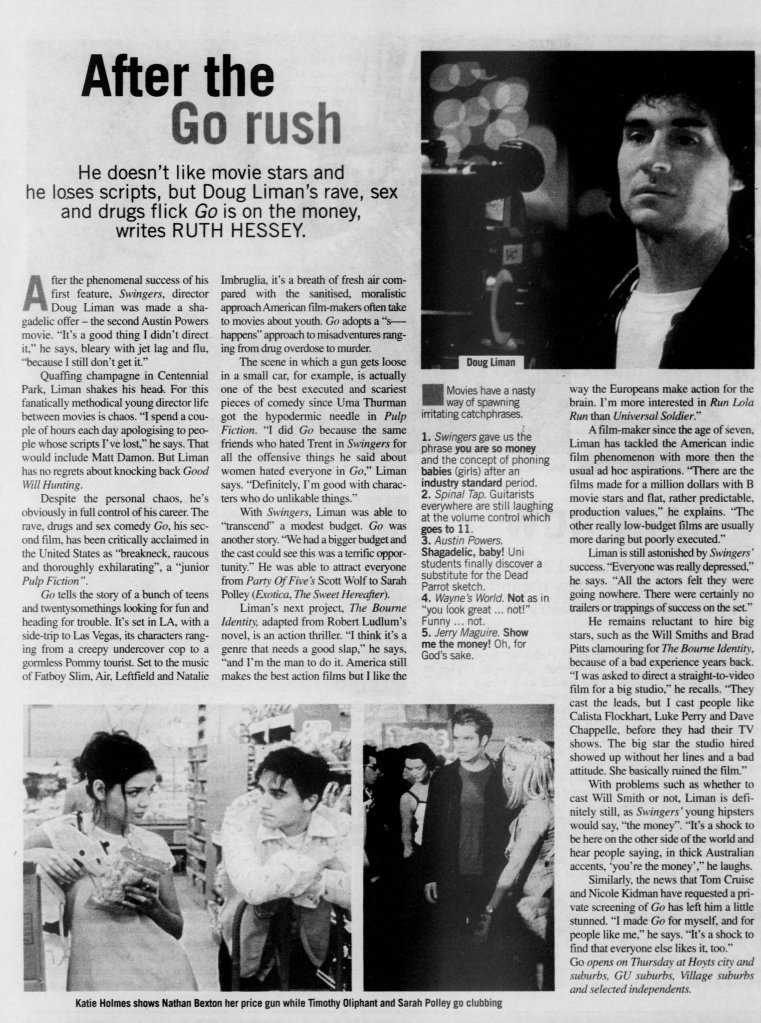
On a technical level, Liman handles this relatively low-budget film like a master in the making. It is easy to see why he landed The Bourne Identity right after this. Doug Liman’s early career, from his underrated debut Breaking In through that absolutely incredible Bourne film, was nearly as exciting to watch as Polley’s career in this period. I haven’t been much interested in Liman’s post-Bourne career, but as the guy who directed Go, Doug Liman is more than just fine by me.
Funny, I haven’t much responded to much of August’s writing since Go either, outside of his Charlie’s Angels, which I have very warm feelings for. Regardless, Go will always be one of my favorite scripts from the nineties, and it still has a remarkable level of freshness and originality. I find it completely irresistible. If Go had never been produced, I think the screenplay would be recalled as one of the great unmade American films.
Thankfully, Go the film very much exists.
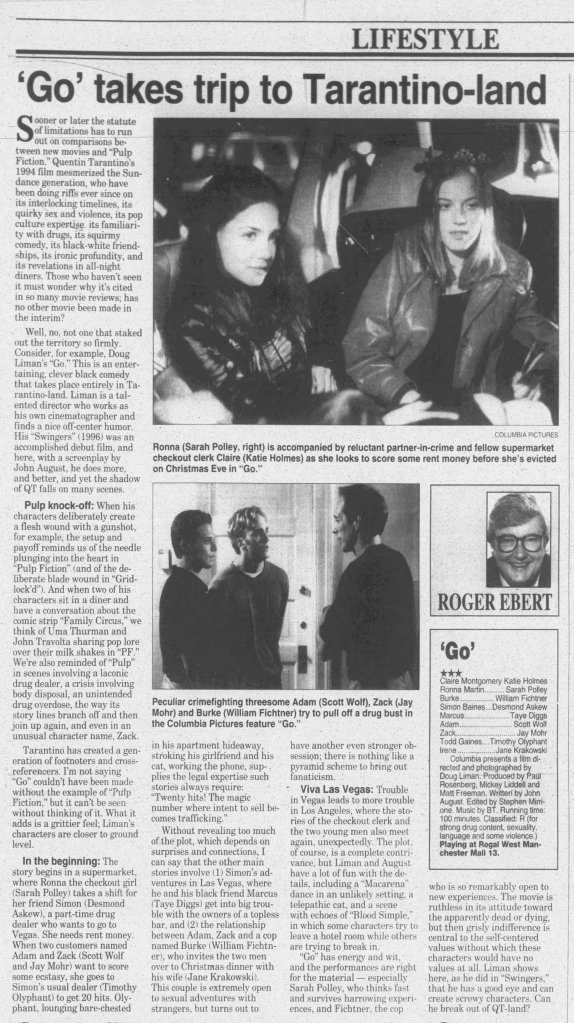
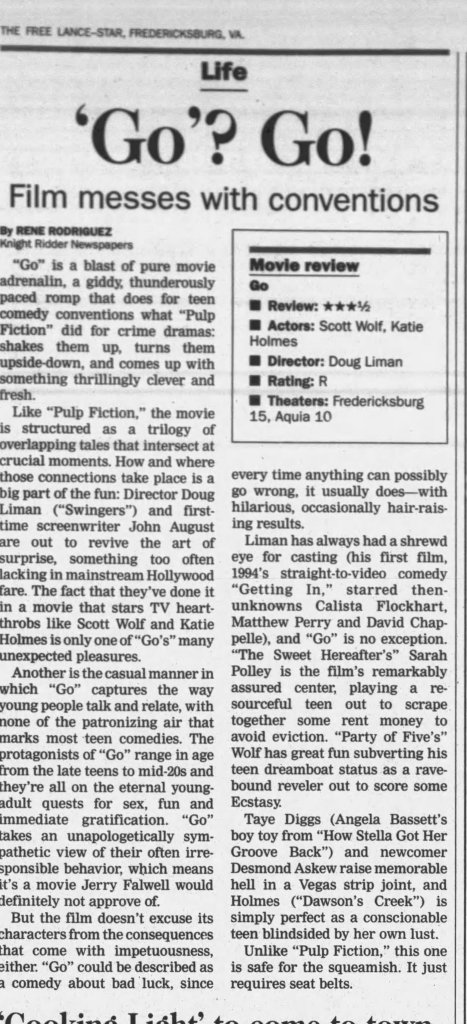
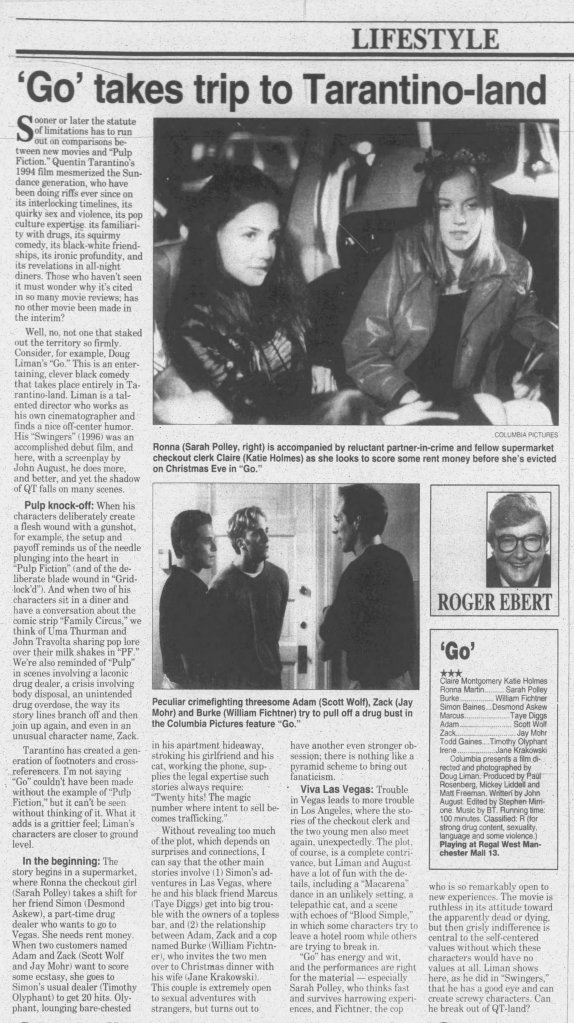
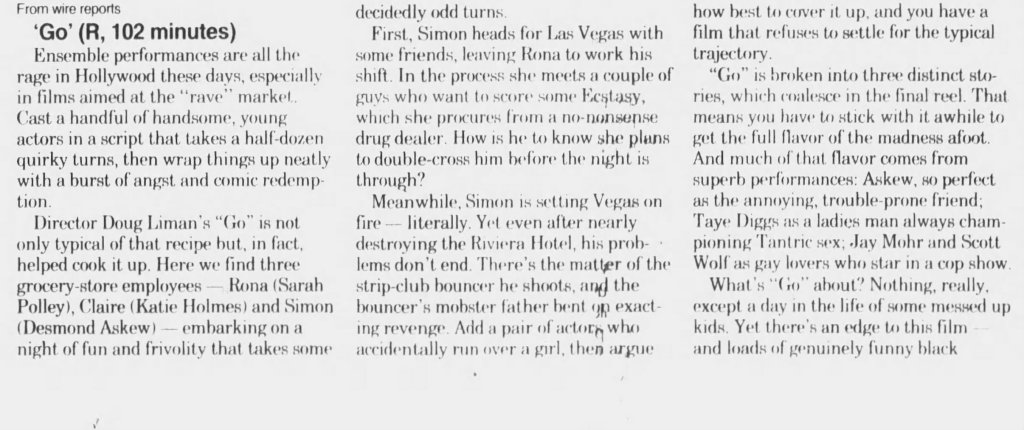
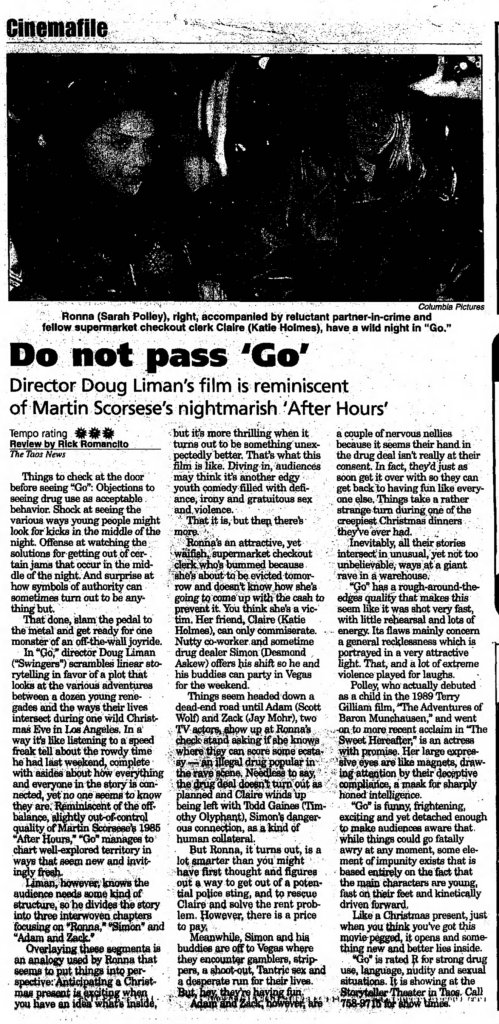
Go did fairly well upon release considering its budget, and the critical reception was mostly warm. Warm but goddamn annoying. Critics like Roger Ebert refused to let anything remotely non-linear escape constant negative comparison to Pulp Fiction. Ebert’s endless championing of a film that didn’t require it became harmful to my eyes, at least, and I say that with all respect for the man. His 3-star review of Go particularly erks me to this day:
“Sooner or later the statute of limitations has to run out on comparisons between new movies and “Pulp Fiction.” Quentin Tarantino’s 1994 film mesmerized the Sundance generation, who have been doing riffs ever since on its interlocking timelines, its quirky sex and violence, its pop culture expertise, its familiarity with drugs, its squirmy comedy, its black-white friendships, its ironic profundity, and its revelations in all-night diners. Those who haven’t seen it must wonder why it’s cited in so many movie reviews; has no other movie been made in the interim? Well, no, not one that staked out the territory so firmly. Consider, for example, Doug Limon’s “Go.” This is an entertaining, clever black comedy that takes place entirely in Tarantino-land. Limon is a talented director who works as his own cinematographer and finds a nice off-center humor. His “Swingers” (1996) was an accomplished debut film, and here, with a screenplay by John August, he does more, and better, and yet the shadow of Q.T. falls on many scenes.”
Once again, Go was greenlit partially because of the success of Pulp Fiction.
The bulk of its writing, save for some on-set additions, was completed before Pulp Fiction.
The phrase “Tarantino-land” annoys me more than we can say.
Ironic and sad that a handful of the most original American films of the nineties were buried by Miramax’s golden child, when we now know that “Tarantino-land” is pretty much made up entirely of other people’s films.
And that’s not a swipe. That’s just what the man does.
Go, on the other hand, isn’t fixated on ‘homage’. Outside of knowingly and obviously referencing a couple of classics like The Breakfast Club, Go doesn’t feel indebted at all to past works. Looking back at some of these films, it is kind of shocking to realize how deeply regressive some of the era’s more celebrated works are, and how deeply heartfelt and progressive films like Go are, regarding both sexuality and class struggle, especially here.
Go is indeed a film about losers,
but we were these losers.
I guess I haven’t talked much about Go on a technical level. Liman does his own cinematography.
He made a good choice.
Shot mostly at night, Liman’s photography has a nice unfussy grittiness about it. Arrow’s new 4K will be a revelation for any who never got to see this marvelous work on the big screen.
Ho-Ho-Ho.
Go is also notable as one of the earliest films future Oscar winner Stephen Mirrione edited. Despite Go’s non-linear storytelling, the film is never overly complicated, and Mirrione’s subtle and occasionally exciting cutting style reflects this. It is fun to see where the characters in Go end up, but Liman isn’t looking to overwhelm his audience. Running just around 100 minutes, Go is a concise and economical work with a delightfully slackerish vibe that few films about youth manage. Few films about chaos have ever been this organized.
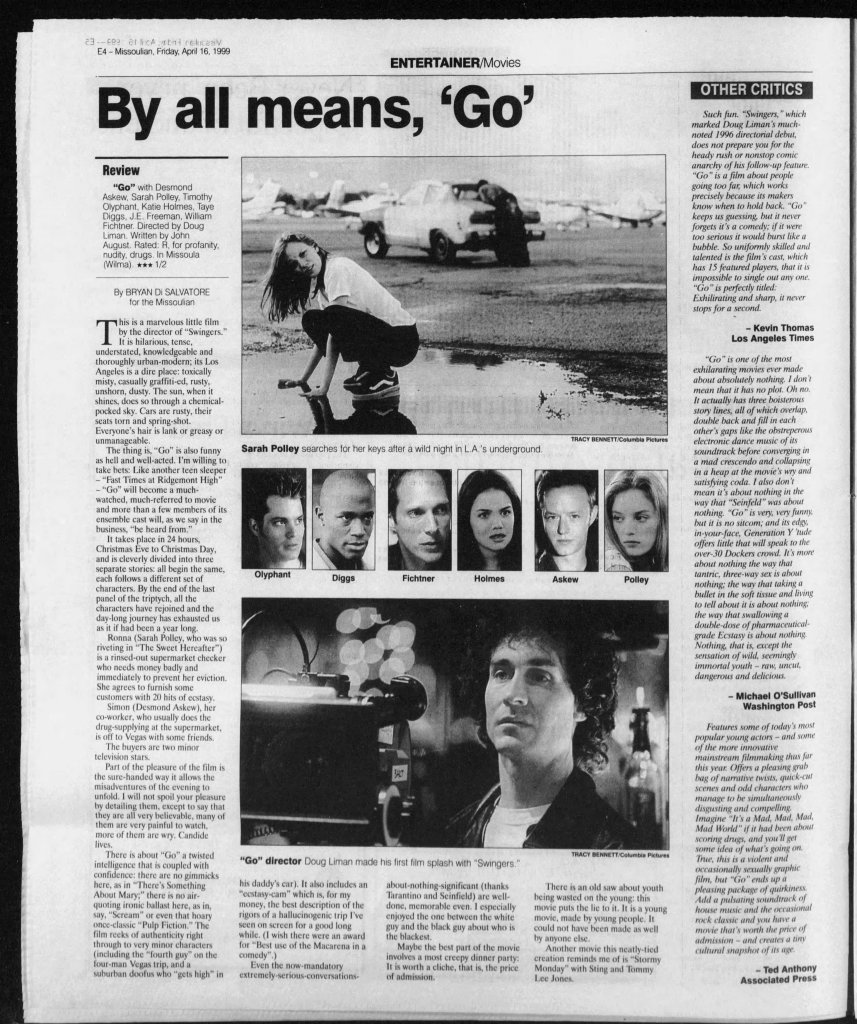
Arrow has put together a nice edition of Go, with a few question marks. If ever a film was deserving a feature-length making-of documentary, like Arrow have done in the past, this is it. Sadly, we don’t get that. We do get the original half-hour deleted scenes reel, featurette and director’s commentary from the 2000 DVD. It would have been quite tragic to lose these, and I am so glad Arrow included them. While I greatly enjoyed the new interviews with actor Desmond Askew and August, I have to admit the commentary track by Bryan Reesman and Max Evry missed the mark for me. For whatever reason, parts of the this track and this collection as a whole are too fixated on the rave aspect of the film. No disrespect to either, but Go is as much about Rave culture as Pulp Fiction is about drug trafficking. Even one of the booklet’s essays, by David Michael Brown, is centered on this aspect of the film. Ironically, Brown’s still very fine essay includes this thought on the film’s connection to the dance/party sub-culture:
” Despite the musical legitimacy, some ravers argue that while Go is a great movie, it is not a pure rave movie because it is largely indifferent to the minutiae of
the dancefloor or DJ culture. In fact, the moments we witness a hot sweaty throng throwing some shapes are all too brief.”
Correct, because Go is not a rave movie.
Those ravers, they are correct.
Any qualms about the commentary or any other extras don’t reflect their quality, which is great, or the research behind them, which is excellent.
I just can’t get behind the idea of Go being a rave film.
As an OG fav, I just find that odd.
Finally, we get God. A nearly unwatchable short written and directed by John August, God (1998) is remembered for being Melissa McCarthy’s debut screen credit. August was watching his extraordinary screenplay for Go turn into one the great American films of the nineties when he created this annoyingly twee 11-minute film. It is included as a bonus on Arrow’s new 4K edition of Go. It makes sense, as this was edited on the same equipment simultaneously with Liman’s film, and it even utilized leftover film stock. That said, this is irritating to the max and Melissa McCarthy’s appeal will always elude me. And August wrote God specifically for her.
Who’d a thunk it?
God really got under my skin, in not a good way.
A fine, informative commentary with August and McCarthy is included.
Go is one of my favorite films.
I will never watch God again.
Minor reservations about this collection aside, Arrow’s 4K release of Go is amongst the year’s most important. Go is a landmark American film and one of the most distinctly American films in general.
The characters that inhabit Go have often entered my mind these past few decades as we have all gotten older.
I wonder what they all up
(or down)
to these days?
-Jeremy Richey, August 2026-
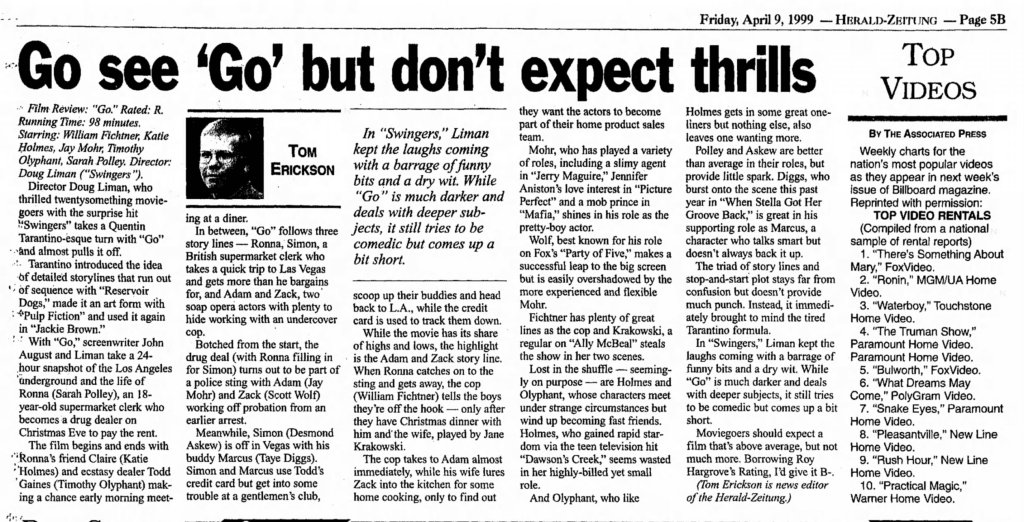
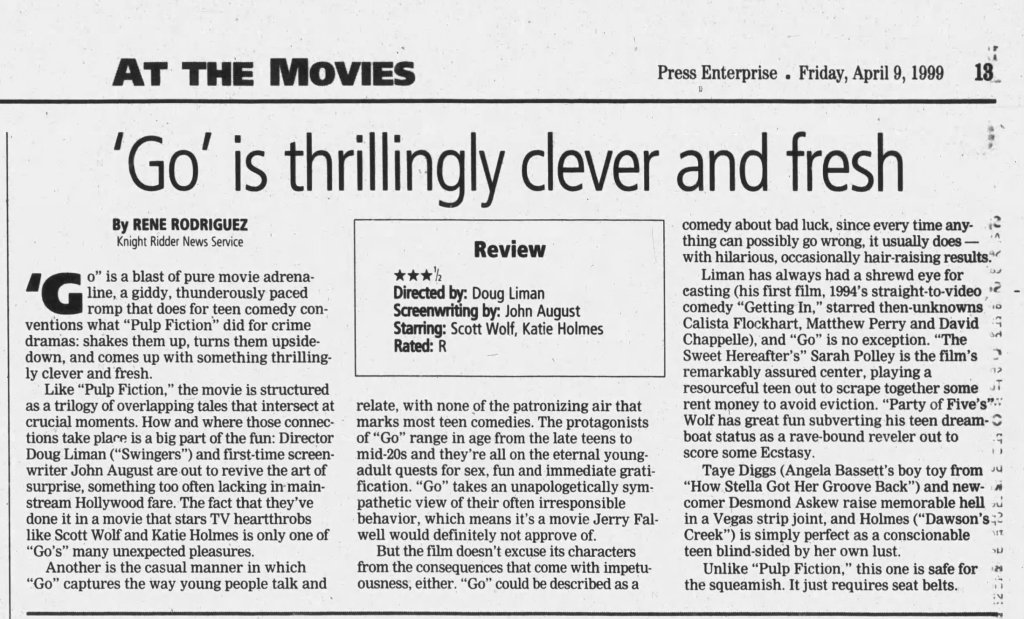
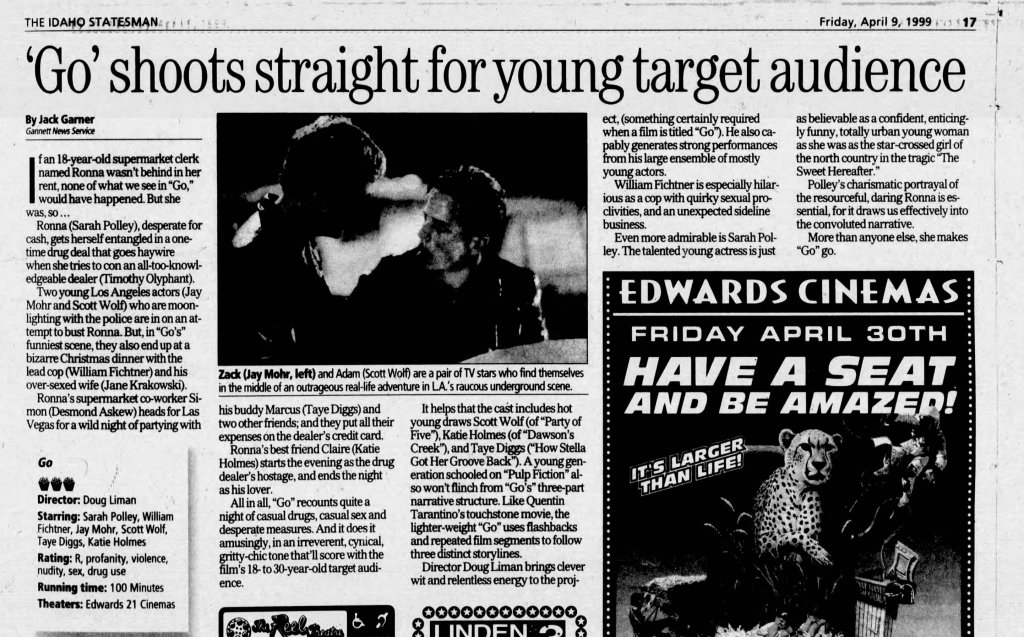
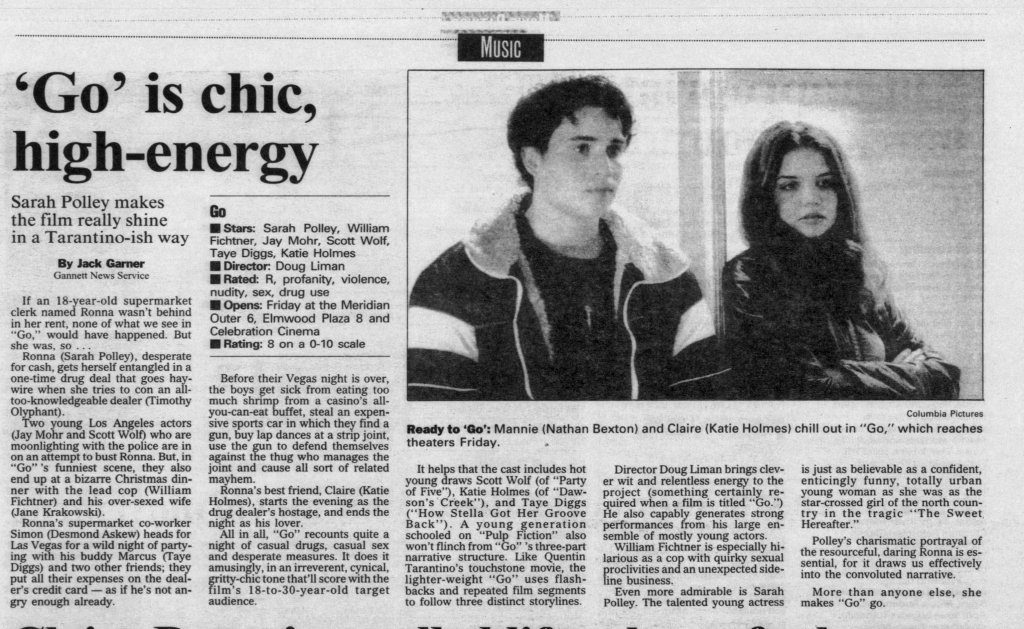
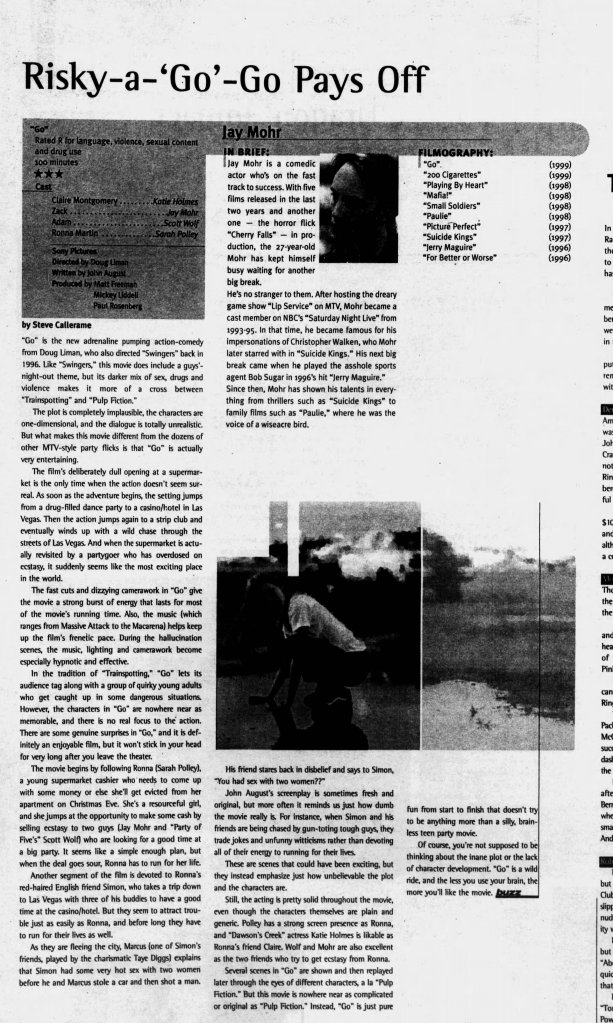
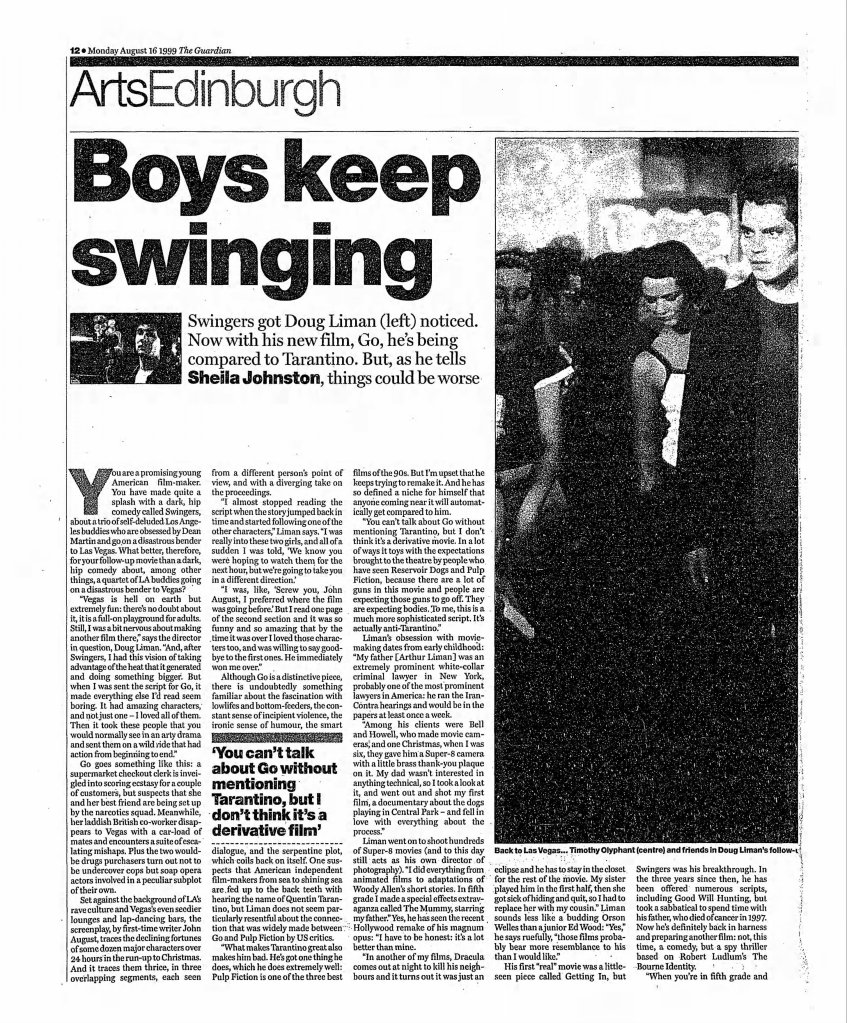
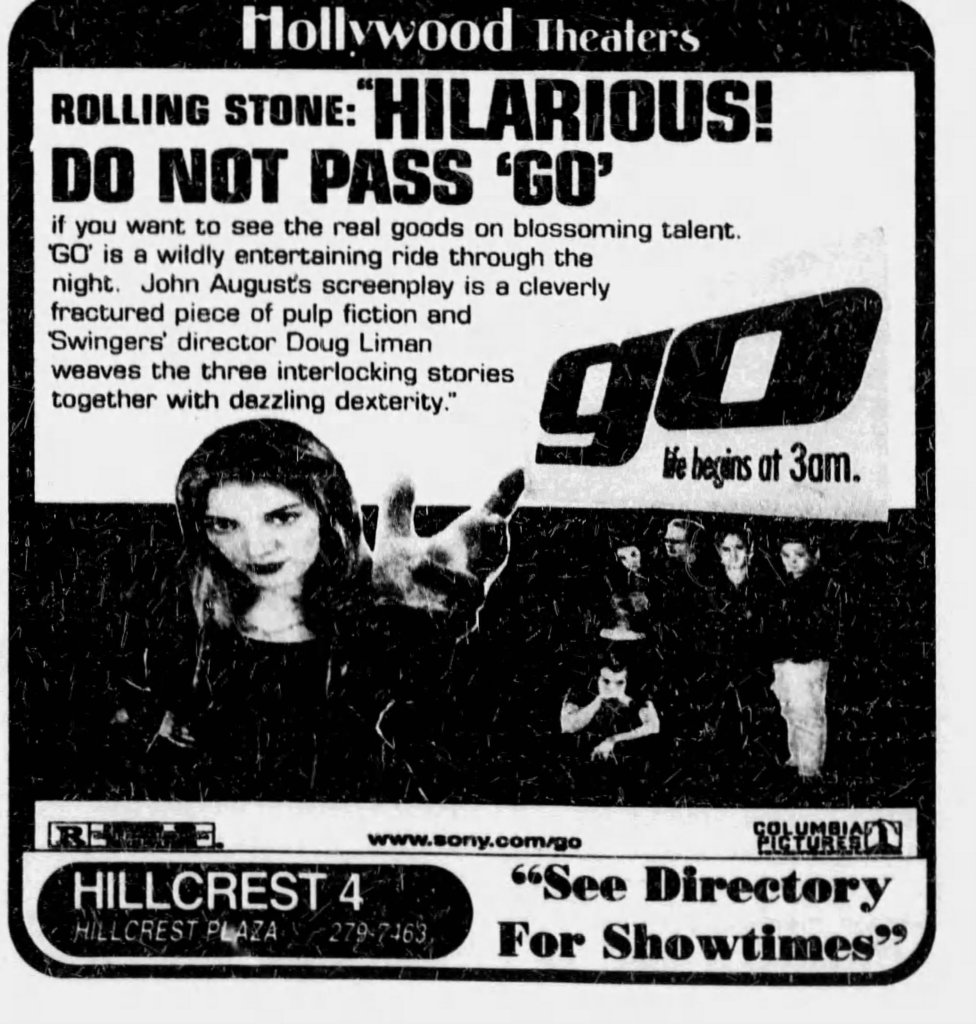
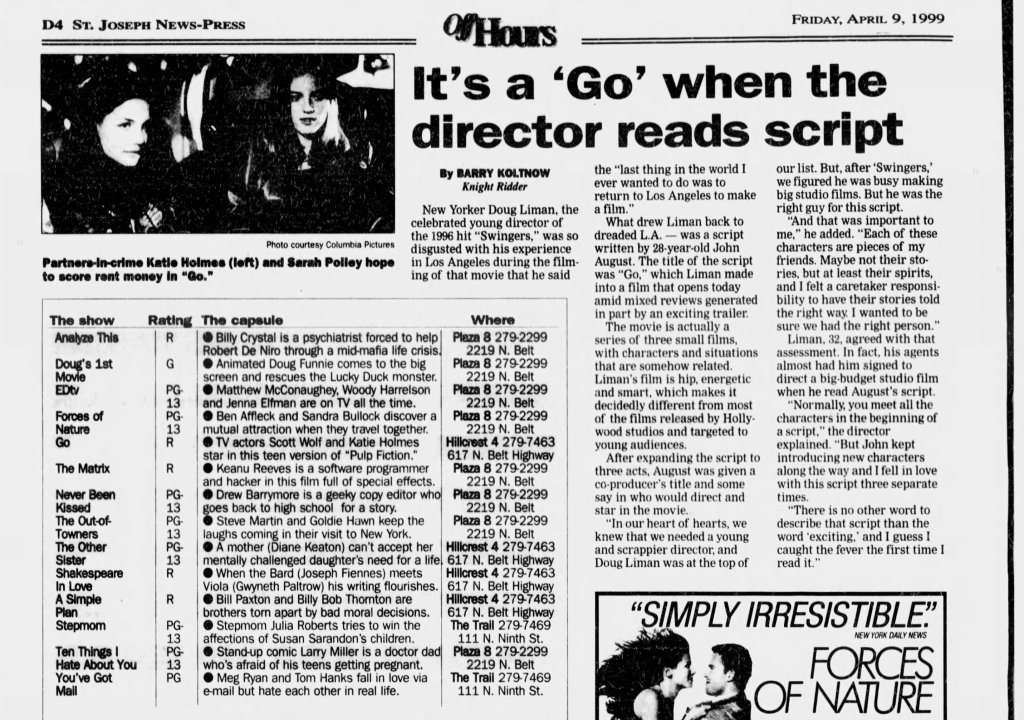
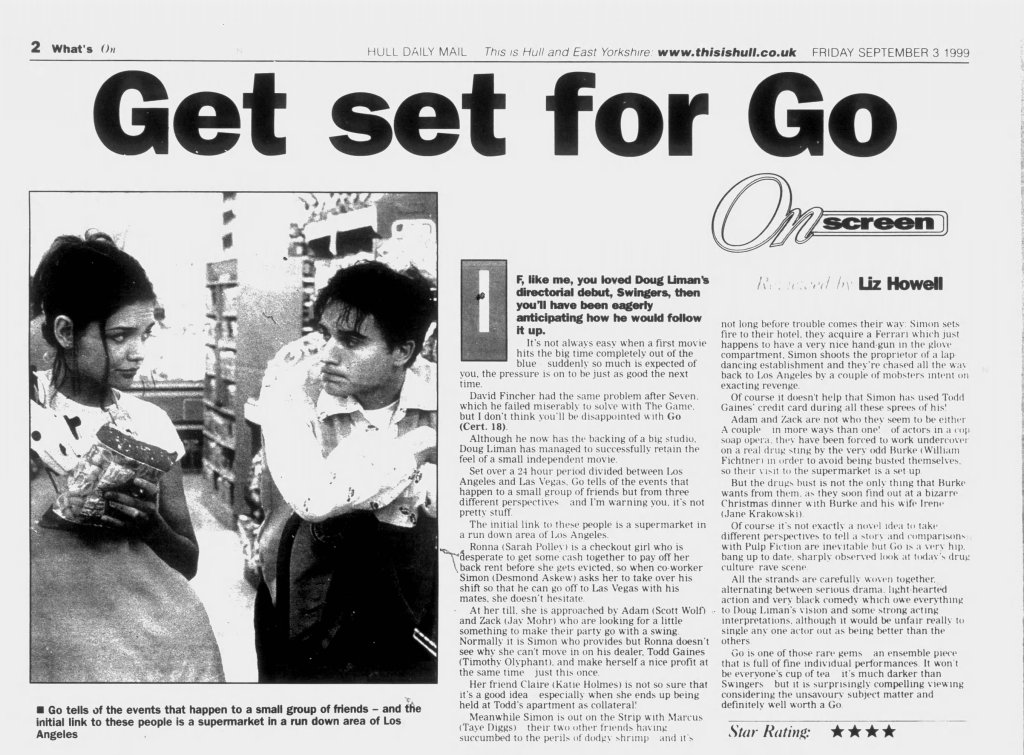
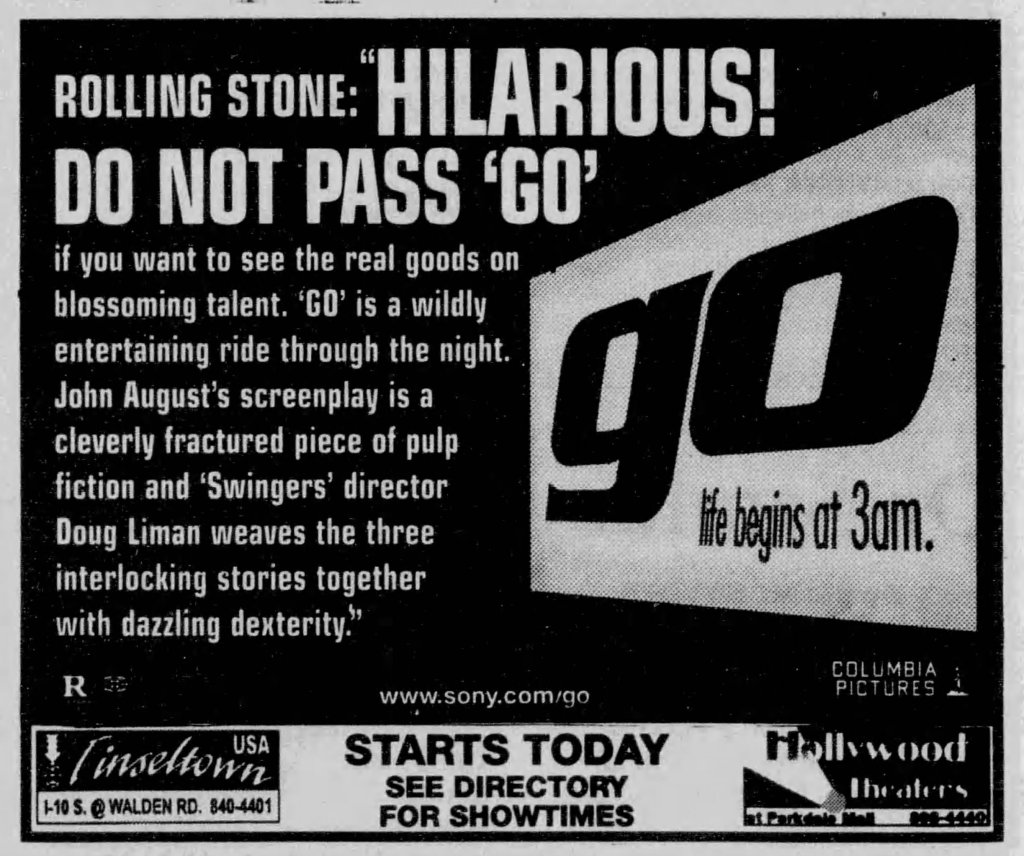
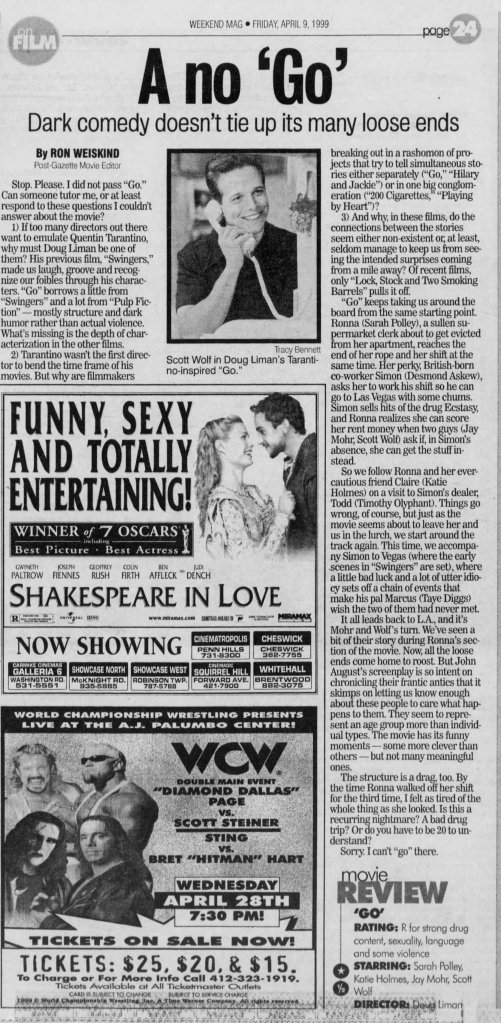
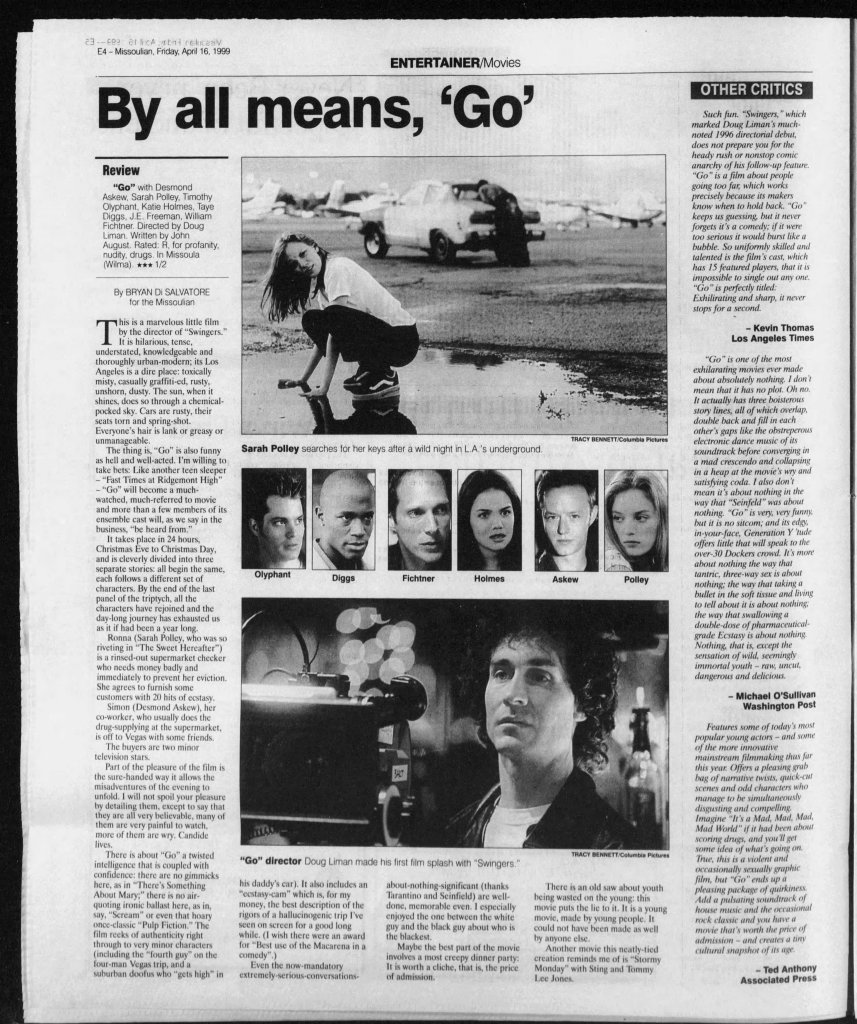
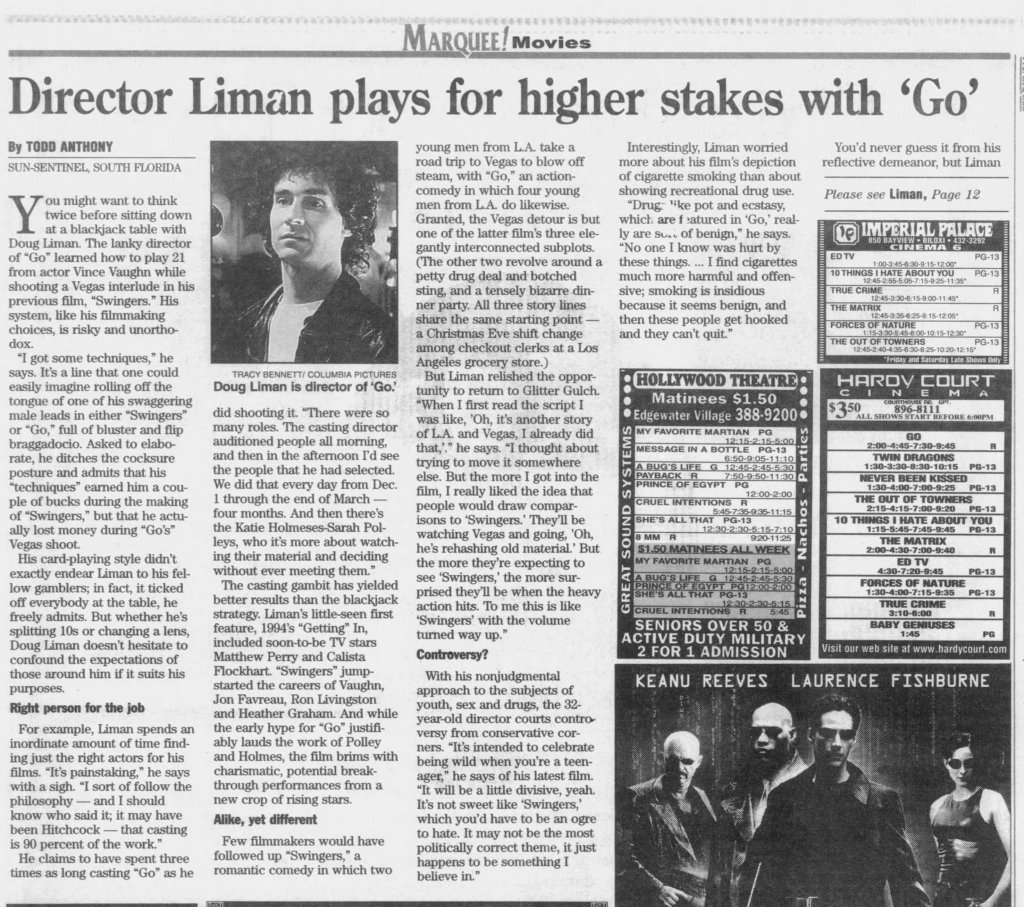
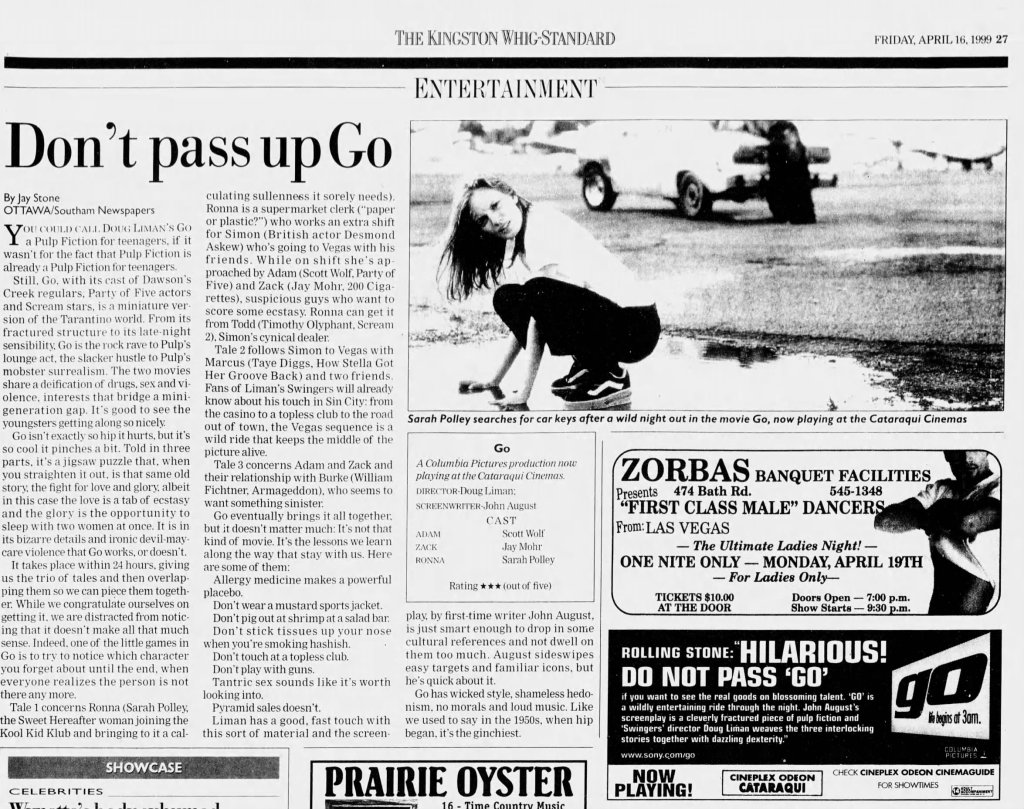
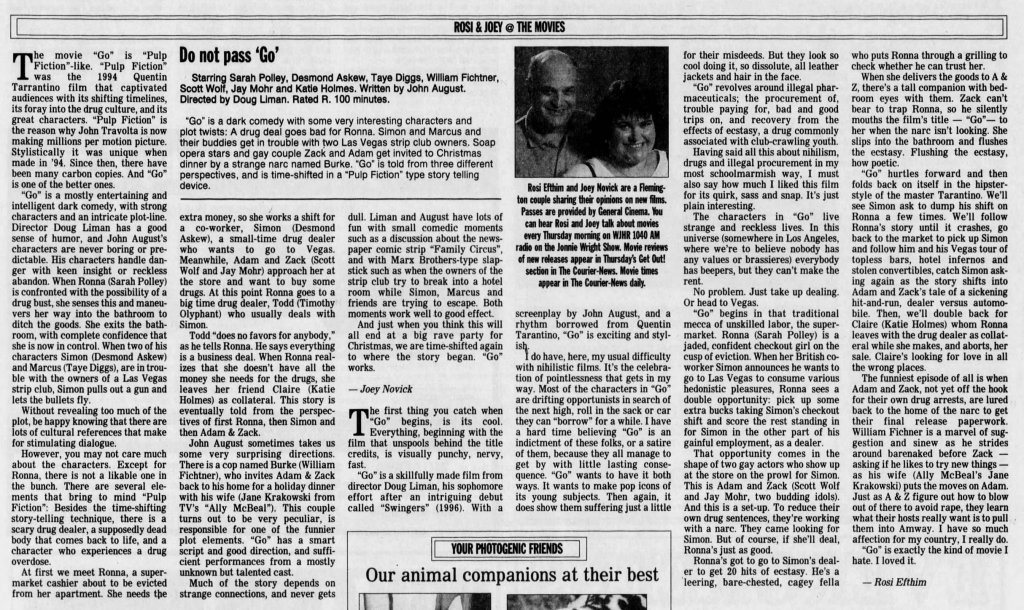
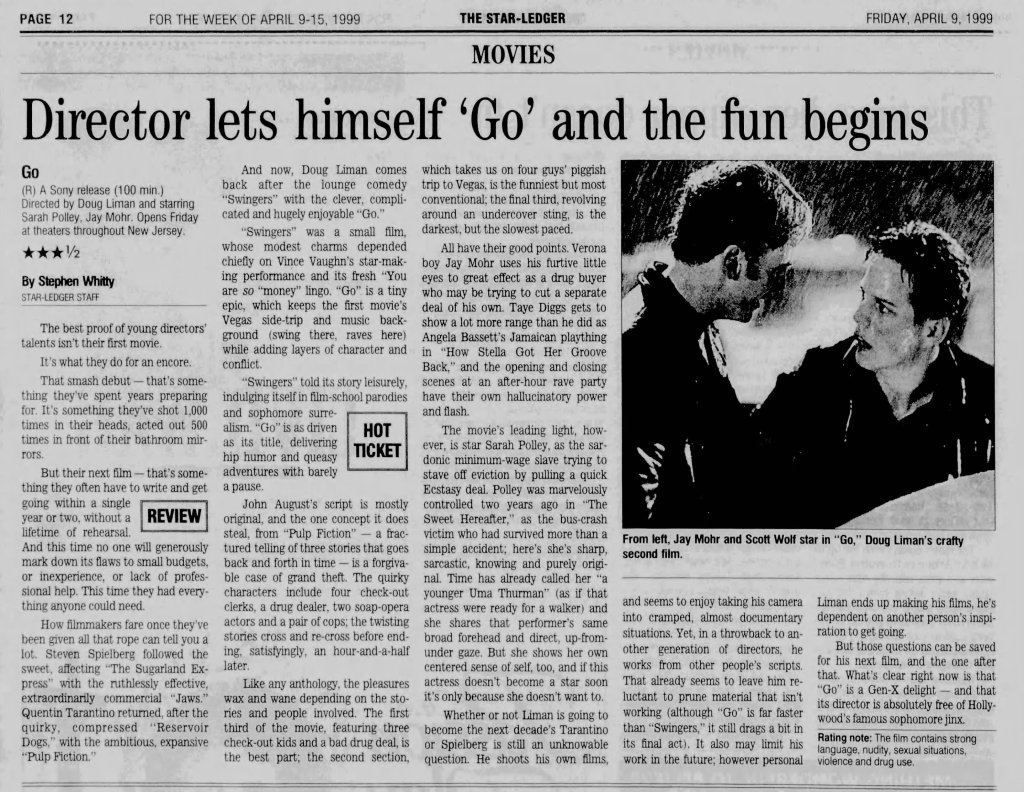
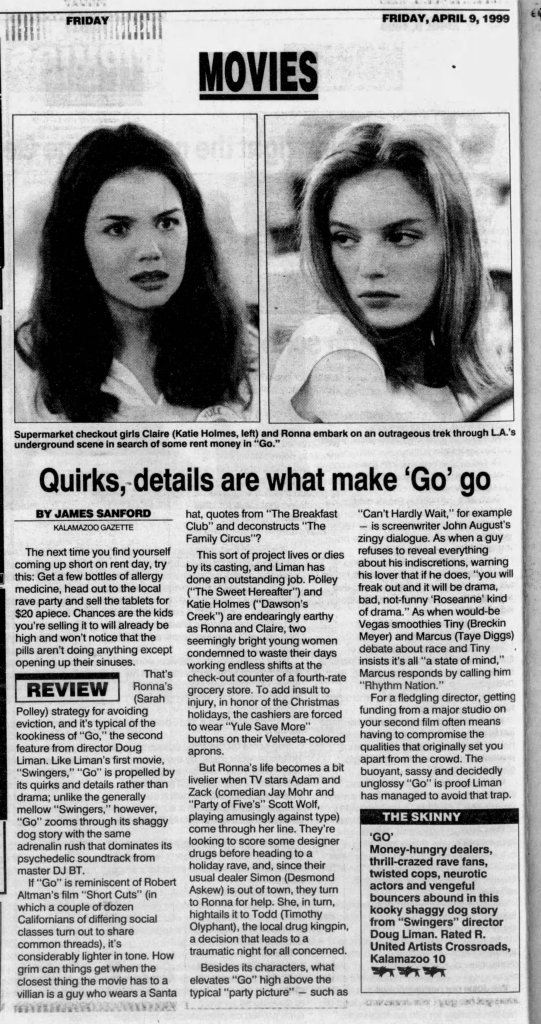
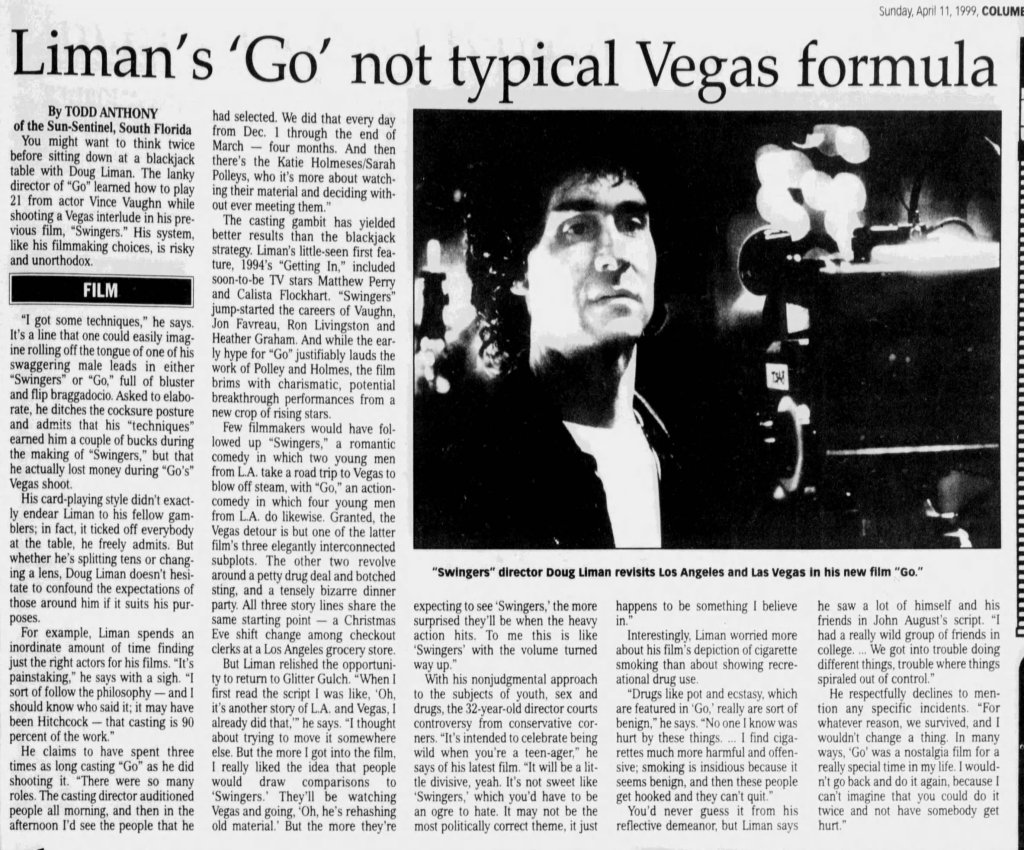
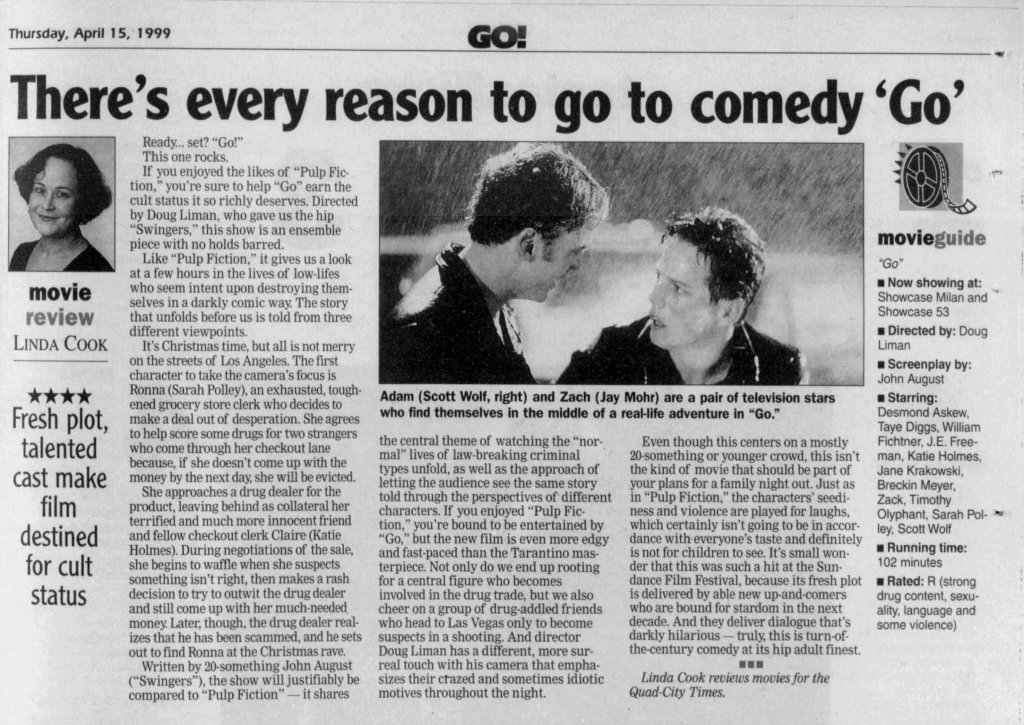
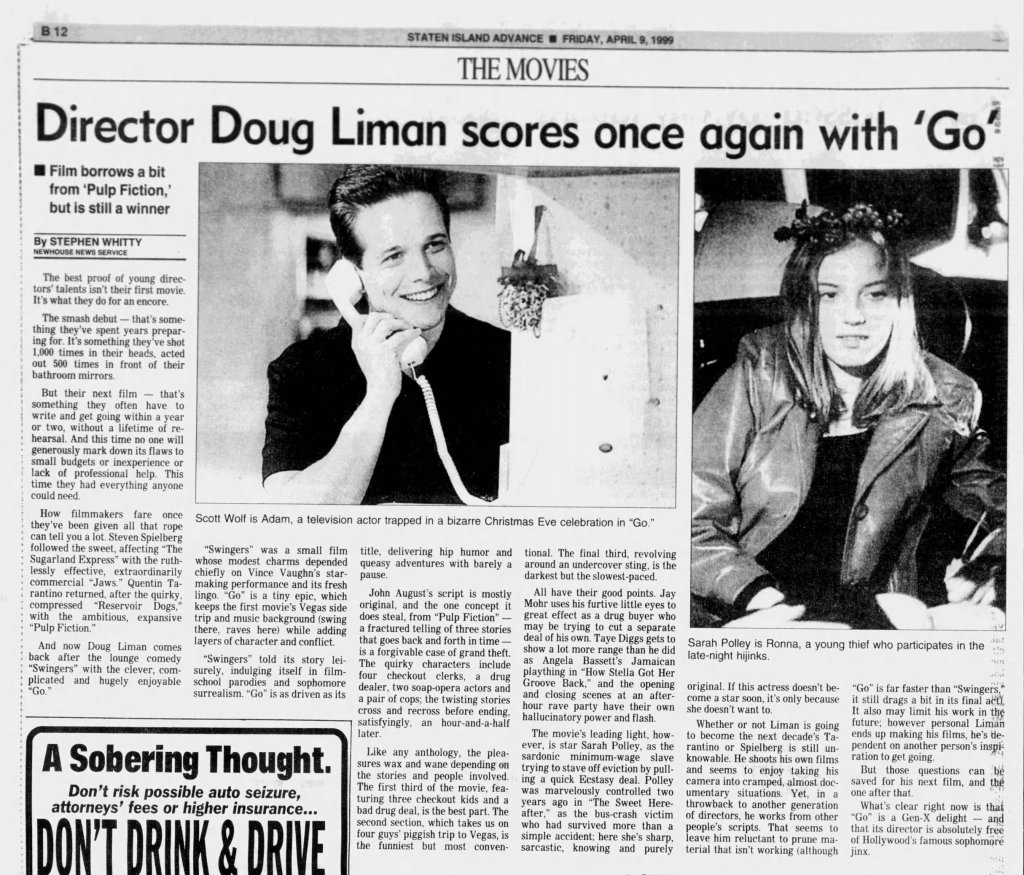
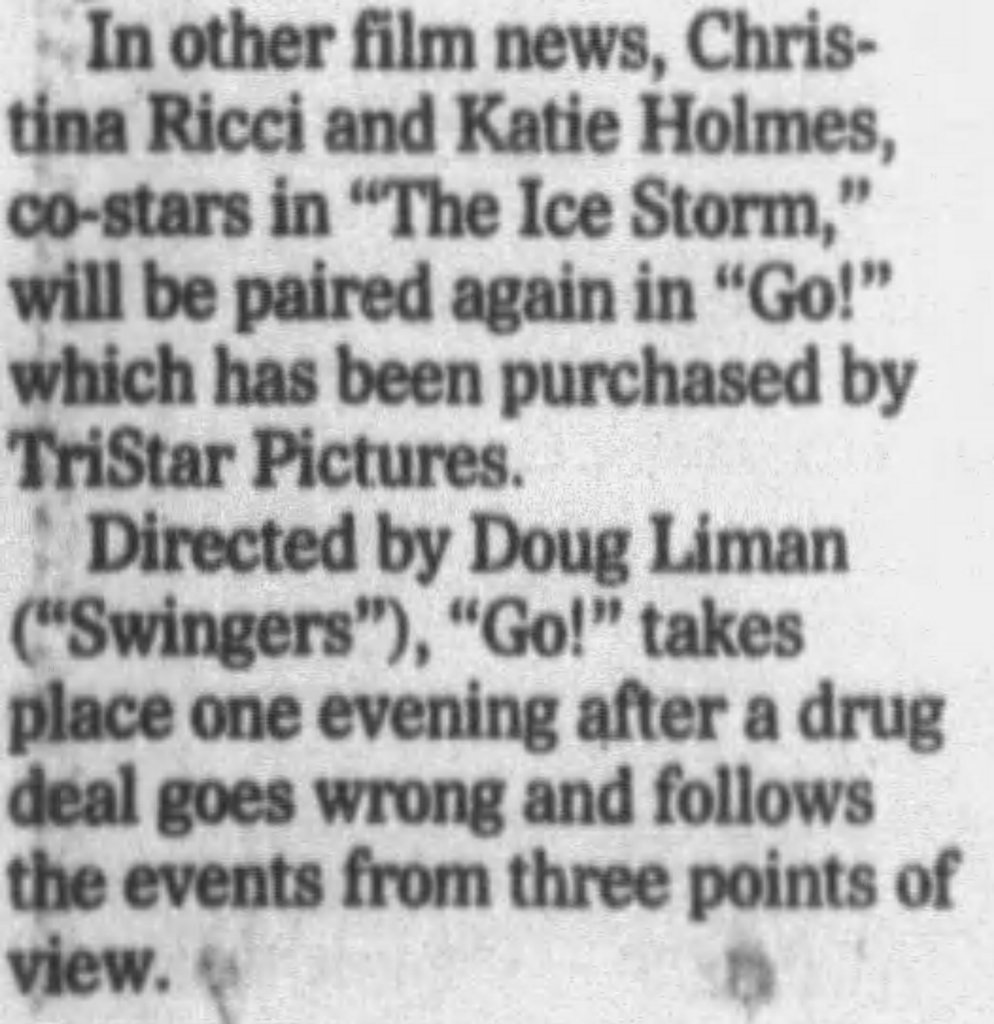
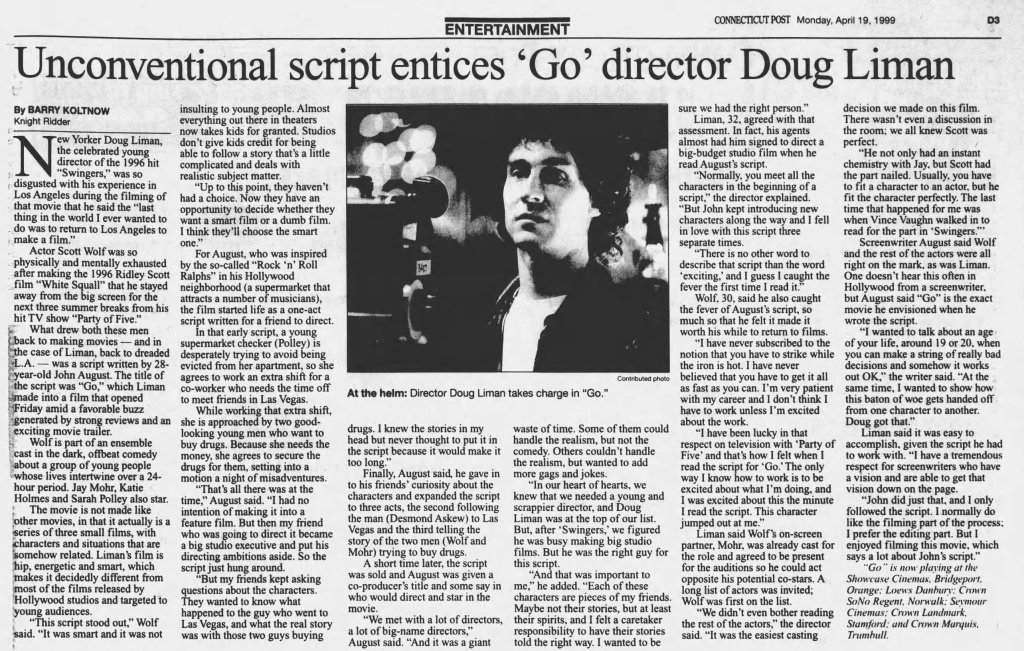
Enjoy this large selection of clippings related to Go that I found:


Leave a Reply